
Why D422 Was Withdrawn and What Replaced It
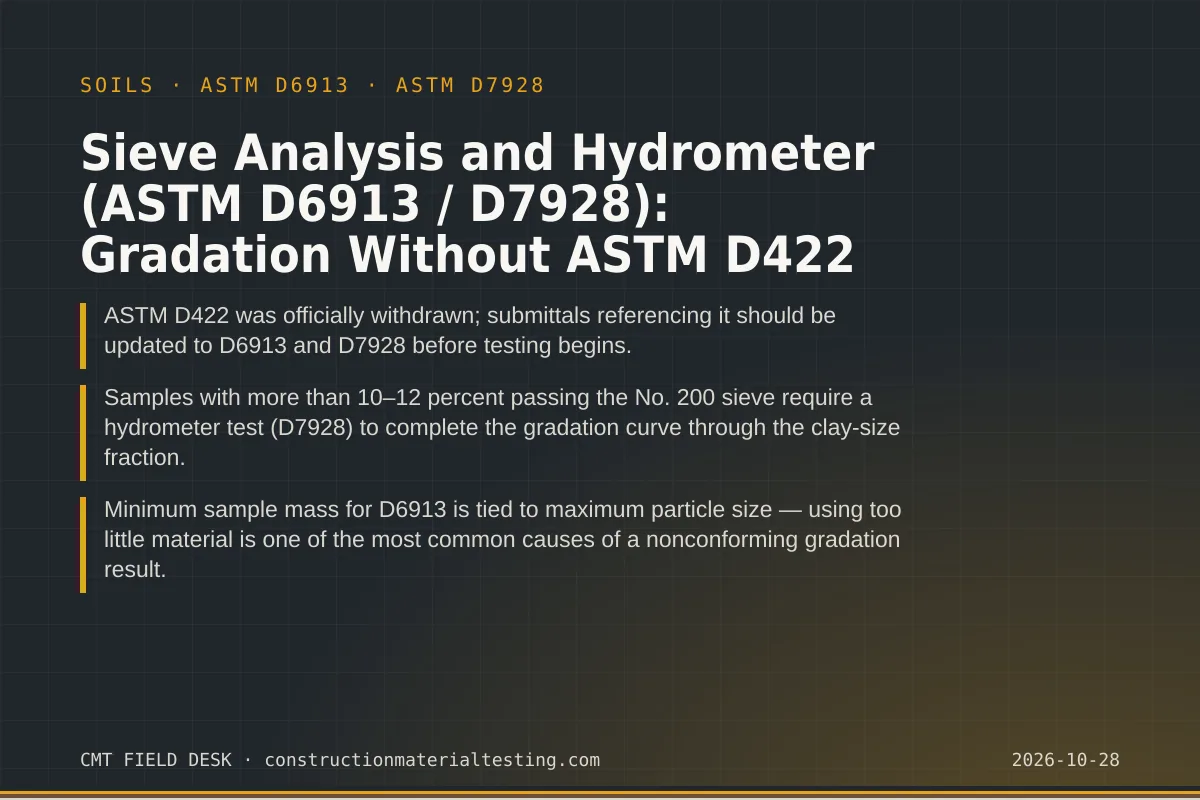
ASTM D422 was the standard method for particle-size analysis of soils for decades. ASTM withdrew it in 2016 without a replacement designation of its own — instead, the committee directed practitioners to ASTM D6913 for the coarse and medium fraction (sieve analysis) and ASTM D7928 for the fine fraction (hydrometer sedimentation). The withdrawal was not a technicality. D422 had procedural gaps, particularly around sample preparation, dispersion agent concentration, and hydrometer corrections, that the newer standards address with tighter controls.
In practice, many project specifications and geotech reports still cite D422 by habit. When that happens, the laboratory runs the equivalent procedures under D6913 and D7928 and notes the standards actually used on the test report. If a specification explicitly requires D422 and has not been updated, the engineer of record should issue a clarification directing the contractor and testing firm to the current standards. Leaving obsolete standard citations in a spec does not make D422 technically valid; ASTM standards require an active designation to be normatively binding.
Understanding the split is straightforward: ASTM D6913 covers dry sieving and wet sieving for material retained on or passing through a series of wire-cloth sieves. ASTM D7928 covers the hydrometer method, which uses Stokes' law to infer particle diameter from the rate at which particles settle through a water-dispersant column. Together they give you a continuous particle-size distribution from boulders down to clay platelets smaller than 0.001 mm.
Sample Collection and Minimum Mass Requirements
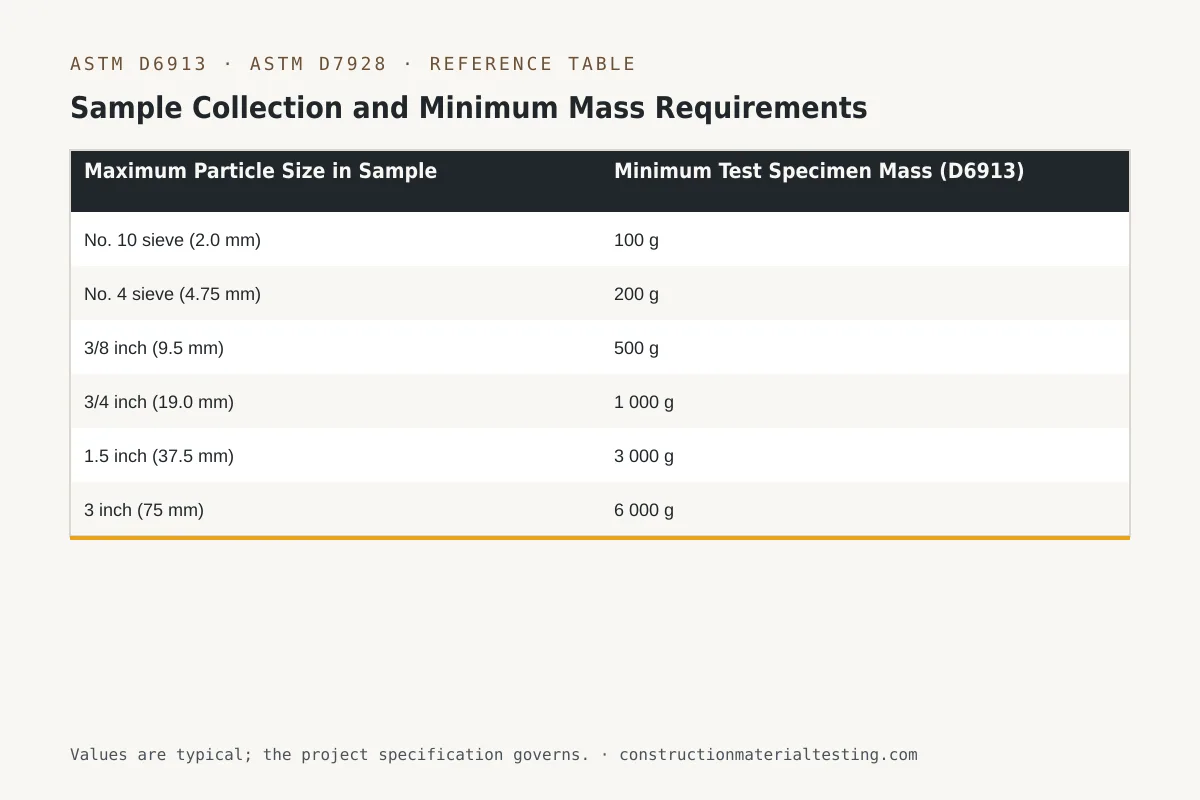
The soil gradation test starts before anyone touches a sieve. ASTM D6913 specifies minimum test specimen masses based on the maximum particle size present in the sample. This is not an arbitrary table — using too little material statistically underrepresents the coarse fraction and will produce a gradation curve shifted artificially toward the fines. On a compacted fill project where the specification sets a maximum percent retained on the 1.5-inch sieve, getting this mass requirement wrong can mean a failing result on material that actually conforms, or a passing result on material that does not.
Field sampling follows ASTM D75 for aggregate or ASTM D4220 for soil specimens, depending on whether you are sampling from a stockpile, a borrow pit, or a compacted lift. The sample is split in the field or in the laboratory using a mechanical splitter or the quartering method to obtain a representative test portion. For most select fill and embankment gradation work, the as-received sample is larger than needed, and splitting it correctly is as important as running the sieves correctly.
Before sieving, the sample is dried. D6913 allows oven drying at 110 ± 5 °C or air drying if the material is sensitive to heat (some clays and shales can break down under oven temperatures). The dry mass is recorded as the basis for calculating percent passing at each sieve size. If the specification also requires a separate fines content determination, that test — ASTM D1140 — can be run on the washed material before sieving, giving you two data points from one sample preparation.
| Maximum Particle Size in Sample | Minimum Test Specimen Mass (D6913) |
|---|---|
| No. 10 sieve (2.0 mm) | 100 g |
| No. 4 sieve (4.75 mm) | 200 g |
| 3/8 inch (9.5 mm) | 500 g |
| 3/4 inch (19.0 mm) | 1 000 g |
| 1.5 inch (37.5 mm) | 3 000 g |
| 3 inch (75 mm) | 6 000 g |
Running the Sieve Analysis Under ASTM D6913
Once the specimen is dry and weighed, it goes through a wash sieve step if fines are present. Washing is done over a No. 200 sieve (75 µm opening) with clean water until the wash water runs clear. The material retained on the No. 200 sieve is oven-dried again and weighed — this difference in mass before and after washing quantifies the fines lost through the sieve, which is exactly what ASTM D1140 measures as well. Wash sieving before dry sieving prevents clay-coated particles from agglomerating on the finer sieves and producing artificially high retained masses on those screens.
The washed, dried material is placed on a nested sieve stack arranged from largest opening at the top to the No. 200 at the bottom, with a pan below. D6913 does not mandate a specific shaking duration but requires that shaking continue until no more than 1 percent of the mass retained on any sieve passes during an additional minute of shaking. In our experience, a mechanical shaker running 10–15 minutes satisfies this for most soil gradations. For well-graded gravels with a significant coarse fraction, hand shaking individual large sieves first speeds up the process and reduces wear on the shaker motor.
After shaking, each sieve is individually weighed and the mass of material retained recorded. The cumulative percent passing is calculated from the bottom up: percent passing any given sieve equals the total mass finer than that sieve divided by the original dry mass, expressed as a percentage. The sum of all individual retained masses plus the pan mass should equal the original dry specimen mass within a tolerance — D6913 allows a maximum discrepancy of 0.3 percent of the original mass. Exceeding that tolerance flags a calculation error or material loss and requires the test to be repeated.
Hydrometer Procedure (ASTM D7928) for the Fines Fraction
When fines content exceeds roughly 10–12 percent passing the No. 200 sieve, sieve analysis alone cannot characterize the material — all of that fine fraction plots at a single point (75 µm) on the gradation curve. To resolve the silt and clay fractions, the material passing the No. 200 sieve is subjected to hydrometer sedimentation under ASTM D7928. The method disperses a measured mass of fines in a 1-liter cylinder of water and sodium hexametaphosphate solution, and a calibrated hydrometer reads the specific gravity of the suspension at timed intervals.
As particles settle under gravity, the suspension density decreases at the hydrometer depth. By applying Stokes' law — which relates settling velocity to particle diameter, fluid viscosity, and the density difference between particle and fluid — each hydrometer reading converts to a particle diameter and a percent finer. D7928 specifies readings at elapsed times of 2, 5, 15, 30, 60, 250, and 1440 minutes after the start of sedimentation. The 24-hour reading captures the clay-size fraction below 0.002 mm. Temperature corrections are applied at each reading because water viscosity changes with temperature, and the standard provides correction factors for this purpose.
Dispersion is critical. D7928 requires the soil-water-dispersant mixture to be mechanically agitated using a high-speed stirrer for 60 seconds immediately before transferring to the sedimentation cylinder. Incomplete dispersion — a common error when technicians skip or shorten the agitation step — causes particles to flocculate and settle faster than their individual diameters predict, which shifts the clay fraction artificially toward the silt range. Blank cylinders with the same dispersant concentration but no soil run concurrently to provide the composite correction factor applied to each reading.
Building the Composite Soil Gradation Test Curve
The sieve data and hydrometer data are joined at the No. 200 sieve (75 µm). Percent passing at the No. 200 from the sieve analysis sets the scale factor for the hydrometer portion: each hydrometer percent-finer value is multiplied by the fraction of the original specimen that was submitted to the hydrometer test. This normalization is necessary because only the material passing the No. 200 sieve goes into the hydrometer cylinders, not the full specimen. Without it, the hydrometer curve would overstate the clay content relative to the total sample.
The result is a single gradation curve plotted on a semi-log grain-size axis with particle diameter on the logarithmic x-axis and percent finer by weight on the linear y-axis. Gravel, sand, silt, and clay fractions are read directly from the curve at the USCS boundary diameters (4.75 mm, 0.075 mm, and 0.002 mm). Coefficient of uniformity (Cu) and coefficient of gradation (Cc) are calculated from the D10, D30, and D60 diameters for classification under ASTM D2487. These index values also appear in many pavement subbase and embankment specifications as acceptance criteria alongside the raw percent passing values.
Our materials testing services include producing the composite curve and the classification summary on the same report sheet, which is what most geotechnical engineers and project owners need to evaluate conformance. The curve also feeds directly into compaction test specimen preparation — knowing the gradation lets the technician verify that the material submitted for a Proctor compaction test matches the gradation of material placed in the field.
Fines Content and Select Fill Specification Limits
Percent passing the No. 200 sieve is one of the most frequently enforced gradation criteria in Texas earthwork specifications. TxDOT select fill classifications, Corps of Engineers embankment specifications, and local municipal grading ordinances all set upper limits on fines content, typically in the range of 15–35 percent depending on material type and use. Material that exceeds the fines limit drains poorly, is more susceptible to frost heave in northern climates, and is harder to compact to a stable density. In the Gulf Coast region, high-plasticity clays with elevated fines content present specific compressibility and swell risks that a gradation alone flags but does not fully quantify — that requires Atterberg limits testing in parallel.
When a soil gradation test result is close to a specification limit on fines, the precision of the wash sieve step matters enormously. A sloppy wash that lets some sand-size particles pass through the No. 200 sieve artificially inflates the fines percentage and can cause a conforming material to appear nonconforming. Conversely, washing with high-pressure water that breaks down weakly cemented particles inflates fines in the other direction by creating material finer than existed in the natural or placed state. D6913 specifies gentle agitation and enough wash cycles to clear the water, not aggressive scrubbing.
For projects where the specification distinguishes between plastic fines and non-plastic fines — a common distinction in select fill specs — the percent passing No. 200 result from the D6913 sieve analysis is combined with Atterberg limits from ASTM D4318 to determine whether the fines fraction is silty (low plasticity, generally acceptable) or clayey (higher plasticity, restricted or excluded). The gradation result alone is necessary but not sufficient for full classification of fine-grained fill material.
Where This Fits on Your Project
Gradation testing under D6913 and D7928 typically appears in the geotechnical investigation phase, the mix design approval phase for treated materials, and during earthwork construction as part of the special inspection and materials testing program required under IBC Section 1705.6 for fill placement. The frequency of gradation testing during construction is usually set by the project specifications or the geotechnical engineer's testing plan — common triggers include every change in borrow material appearance, every 500 to 2,000 cubic yards placed, or at any location where the inspector observes a visible change in soil type.
Our regional dispatch hubs across the state allow us to mobilize sampling technicians to borrow pits and active fill placements and return samples to the laboratory without delays that would hold up compaction testing or fill acceptance decisions. If you are putting together a testing scope for an upcoming earthwork project or need a D7928 hydrometer test added to an existing gradation program, reach out through our project proposal request and we will put together a testing plan that matches your specification requirements and construction schedule.
Get our guides in your Google results
Add Construction Materials Testing as a preferred source and Google shows our guides more often when you search for testing topics.