
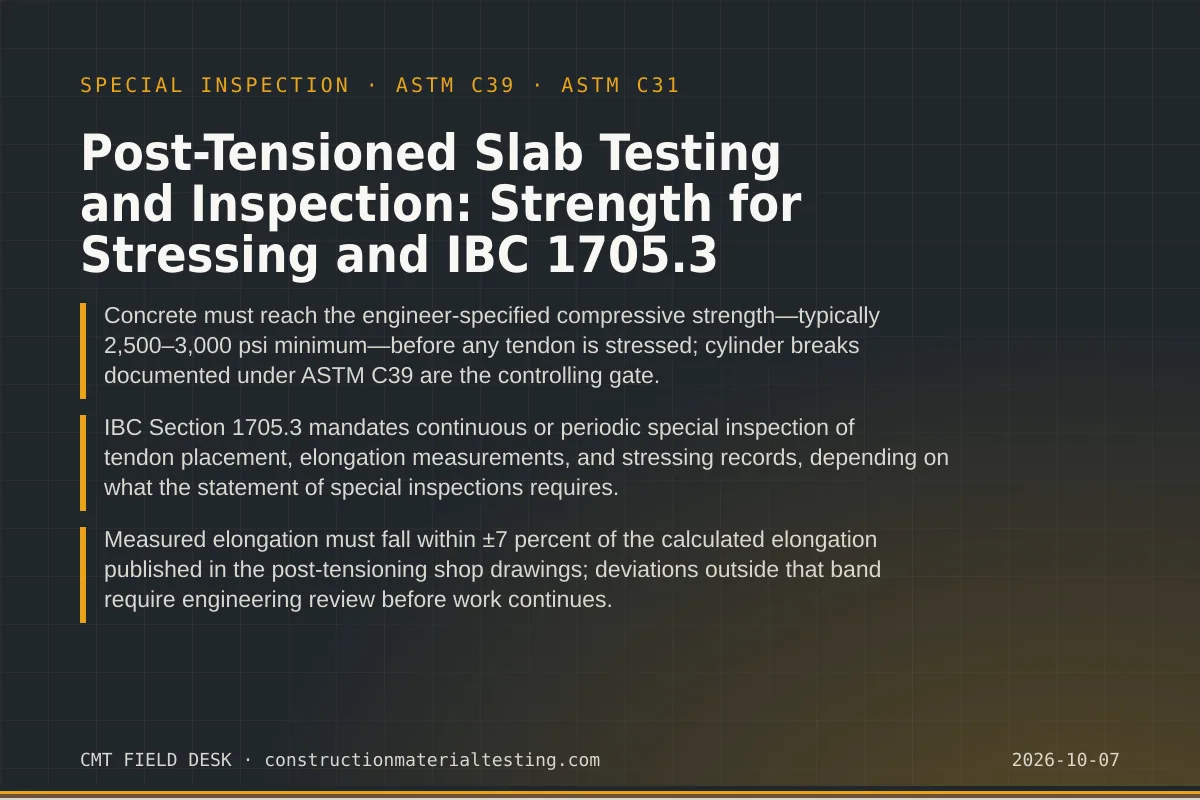
Why Post-Tensioned Slab Inspection Is Different from Conventional Concrete Work
Ordinary reinforced concrete slabs rely on passive steel that activates only after cracking. Post-tensioned slabs work differently: the tendons are deliberately stressed to a calculated load, putting the concrete into compression before any service load ever arrives. That means the condition of the concrete at the moment of stressing matters enormously. Stress too early, when the concrete is still gaining strength, and the anchor zones can blow out or the slab can crack in ways that are expensive and sometimes irreparable.
This distinction drives everything about the inspection sequence. The special inspector's role is not simply to watch; it is to hold the work at defined checkpoints until the data confirms the concrete is ready. IBC Section 1705.3 formalizes those checkpoints for post-installed and cast-in-place post-tensioned construction alike. Understanding the logic behind each hold point helps contractors plan their schedule around testing milestones rather than treating inspection as a formality that happens after the fact.
Our technicians dispatch to post-tensioned slab projects across Texas from 27 regional offices supported by our materials testing services. The sequence below reflects the order we actually work through on site, starting the day the tendons arrive and ending when the stressing log is signed and filed.
Tendon Placement Inspection Before the Pour
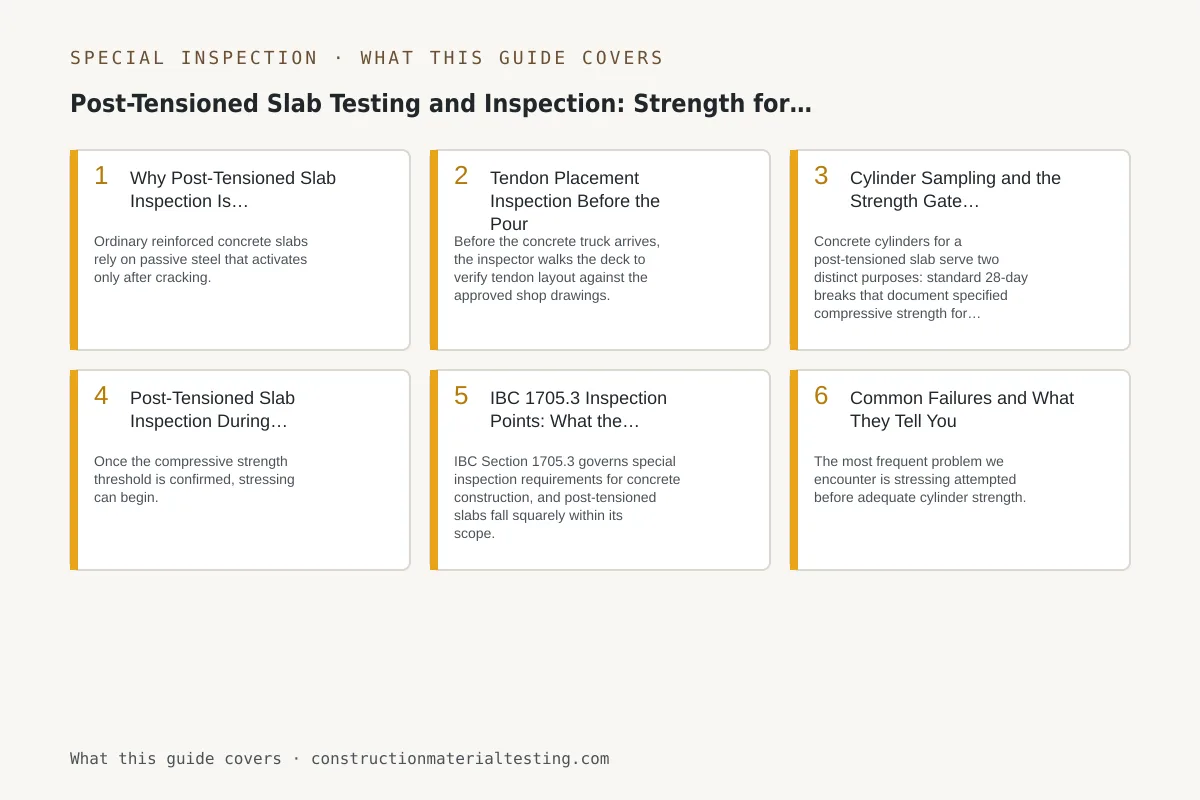
Before the concrete truck arrives, the inspector walks the deck to verify tendon layout against the approved shop drawings. The Post-Tensioning Institute publishes specification guidance on minimum and maximum tendon spacing, cover requirements, and chair heights. The inspector checks each of those items: tendon profile (the high and low points relative to the slab thickness), horizontal spacing, and whether the tendons are secured well enough that they will not shift during vibration. Any tendon that is kinked, has a damaged sheath, or sits at the wrong elevation should be flagged before concrete is placed—correcting the problem afterward is not a realistic option.
Anchorage hardware at the live ends and dead ends receives the same scrutiny. The pockets at live ends must be formed cleanly so the jack can seat without obstruction after the pour. Dead-end anchors must be fully seated and the tail properly trimmed or coiled. If the project uses unbonded tendons—the dominant system in Texas residential and light commercial construction—the inspector also checks that the plastic sheathing is continuous and that grease fill is intact along the full length. A torn sheath or a dry section is a corrosion path that cannot be remedied once the concrete is placed.
This pre-pour phase is typically a periodic inspection point under IBC 1705.3, meaning the inspector must be present and must document findings before the pour begins. The findings go into the inspection report that becomes part of the project record.
Cylinder Sampling and the Strength Gate for Stressing
Concrete cylinders for a post-tensioned slab serve two distinct purposes: standard 28-day breaks that document specified compressive strength for the structural record, and early-age breaks that determine when stressing may begin. The early-age breaks are the critical ones operationally. They are made and cured in the field alongside the slab—not in a standard laboratory water bath—because the engineer needs to know what the concrete in the slab is doing, not what ideally cured cylinders would do. Our technicians follow ASTM C31 field procedures for making and curing concrete test specimens to produce cylinders that track actual slab conditions as closely as a cylinder can.
The minimum compressive strength required before stressing is specified on the structural drawings or the post-tensioning shop drawings. Common values range from 2,500 psi to 3,500 psi for residential slabs, though engineers designing for larger anchor zones or higher prestress levels may specify more. That threshold is not a suggestion. Breaking the cylinders under ASTM C39 compressive strength procedures and comparing the result to the specified threshold is the only objective way to confirm the concrete is ready. If the break comes in below threshold, stressing waits—period.
Timing of the break matters. Field-cured cylinders that will be broken for stressing clearance should be tested the morning the contractor expects to begin stressing, so the result is available before the jack is moved into position. Waiting until the afternoon to get a break result and then discovering the concrete did not pass costs at least a full day. Coordinate with your testing laboratory early so the break schedule aligns with your planned stressing window.
For projects in the greater Houston area, our Houston-area materials testing team can schedule early-morning cylinder pickups to support same-day stressing decisions. Outside that region, coordinate timing with your dispatch hub so transport and testing do not become the bottleneck.
Post-Tensioned Slab Inspection During Stressing: Elongation Records and Tolerances
Once the compressive strength threshold is confirmed, stressing can begin. The special inspector must be present during this phase under most statements of special inspections written to IBC 1705.3, because this is where the structural load is being introduced into the system for the first time. The inspector is not operating the jack—that is the post-tensioning contractor's work—but the inspector is recording the elongation of each tendon and verifying that the jack pressure corresponds to the specified load.
Elongation measurement is straightforward in principle and detail-sensitive in practice. Before stressing, the contractor marks a reference point on the tail of the tendon at the live end. After jacking to the specified load (read from the calibrated pressure gauge), the distance the tail has moved is the measured elongation. That number is then compared to the calculated elongation shown on the approved shop drawings. The ACI 318 building code requirements for structural concrete and the Post-Tensioning Institute both recognize a ±7 percent tolerance between measured and calculated elongation as the standard acceptance criterion.
When a tendon falls outside that range, the contractor and engineer of record must be notified immediately. A short elongation can mean the tendon did not fully seat, friction loss is higher than calculated, or the tendon is hung up somewhere along its path. An excessive elongation can indicate a broken or slip-through anchor. Neither condition is acceptable without engineering review. The inspector documents the out-of-tolerance reading and does not allow stressing to proceed on adjacent tendons until the engineer has evaluated and responded.
Stressing sequence matters too. Engineers typically specify the order in which tendons are stressed—often alternating or banded patterns—to distribute the load evenly and avoid eccentric shortening that could crack the slab edge. The inspector confirms the contractor is following the specified sequence, not an expedient one.
IBC 1705.3 Inspection Points: What the Code Actually Requires
IBC Section 1705.3 governs special inspection requirements for concrete construction, and post-tensioned slabs fall squarely within its scope. The section requires that the statement of special inspections—prepared by the registered design professional in responsible charge—identify which inspection tasks are continuous and which are periodic. For post-tensioned work, stressing operations are almost always listed as continuous inspection, meaning the inspector must be on site throughout the stressing operation, not just for a portion of it.
The code also requires that inspection records be maintained and that the special inspector submit a final report to the building official confirming that the work was done in conformance with the approved documents. That report cannot be written from memory. It depends on the stressing logs, elongation sheets, cylinder break reports, and placement inspection records that the inspector creates in real time. Inspectors who summarize from notes at the end of the job rather than documenting contemporaneously create gaps that can complicate the closeout process with the authority having jurisdiction.
Beyond the IBC requirements, the structural engineer's special inspection program may add project-specific hold points—for example, requiring that the engineer review the first bay of stressing records before stressing continues. Contractors should read the full statement of special inspections before scheduling, not just the general IBC section, because those project-specific requirements can affect sequencing and duration.
Common Failures and What They Tell You
The most frequent problem we encounter is stressing attempted before adequate cylinder strength. This typically happens when a contractor estimates strength based on calendar days or ambient temperature without running field-cured breaks. Warm Texas summers accelerate strength gain, but cold fronts, shaded pours, and thick slabs with low water-cement ratios can delay it significantly. A calendar-based estimate is not a substitute for a break.
Anchor blowouts at the live end—where the concrete cone surrounding the bearing plate fractures—usually trace back to inadequate concrete strength at stressing, improper confinement reinforcement, or both. The IBC Chapter 17 requirements for special inspections do not prevent this type of failure on their own; the cylinder break gate is the mechanism that does. When inspectors or contractors treat that gate as a formality, blowouts become more likely.
Out-of-tolerance elongations that are dismissed without engineering review are a second recurring failure mode. Short elongations that are waved through sometimes indicate tendons that were stressed against high friction but not fully loaded, leaving the slab under-prestressed. The slab may look fine at turnover and show cracking only after service loads arrive. At that point, the stressing log—if it exists and was accurate—is the first document any engineer or attorney will request.
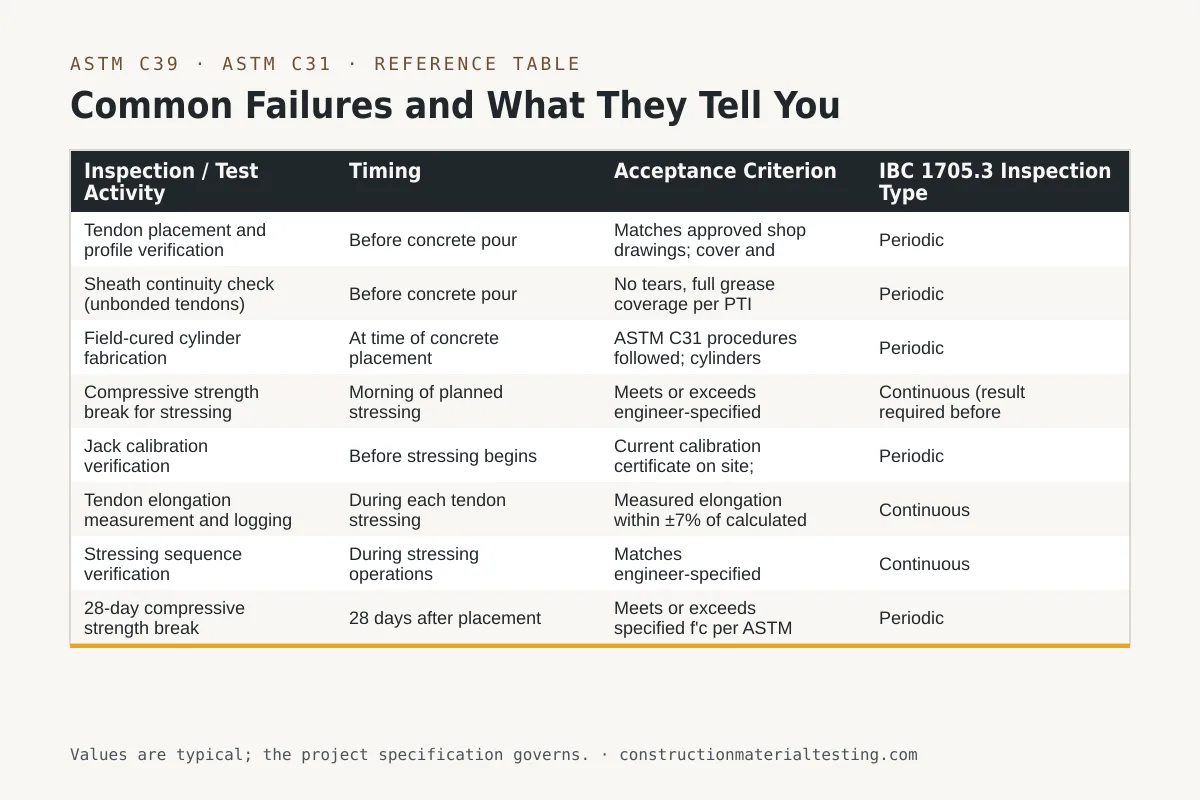
| Inspection / Test Activity | Timing | Acceptance Criterion | IBC 1705.3 Inspection Type |
|---|---|---|---|
| Tendon placement and profile verification | Before concrete pour | Matches approved shop drawings; cover and spacing within tolerance | Periodic |
| Sheath continuity check (unbonded tendons) | Before concrete pour | No tears, full grease coverage per PTI specification | Periodic |
| Field-cured cylinder fabrication | At time of concrete placement | ASTM C31 procedures followed; cylinders stored adjacent to slab | Periodic |
| Compressive strength break for stressing clearance | Morning of planned stressing | Meets or exceeds engineer-specified minimum (commonly 2,500–3,500 psi) | Continuous (result required before stressing begins) |
| Jack calibration verification | Before stressing begins | Current calibration certificate on site; within calibration interval | Periodic |
| Tendon elongation measurement and logging | During each tendon stressing | Measured elongation within ±7% of calculated elongation | Continuous |
| Stressing sequence verification | During stressing operations | Matches engineer-specified sequence on shop drawings | Continuous |
| 28-day compressive strength break | 28 days after placement | Meets or exceeds specified f'c per ASTM C39 | Periodic |
Where This Fits on Your Project
Post-tensioned slab inspection is not something that can be scheduled the morning stressing begins. The cylinder sampling plan needs to be in place before the pour, the field-cure storage location needs to be established with the contractor, and the inspector needs the approved shop drawings and statement of special inspections in hand before setting foot on the deck. For complex projects with multiple bays or a phased stressing sequence, a pre-construction coordination meeting between the contractor, post-tensioning sub, structural engineer, and testing firm prevents the scheduling conflicts that push stressing attempts before the strength data is ready.
If your project involves a post-tensioned slab—whether a residential foundation, a podium deck, or a parking structure—our ACI- and NICET-certified technicians can coordinate the full inspection and testing scope from placement through stressing sign-off. Submit a proposal request with your project details and we will outline the inspection program, sampling frequency, and logistics for your specific scope.
Get our guides in your Google results
Add Construction Materials Testing as a preferred source and Google shows our guides more often when you search for testing topics.