
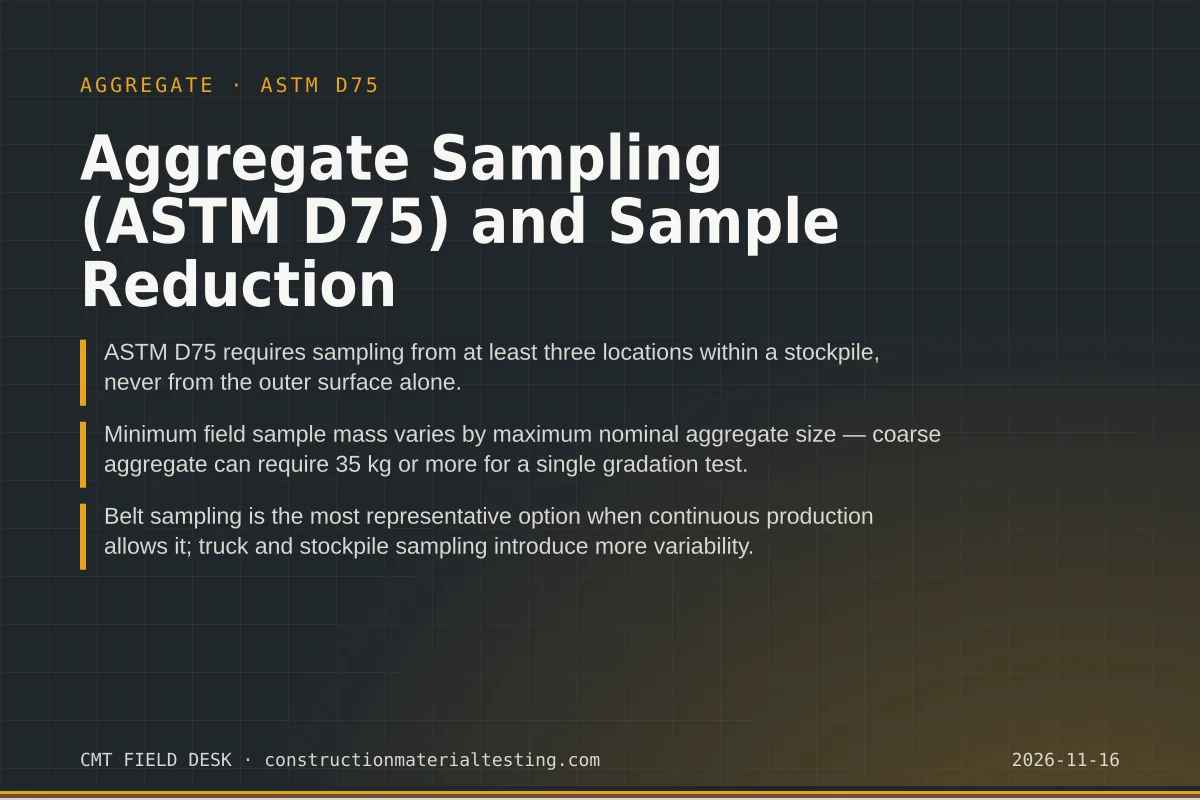
What ASTM D75 Actually Requires for Aggregate Sampling
Aggregate sampling under ASTM D75 is not simply grabbing material from a convenient spot. The standard defines three primary sampling locations — flowing aggregate streams (belt or chute), stockpiles, and transportation units (trucks, rail cars, barges) — and sets distinct procedures for each because each introduces different segregation and contamination risks. The goal is a sample that represents the lot, not the surface of a pile or the tailgate of a truck.
For flowing-stream sampling, the preferred method is to pass a container through the full cross-section of the belt discharge or chute at regular intervals. This collects the entire stream width and captures any gradation variation across the flow. It is the most statistically defensible option when a plant is running and belts are accessible. When belt access is not feasible, we sample from stopped belts by inserting a template across the full belt width and scooping the material within the template boundaries — again, full cross-section is the operative requirement.
Truck and rail car sampling is permitted but carries more uncertainty. ASTM D75 specifies sampling from at least three separate locations distributed across the load — typically front, middle, and rear — and at depth, not just the exposed surface. Surface material is more likely to have segregated during transport or loading, so inserting a sampling tube or shovel to depth is not optional; it is the method.
Stockpile Sampling and Why the Outer Layer Is Off-Limits
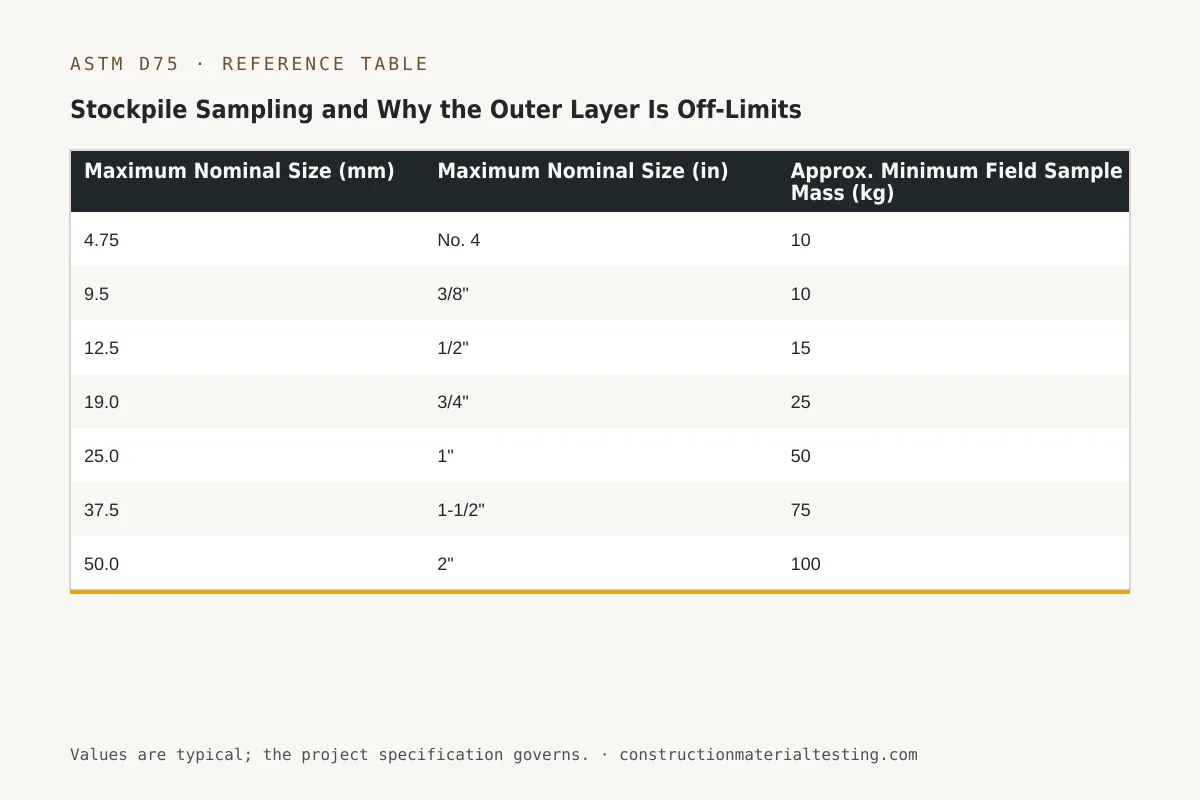
Stockpile sampling is the most common situation we encounter on project sites, and it is also the most frequently done wrong. Fines migrate inward and downward as material is deposited; coarse particles roll to the perimeter and base. The outer 300 mm (roughly 12 inches) of a cone stockpile is therefore not representative of the stockpile as a whole. ASTM D75 requires that samples be taken from the interior after the outer layer is removed, using a board or bladed equipment to expose undisturbed material before increments are collected.
The standard requires at least three increments per sample, taken from separate locations. Those increments are then combined into a single field sample. The combined mass must meet or exceed the minimum field sample mass for the largest nominal aggregate size present — a requirement that links directly back to downstream test methods like sieve analysis per ASTM C136. Collecting an undersized field sample and then trying to run a full gradation on it produces results that cannot be defended under a quality system or during special inspection review.
| Maximum Nominal Size (mm) | Maximum Nominal Size (in) | Approx. Minimum Field Sample Mass (kg) |
|---|---|---|
| 4.75 | No. 4 | 10 |
| 9.5 | 3/8" | 10 |
| 12.5 | 1/2" | 15 |
| 19.0 | 3/4" | 25 |
| 25.0 | 1" | 50 |
| 37.5 | 1-1/2" | 75 |
| 50.0 | 2" | 100 |
Sample Reduction: Splitting and Quartering Under ASTM C702
A field sample large enough to represent the lot is usually too large to run directly through lab tests. Reduction to a test portion must be done by a method that does not introduce gradation bias, and ASTM C702 governs that process. The standard recognizes three methods: mechanical splitting with a riffle splitter, miniature stockpile quartering, and random selection for fine aggregates. Of these, the riffle splitter is the most repeatable in a lab setting and the method we default to for coarse and mixed aggregates.
A riffle splitter divides material into two equal portions by routing alternating chutes to opposite collection pans. To use it correctly, the material is first spread evenly across the feed hopper and released in one continuous motion — not scooped incrementally. The resulting half is returned to the hopper and split again until the target test portion mass is reached. Each split must be accepted as-is; selectively discarding a split because it looks too coarse or too fine defeats the purpose of the method entirely.
Quartering — placing the sample in a cone, flattening it into a disc, and dividing it into quadrants — is acceptable for fine aggregates when a riffle splitter is unavailable, but it is more operator-dependent and less precise. Whatever method is used, the final test portion must still meet the minimum mass required by the specific test being run. For a standard gradation test on aggregates, that minimum is set by the sieve analysis standard, not by the technician's judgment about what seems like enough.
Where Aggregate Sampling Fits on Your Project
Aggregate sampling and reduction sit at the front of nearly every materials quality chain on a construction project. If the sample is biased, every downstream test — gradation, absorption, specific gravity, durability — carries that bias forward into mix designs, structural calculations, and special inspection records. Getting the sampling step right is not paperwork; it is the control point that determines whether your test data can actually be used to accept or reject a material.
Whether you need belt sampling during active production, stockpile sampling prior to mix design, or verified reduction procedures for a lab test series, our construction materials testing services are structured to handle the full sequence from field increment to reported result. If you are ready to scope aggregate testing for an upcoming project, submit a proposal request so we can confirm coverage from one of our regional dispatch hubs nearest your site.
Get our guides in your Google results
Add Construction Materials Testing as a preferred source and Google shows our guides more often when you search for testing topics.