
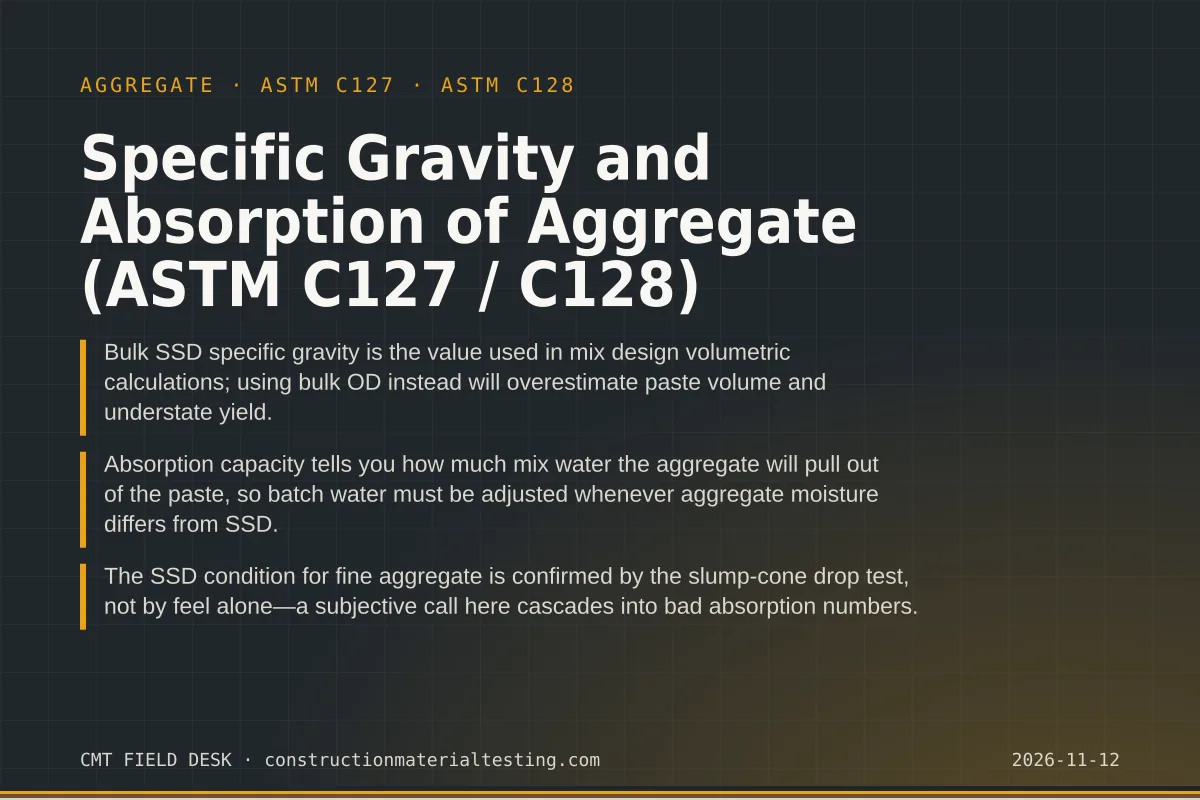
What aggregate specific gravity actually measures
Specific gravity—more precisely called relative density in current ASTM language—is the ratio of the mass of a material to the mass of an equal volume of water at a specified temperature. For aggregate, the tricky part is deciding which volume you mean, because aggregate particles are not solid glass beads. They contain permeable pores that can fill with water and impermeable pores that cannot. The choice of which pore volume to include in the denominator is what separates bulk specific gravity, bulk SSD specific gravity, and apparent specific gravity from one another.
This distinction is not academic. When a mix designer calculates absolute volume in a cubic yard of concrete, the gravity value plugged into the equation determines how many cubic feet the aggregate occupies. Use the wrong value and your computed yield will not match what the truck delivers. That gap shows up as short loads, overfilled forms, or wasted material—none of which are free. Understanding which of the three values belongs in which formula is the first thing we confirm before we sign off on a mix design review.
ASTM governs this measurement in two separate standards: ASTM C127 for coarse aggregate (retained on the No. 4 sieve) and ASTM C128 for fine aggregate (passing the No. 4 sieve). The procedures differ because fine particles cannot be weighed conveniently in a wire basket submerged in water the way coarse particles can. Both standards define the same three gravity values and absorption capacity using consistent formulas, so the results are directly comparable in a mix design.
The three specific gravity values and what each one includes
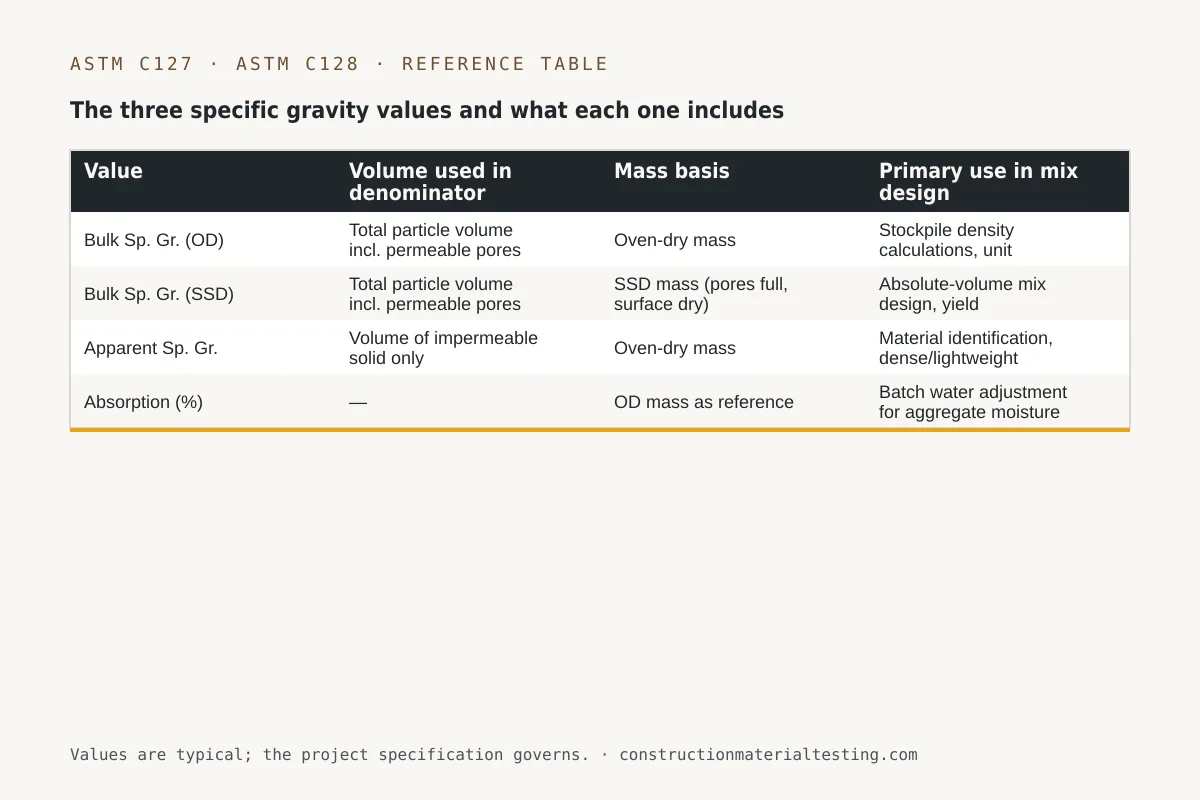
Bulk specific gravity (OD basis) uses the total external volume of the particle—permeable pores included—but measures mass in the oven-dry state. Because the pores are empty when you weigh the sample but are counted as part of the volume, this value is the lowest of the three. It is used when you need to know how much space the aggregate physically occupies in a mixture regardless of its moisture state.
Bulk specific gravity on the saturated surface-dry (SSD) basis uses the same total external volume but measures mass with the permeable pores full of water and the surface dry. This is the value mix designers use most often in absolute-volume calculations, because SSD is the reference moisture state for concrete mix design. At SSD, the aggregate neither absorbs water from the paste nor bleeds water into it, so the mix water calculation stays clean.
Apparent specific gravity uses only the volume of the impermeable portion of the particle—it excludes permeable pore space entirely. This gives the highest of the three values and best represents the true solid-material density. It is most useful for evaluating aggregate in applications where the permeable pore structure is not relevant, or for identifying whether a marginal source material has unusually high void content. For everyday concrete mix design it is a secondary check, not the primary input.
Absorption capacity, expressed as a percentage of the OD mass, tells you how much water the aggregate will soak up to reach SSD from the oven-dry state. A coarse limestone might absorb 1–2 %; a lightweight expanded shale can run well above 10 %. That range matters because every percentage point of absorption capacity in your stockpile represents mix water that disappears into the stone before it can hydrate cement.
| Value | Volume used in denominator | Mass basis | Primary use in mix design |
|---|---|---|---|
| Bulk Sp. Gr. (OD) | Total particle volume incl. permeable pores | Oven-dry mass | Stockpile density calculations, unit weight |
| Bulk Sp. Gr. (SSD) | Total particle volume incl. permeable pores | SSD mass (pores full, surface dry) | Absolute-volume mix design, yield calculation |
| Apparent Sp. Gr. | Volume of impermeable solid only | Oven-dry mass | Material identification, dense/lightweight evaluation |
| Absorption (%) | — | OD mass as reference | Batch water adjustment for aggregate moisture |
ASTM C127: testing coarse aggregate step by step
The C127 procedure for coarse aggregate starts with a sample that meets the standard's minimum mass requirements—roughly 2 kg for 3/4-inch nominal maximum size, more for larger stone. We wash the sample to remove dust and fine material that would otherwise skew the submerged weight, then soak it in water for 15 to 19 hours. After soaking, we towel the surface dry to reach SSD condition and weigh the sample in air. That is the SSD mass (B in the standard's notation).
Next, the sample goes into a wire basket submerged in water and we record the submerged mass (C). The difference between B and C equals the volume of water displaced, which is the total external volume of the particles. After the submerged weighing, we dry the sample to constant mass in an oven at 110 ± 5 °C and weigh it again to get the OD mass (A). With A, B, and C in hand, all three specific gravity values and absorption fall out of straightforward arithmetic. We also verify the water temperature because water density changes with temperature; most labs target 23 °C with a correction applied if the actual temperature deviates.
The most common field mistake is insufficient soaking time or toweling the sample too aggressively at the SSD step. Under-soaked stone absorbs water from the paste in service, raising the effective water-cement ratio in the interfacial zone. Over-toweled stone has surface-dry pores that are not actually full, which makes the SSD mass low and the computed absorption artificially high. We time the soak, control the toweling technique with a consistent motion pattern, and check that surface sheen is gone but the stone is not chalky.
ASTM C128: testing fine aggregate and reading the cone
Fine aggregate cannot be weighed in a wire basket because the particles would fall through. Instead, the C128 procedure for fine aggregate uses a glass or metal pycnometer—a flask of known volume—filled with the sand sample and topped off with water. The mass of pycnometer-plus-water-plus-sand, compared to the mass of pycnometer-plus-water-only, gives the displaced volume and from there the specific gravity. We calibrate the pycnometer volume at the test temperature before running the sample.
The SSD determination for fine aggregate is more subjective than for coarse. The standard specifies a truncated metal cone and a small tamper. We place damp sand in the cone in three layers, tamp each layer 25 times, lift the cone, and observe what happens. If the sand slumps completely, it is wetter than SSD and needs to dry further. If it retains the cone shape perfectly, it may still be above SSD—the standard actually calls for the point where the cone just barely slumps with the first free particle sliding down the face. Reaching that point consistently takes practice. Technicians who rush this step or misjudge the slump condition introduce error that flows through to every downstream calculation.
Air entrainment in the pycnometer is the other major error source. Fine particles trap air bubbles on their surfaces and those bubbles displace water, making the sample appear to have a larger volume than it truly does. We roll and agitate the pycnometer and may apply mild vacuum to drive bubbles out before taking the final mass reading. The standard allows both the gravimetric (pycnometer) method and a volumetric flask method; we use whichever the project specification requires or, absent that, the gravimetric method by default.
How absorption capacity shifts batch water and concrete yield
Once you have absorption capacity from C127 or C128, you can calculate the surface moisture or moisture deficit of stockpile aggregate and adjust batch water accordingly. The relationship is straightforward: if aggregate absorption is 1.5 % and the stockpile moisture content (measured per ASTM C566) is 0.8 %, the aggregate is 0.7 % below SSD. It will absorb that 0.7 % from the mix water during batching. For 1,800 lb of coarse aggregate per cubic yard, that works out to 12.6 lb of water—roughly 1.5 gallons—that never makes it to the paste. Ignore it and your effective water-cement ratio drops, your slump drops, and your pump line plugs.
The reverse is also true. Wet aggregate above SSD carries free surface moisture that adds to the mix water. A saturated, surface-wet sand stockpile after a rainstorm can carry 4–6 % free moisture, which at typical fine aggregate quantities can add 15–25 lb of water per yard. That water does show up in the paste and raises the water-cement ratio. The only way to know the correction to apply is to know both the absorption capacity (a material property, stable) and the current stockpile moisture (a field variable, changing with weather). Both numbers are required; neither can be assumed.
Yield is the other consequence. Absolute volume calculations in ACI mix design use the SSD bulk specific gravity to convert aggregate mass to cubic feet. If the gravity value used in the design does not match the aggregate actually batched, the computed total volume of ingredients will not equal 27 cubic feet. A specific gravity that is 0.02 units lower than actual—easily within the variation between aggregate sources or between quarry zones—shifts yield noticeably on a large pour. Our materials testing services include mix design verification runs that catch this before a placement, not after.
Precision, bias, and when to retest
ASTM C127 and C128 both contain precision statements based on multi-laboratory studies. For coarse aggregate, the single-operator standard deviation for bulk SSD specific gravity is on the order of 0.009, meaning two results from the same operator on the same material should agree within about 0.025. Multi-laboratory limits are wider. Absorption precision is proportionally tighter at low absorption values and looser at high ones—which is why lightweight aggregate absorption results carry larger uncertainty bands and should be confirmed with replicate testing.
In practice, we retest whenever a new aggregate shipment arrives, whenever the source or crushing operation changes, and whenever a mix design is being established or verified. Project specifications often tie retest frequency to lot size or to observed variability in fresh concrete properties. If unit weight or slump starts drifting without an obvious batching explanation, returning to C127 and C128 is one of the first checks we make—gravity and absorption shifts can masquerade as cement variability or admixture dosing problems if you do not look at the aggregate.
- Retest at each new aggregate source or when gradation changes substantially
- Confirm absorption after extended stockpile storage, especially for porous materials like limestone
- Check C127/C128 results against mix design assumptions before first concrete placement on a new project
- Flag any single-test bulk SSD Sp. Gr. result more than 0.030 from the established project value for investigation
- Correlate aggregate-test results with field unit weight and slump records to catch drift early
Where this fits on your project
Aggregate specific gravity and absorption sit at the foundation of every concrete mix design. They are not one-time qualification tests—they are recurring quality inputs that must stay current as materials change. Whether you are establishing a new mix design, verifying an existing one against a new aggregate source, or troubleshooting yield and consistency problems in the field, accurate C127 and C128 data are the starting point. Our laboratory staff and field technicians run these tests under a documented quality system, and our 27 regional dispatch hubs mean the samples reach the lab without the kind of delay that changes stockpile moisture between collection and weighing.
If you are starting a project and need aggregate characterization as part of a broader materials testing program, or if you need C127 and C128 specifically to support a mix design submittal, submit a proposal request and we will put together a testing scope matched to your specification requirements and schedule.
Get our guides in your Google results
Add Construction Materials Testing as a preferred source and Google shows our guides more often when you search for testing topics.