
Why Pavement Subgrade and Flexible Base Testing Matter
A pavement is only as stable as the material beneath it. When subgrade soils are soft, over-wet, or poorly compacted, even a correctly built base and surface course will rut, crack, or fail prematurely. Conversely, when flexible base material is placed at the wrong gradation, moisture, or density, the structural number the pavement designer assumed simply does not exist in the field. These are not theoretical concerns — they show up as warranty claims, early distress, and costly reconstruction.
Flexible base testing is the collective term for the field and laboratory procedures that confirm whether the prepared roadbed and the crushed-stone or gravel base layer meet the project specifications before asphalt or concrete is placed on top. On TxDOT-funded or TxDOT-let work, those specifications are primarily governed by Item 247 (Flexible Base) in the TxDOT Standard Specifications, which defines gradation bands, plasticity limits, bearing values, and compaction requirements. Private and municipal projects typically reference the same material standard or adopt it by reference.
Our technicians perform these tests on roadway projects of all scales — from county road rehabilitation to major highway widening. The sequence of testing is not arbitrary: proof rolling, subgrade density, base gradation, base compaction, and thickness verification each answer a distinct question. Skipping or reordering them creates gaps in the quality record that can expose owners and contractors to dispute and liability. This guide explains each step, the numbers that matter, and what happens when a result falls outside tolerance.
Proof Rolling: The First Look at Subgrade Condition
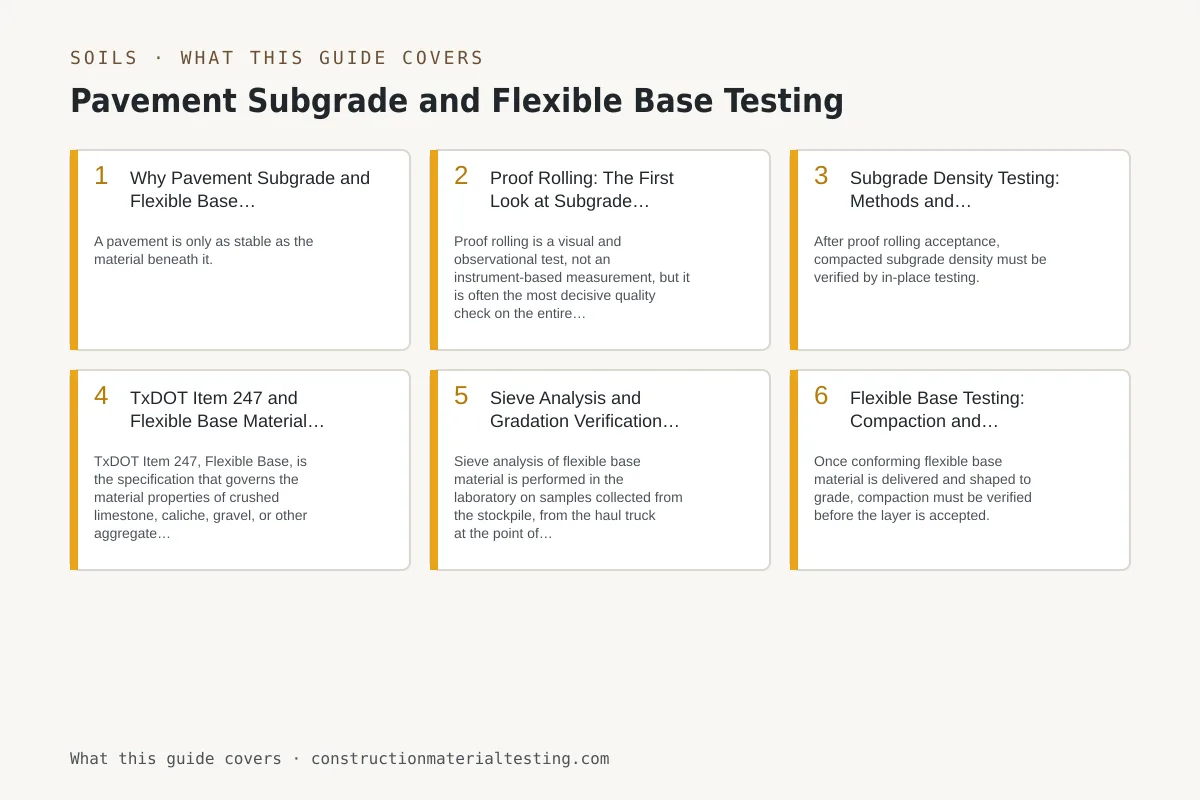
Proof rolling is a visual and observational test, not an instrument-based measurement, but it is often the most decisive quality check on the entire project. The procedure involves driving a loaded tandem-axle dump truck or similar vehicle — typically loaded to roughly 20 to 25 tons gross weight — across every lane width of the prepared subgrade while an inspector watches for deformation, pumping, or excessive deflection under the axles. The goal is to identify weak or wet zones before they are buried under base material.
What the inspector is watching for is any rutting deeper than approximately half an inch, any area that visibly flexes or 'pumps' as the truck passes, and any localized soft spots that spring back slowly. These are signs that the subgrade either has not been compacted adequately, contains excessive moisture, or has underlying material (clay lenses, organic pockets, utility trench backfill) that is incompetent for pavement support. The inspector should walk behind and alongside the truck, not ride in it, so they can observe the full deformation pattern.
When a soft area is identified, the response depends on cause. If moisture is the issue, the subgrade may be scarified, dried, and recompacted. If the soil is inherently weak, options include moisture-density conditioning, stabilization with lime or cement (covered under separate TxDOT items), or over-excavation and replacement. In every case, the repaired area must be proof rolled again and pass before work continues. Proof rolling documentation — truck tare and gross weight, load ticket, date, weather, and the inspector's written observations with stationing of any failures — should be retained in the project file.
Subgrade Density Testing: Methods and Acceptance Criteria
After proof rolling acceptance, compacted subgrade density must be verified by in-place testing. The nuclear gauge method (ASTM D6938) is the most common approach on roadway projects because it is fast, non-destructive, and returns both wet density and moisture content simultaneously. The sand-cone method (ASTM D1556) and the drive-cylinder method (ASTM D2937) are alternatives when nuclear gauge use is restricted or when a referee test is needed. Each method has its own calibration and procedural requirements; they are not interchangeable without recognizing the small systematic differences between them.
Acceptance is always relative to a reference maximum dry density established in the laboratory. For most subgrade soils on Texas projects, the reference test is the Standard Proctor (ASTM D698), which produces a moisture-density curve at Standard Proctor energy. Some projects, particularly those under heavier traffic or with granular subgrades, specify the Modified Proctor (ASTM D1557) instead. The field density result — expressed as a percentage of that laboratory maximum — must equal or exceed the specified minimum, which on TxDOT subgrade work is commonly 95 % of Standard Proctor maximum dry density for the top twelve inches. Confirm the specific percentage and reference test from the project special provisions, because they vary.
A common error is testing subgrade density without a current, project-specific Proctor curve for the material being compacted. Soil on a project is rarely uniform; a borrow pit may change character every few feet, and a stockpile blended from multiple sources may not match the curve from the initial sample. When field material looks different — different color, texture, or plasticity — a new Proctor must be run before that material's compaction can be accepted. Our laboratory compaction testing under ASTM D698 is the foundation on which every field density acceptance rests.
Testing frequency for subgrade density on TxDOT projects is defined by the governing specification and the project's inspection level. A common baseline for roadway subgrade is one test per 1,000 linear feet per lane, but the engineer of record or TxDOT area engineer may require a denser pattern in areas with known variability or after repair of a proof-roll failure. Our nuclear gauge density testing under ASTM D6938 can typically be mobilized to match the contractor's rolling and grading schedule.
TxDOT Item 247 and Flexible Base Material Requirements
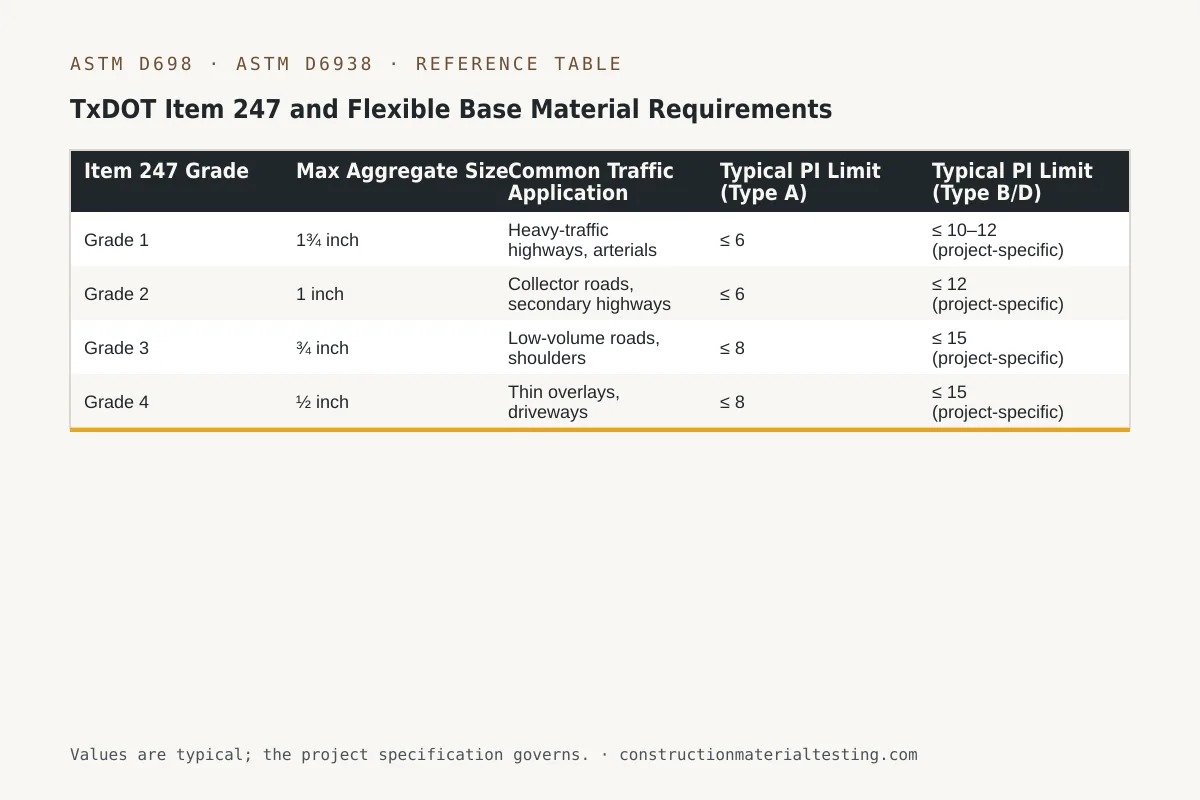
TxDOT Item 247, Flexible Base, is the specification that governs the material properties of crushed limestone, caliche, gravel, or other aggregate bases used under pavements on TxDOT projects. It classifies material by type (Type A through Type D based on source rock) and grade (Grade 1 through Grade 4 based on maximum aggregate size), and it sets limits on gradation, plasticity index, wet-ball mill value, and soil support value. Projects using TxDOT pay items or TxDOT funding are required to verify these properties; many local agency and private projects adopt Item 247 by reference because it is a well-established, enforceable standard. The full text is available through the TxDOT Standard Specifications.
Gradation under Item 247 is verified by sieve analysis (ASTM C136 and ASTM C117 for the wash). The specification sets percentage-passing limits at multiple sieve sizes for each grade. Grade 1, the most common for heavy-traffic roadways, allows a maximum aggregate size of 1¾ inches and specifies tolerances at the No. 4, No. 40, and No. 200 sieves among others. Grade 2 and Grade 3 use smaller maximum sizes and are common on lower-volume roads. Gradation that falls outside the specified band — either too coarse, which reduces cohesion and load distribution, or too fine, which elevates plasticity and susceptibility to moisture — must be corrected at the stockpile or at the plant before placement.
The plasticity index (PI) of the material passing the No. 40 sieve is a critical Item 247 control point. PI measures the range of moisture content over which a soil behaves plastically; high-PI flexible base will rut and shove under traffic when wet. Item 247 sets PI limits that vary by material type and, in some cases, by traffic class. For Type A material (crushed stone) used on high-traffic corridors, the PI limit is typically very low — often 6 or less — because even modest plasticity in a crushed-stone base signals contamination with clay fines. For Type D (caliche) on low-volume roads, higher PI limits may apply. Always confirm limits from the specific project special provision, because TxDOT periodically updates Item 247 and project special provisions can tighten standard limits.
Wet-ball mill value (ASTM D6928, referenced in Item 247 as Tex-116-E) measures the resistance of the aggregate to degradation under traffic. A material that is marginally acceptable in gradation when stockpiled may exceed gradation limits after rolling due to breakdown of weak particles. Projects with wet-ball mill requirements should verify this value from the material source qualification data before accepting a stockpile, not after placement and compaction.
| Item 247 Grade | Max Aggregate Size | Common Traffic Application | Typical PI Limit (Type A) | Typical PI Limit (Type B/D) |
|---|---|---|---|---|
| Grade 1 | 1¾ inch | Heavy-traffic highways, arterials | ≤ 6 | ≤ 10–12 (project-specific) |
| Grade 2 | 1 inch | Collector roads, secondary highways | ≤ 6 | ≤ 12 (project-specific) |
| Grade 3 | ¾ inch | Low-volume roads, shoulders | ≤ 8 | ≤ 15 (project-specific) |
| Grade 4 | ½ inch | Thin overlays, driveways | ≤ 8 | ≤ 15 (project-specific) |
Sieve Analysis and Gradation Verification in the Field
Sieve analysis of flexible base material is performed in the laboratory on samples collected from the stockpile, from the haul truck at the point of delivery, or from the roadway before final compaction. Each sampling location has advantages and limitations. Stockpile sampling catches problems early and prevents defective material from ever reaching the road, but it requires the sampler to follow ASTM D75 sampling procedures carefully to get a representative sample from a segregated pile — which almost always requires sampling from multiple locations and depths, not just the surface. Sampling from haul trucks gives a better picture of what is actually being placed but requires the contractor's cooperation to hold the truck.
The sieve analysis procedure under ASTM C136 requires washing the sample over a No. 200 sieve before dry sieving to ensure clay and silt-sized particles are fully accounted for. Skipping the wash underestimates fines content and can produce a gradation that appears to pass when the material actually fails. This is not a minor procedural detail — in Texas caliche materials, the minus-No. 200 fraction can be substantial and is directly related to both PI and load-spreading performance.
When a gradation result falls outside the Item 247 band, the most common immediate response is to test additional samples to determine whether the failure is isolated (a segregated portion of the stockpile) or systemic (the entire material source is out of spec). If the failure is systemic, the material must be replaced with a conforming source; blending to correct gradation is permissible under some conditions but must be pre-approved by the engineer and re-tested before placement.
Flexible Base Testing: Compaction and Moisture During Placement
Once conforming flexible base material is delivered and shaped to grade, compaction must be verified before the layer is accepted. The reference curve is again a laboratory Proctor, but for flexible base material, TxDOT Item 247 and the governing project special provisions specify whether Standard Proctor (ASTM D698) or a TxDOT-specific compaction method (Tex-113-E) applies. The in-place density test method is the same nuclear gauge procedure or sand-cone alternative used for subgrade, but now applied to the base layer itself.
Moisture content at time of compaction matters as much as the final density reading. Flexible base compacted significantly dry of optimum moisture content may achieve the target density percentage under the roller but will not develop the inter-particle friction and cohesion needed for performance. Material compacted significantly wet of optimum moisture will appear to densify but will shove under construction traffic before the asphalt is placed. The nuclear gauge moisture reading provides a real-time check; when the gauge moisture deviates more than a few points from optimum, the contractor needs to adjust water application or aeration before continuing to roll.
Lift thickness during flexible base placement also controls the achievable density. Rollers compact from the surface downward, and their energy diminishes with depth. TxDOT Item 247 generally limits compacted lift thickness to eight inches for Grade 1 material compacted with heavy rollers, though the specific limit depends on roller type and project specification. Placing oversized lifts is a common field problem; the surface density test passes because the roller adequately densified the top few inches, while the lower portion of the lift remains loose. Core samples or probe measurements during placement are the only reliable way to catch this problem.
Thickness Verification and Pavement Section Acceptance
Compaction acceptance and thickness acceptance are independent, and both must be satisfied. A flexible base layer that passes all density tests but is under-thick by more than the specified tolerance will not deliver the structural contribution the pavement design assumed. Thickness is typically verified by taking cores after compaction (before asphalt placement) or by measuring with a probe or pin through the loose material before final rolling. Cores have the advantage of providing both thickness and a visual check on material uniformity and layer bonding; probes are faster but do not reveal internal layer issues.
TxDOT specification tolerances for base thickness are project-specific, but a common allowance is plus or minus half an inch from the plan thickness for individual measurements, with a stricter limit on the average. When an individual core is deficient beyond the tolerance, the typical response is to investigate adjacent cores to define the limits of the deficiency, then either add material and re-compact or negotiate a plan-quantity adjustment with the engineer. Under-thick base discovered after asphalt placement is far more expensive to correct — it typically means milling the surface, adding base, and repaving.
The pavement section diagram below illustrates the relationship between subgrade, flexible base, and surface course thicknesses. Understanding that diagram — and verifying every layer before the next one is placed — is the core of pavement quality assurance. FHWA geotechnical guidance provides additional background on how pavement structure interacts with subgrade conditions and how testing programs should be designed to capture variability across a project.
| Test | Standard | Typical Frequency (TxDOT Roadway) | Acceptance Criteria | Who Provides Reference Value |
|---|---|---|---|---|
| Proof rolling | TxDOT Item 216 / project spec | 100% of subgrade area, every lane width | No deformation > ~½ inch; no pumping | Inspector judgment; documented by engineer |
| Subgrade compaction | ASTM D6938 field / ASTM D698 lab | 1 test per 1,000 LF per lane minimum | ≥ 95% of Standard Proctor max dry density | Laboratory Proctor on project material |
| Base gradation (sieve analysis) | ASTM C136 + wash | 1 per 500 tons or per engineer's direction | Within Item 247 grade band at all sieves | Item 247 / project special provision |
| Base plasticity index | ASTM D4318 | Same frequency as gradation | Per Item 247 type and traffic class (commonly ≤ 6 for Type A) | Item 247 / project special provision |
| Base compaction | ASTM D6938 field / D698 or Tex-113-E lab | 1 per 1,000 LF per lane minimum | ≥ 95–100% per project spec | Laboratory Proctor on base material |
| Base thickness | Core or probe | Per plan or engineer's direction; often 1 per 500 LF | Plan thickness ± ½ inch (project-specific) | Plan sheets / project special provision |
Common Failures and How to Respond
Proof-roll failure after compaction is the most disruptive failure because it triggers subgrade repair before any other work can proceed. The investigative step is to determine depth of the problem: a simple probe rod pushed into the subgrade by hand gives a quick estimate of how deep the softness extends. If the soft zone is confined to the top six inches, drying and recompaction are usually sufficient. If softness extends deeper, the contractor and engineer need to evaluate whether undercut, lime treatment, or geosynthetic reinforcement is warranted. Repair documentation — depth of undercut or stabilizer application rate, re-compaction records, and re-proof-roll observation — should all enter the project file.
Gradation failure on a base material stockpile is often recoverable if caught early. The first step is to confirm the failure is real and not a sampling artifact — take additional samples using proper ASTM D75 technique and re-test. If the failure is confirmed, determine whether the material can be corrected by scalping oversize at the crusher or by processing through additional screening. If correction is not feasible, the entire nonconforming stockpile must be removed from the project. Using nonconforming material and hoping it will average out with conforming material placed later is not an acceptable response under any standard specification.
Density failures on base compaction often trace to moisture. If the material is too dry, uniform water application and additional rolling passes usually resolve the problem. If the material is too wet — common after rain events on fine-graded base — aeration and drying before rolling is necessary; adding more roller passes to wet material compacts the surface and seals moisture into the lower lift. PI failures discovered after placement are the most expensive failure type; they generally cannot be corrected in place and require removal and replacement of the nonconforming material, which is why PI testing at the stockpile, before placement, is the correct quality control approach.
Our materials testing services are structured to provide both the laboratory reference values and the field verification testing in a coordinated program, so that failures at any stage can be diagnosed against a complete data record rather than in isolation.
Coordination Between Lab and Field on Pavement Projects
Pavement subgrade and flexible base testing requires close coordination between laboratory and field operations. The laboratory must have current Proctor curves before field density testing begins; the field team must communicate any apparent change in material so the laboratory can run a new curve before that material's compaction is accepted. On projects where multiple borrow sources or multiple base suppliers are used, this means maintaining a library of Proctor curves indexed to material source and updating it as sources change.
Pre-construction conference coordination should establish the testing frequency, the reporting format, the response protocol for failures, and the chain of communication between the contractor, the engineer of record, the owner's representative, and the testing firm. When these roles and expectations are established before dirt starts moving, test failures get resolved efficiently rather than becoming the subject of claims. Field reports should be transmitted promptly — a density failure discovered at the end of the week that was actually measured on Monday has already had additional material placed over it, complicating the response.
The FHWA geotechnical resource library provides design and specification context that helps owners and engineers understand how field testing fits into the broader pavement performance picture. Pavement performance begins in the soil beneath it, and the testing program is the only way to verify that the soil — and the base built on it — will perform as designed.
Where Flexible Base Testing Fits on Your Project
Whether you are building a highway, a parking lot, or a subdivision street, the testing sequence described here applies in some form to every flexible pavement project. Subgrade proof rolling and density, ASTM D698 Standard Proctor reference testing, ASTM D6938 in-place density, ASTM C136 gradation verification, PI limits, and thickness checks are not bureaucratic checkboxes — they are the documented evidence that the pavement was built to the design. When a pavement fails early, the first question from an owner or insurer is what the testing record shows. When the record is complete and correct, the contractor and engineer are protected. When it is missing or inconsistent, liability follows the gaps.
Our field technicians are ACI- and NICET-certified and are dispatched from regional hubs positioned to cover projects across Texas. We provide laboratory reference testing, field density and gradation sampling, proof-roll observation and documentation, and written reports in formats compatible with TxDOT project submittals and local agency requirements. If you are in the planning or pre-bid phase, early coordination with a testing firm allows the inspection and testing plan to be built into the project schedule rather than bolted on after issues arise. Submit a proposal request to discuss testing scope and scheduling for your pavement project.
Get our guides in your Google results
Add Construction Materials Testing as a preferred source and Google shows our guides more often when you search for testing topics.