
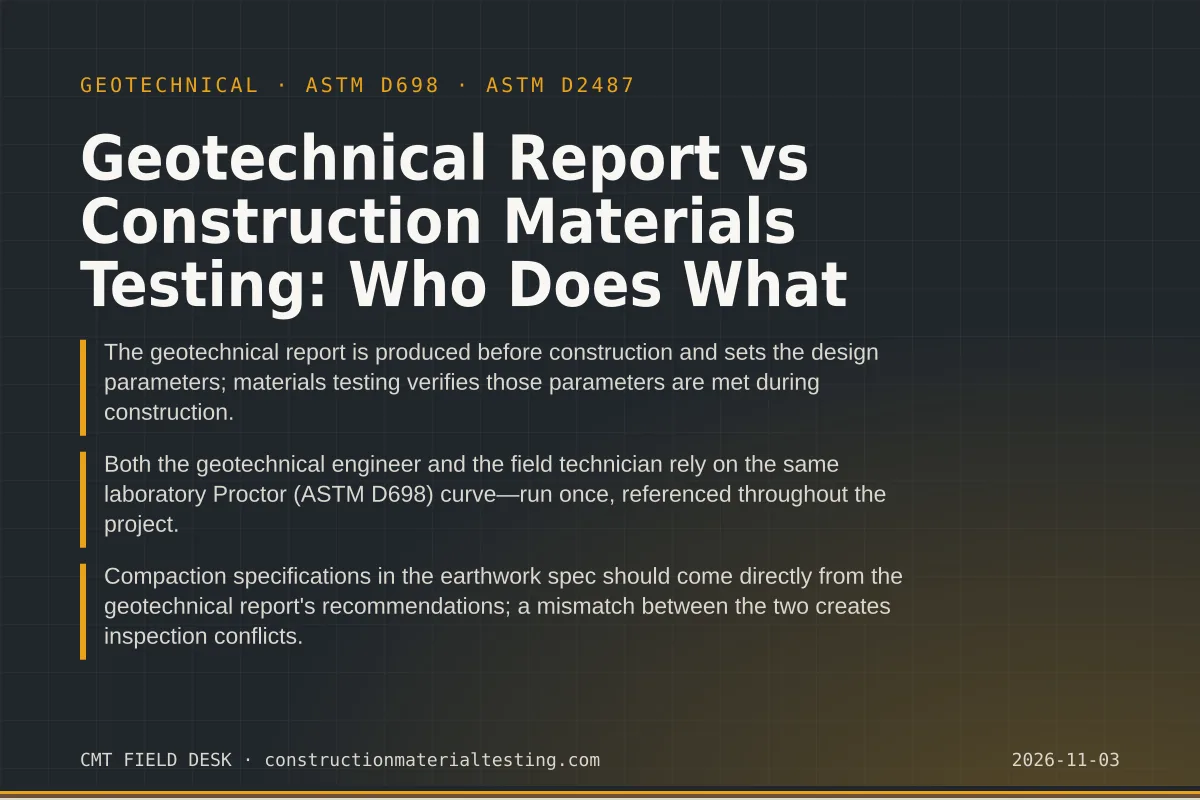
What each scope actually covers
A geotechnical report is a pre-construction document. A geotechnical engineer directs borings or test pits, logs the subsurface conditions, runs index and strength tests in a laboratory, and then issues recommendations for foundation type, allowable bearing pressure, earthwork compaction targets, and subgrade treatment. By the time the contractor mobilizes, that report is already complete. Its job is to inform design, not to monitor construction.
Construction materials testing—sometimes called special inspection or CMT—is a during-construction scope. Technicians come to the site repeatedly, observe operations in progress, and collect samples or run field tests to confirm that what is being built matches what was specified. For earthwork, that means nuclear density gauge or sand-cone readings on each lift, moisture checks, and documentation that the compacted layer meets the percentage of maximum dry density the geotechnical report recommended. The two scopes do not compete; they are sequential and complementary. You can read more about how we structure each engagement at geotechnical services and materials testing services.
How the geotechnical report vs materials testing relationship works through the Proctor
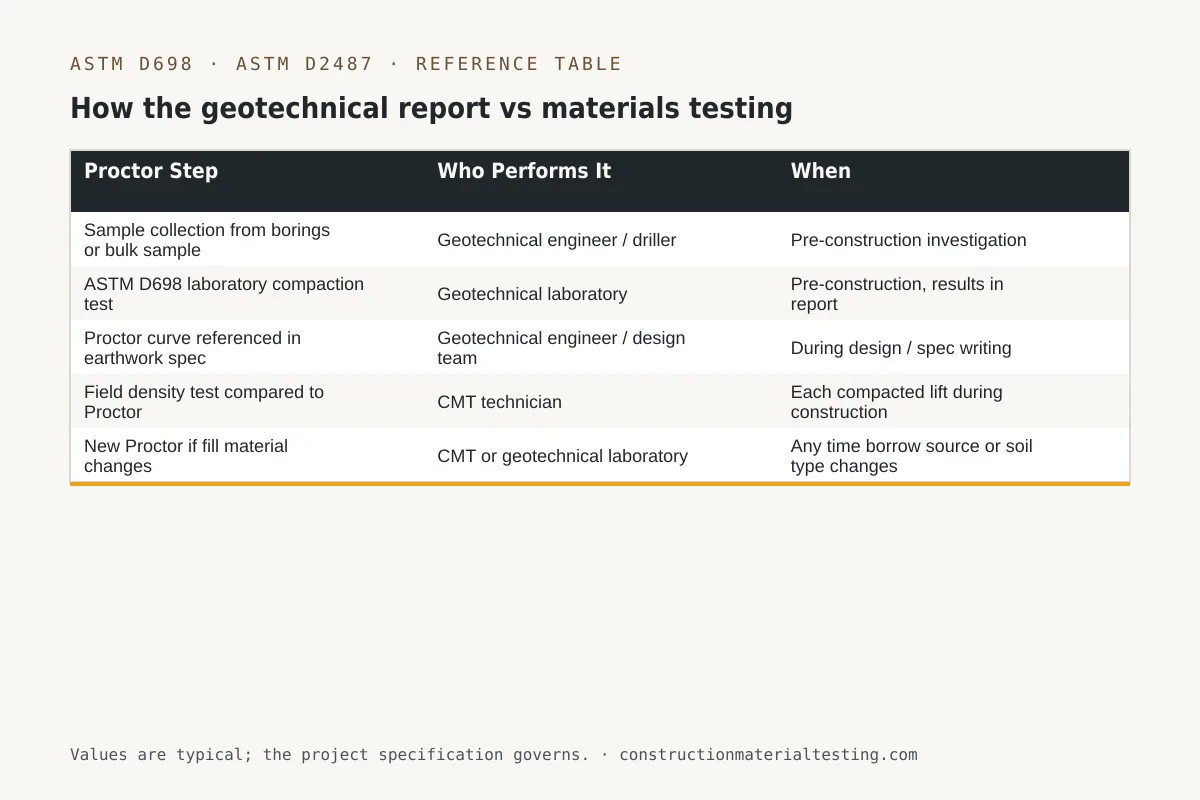
The clearest illustration of the handoff is the Standard Proctor test, ASTM D698. The geotechnical engineer runs this test—or directs it—on representative samples collected during the subsurface investigation. The result is a compaction curve showing maximum dry density and optimum moisture content for that specific soil. Those numbers go into the geotechnical report, and the earthwork specification is then written around them: typically 95% of maximum dry density for structural fill, sometimes 90% for non-structural areas, with an allowable moisture window above and below optimum.
When the CMT technician arrives on the first fill lift, they pull that Proctor curve from the project file and use it as the reference standard for every field density test run on that material. The field result—expressed as a percentage of the laboratory maximum—is only meaningful if the reference curve matches the actual fill. This is why soil classification matters in the field. The ASTM D2487 classification logged on the boring, and described in the Unified Soil Classification System standard, gives both the geotechnical engineer and the field technician a shared language for confirming the material is consistent. If the fill being placed is a CL lean clay and the Proctor was run on a CL, the reference is valid. If a contractor substitutes a SM silty sand, that Proctor no longer applies and a new curve must be run before testing continues.
The FHWA's geotechnical engineering resources discuss this same principle in the context of highway earthwork—the reference compaction standard must match the material being placed. The same logic applies to building pads, utility trenches, and retaining wall backfill.
| Proctor Step | Who Performs It | When |
|---|---|---|
| Sample collection from borings or bulk sample | Geotechnical engineer / driller | Pre-construction investigation |
| ASTM D698 laboratory compaction test | Geotechnical laboratory | Pre-construction, results in report |
| Proctor curve referenced in earthwork spec | Geotechnical engineer / design team | During design / spec writing |
| Field density test compared to Proctor | CMT technician | Each compacted lift during construction |
| New Proctor if fill material changes | CMT or geotechnical laboratory | Any time borrow source or soil type changes |
Reading geotechnical recommendations into the earthwork spec
One of the most common disconnects we see in the field is a geotechnical report that recommends 95% Standard Proctor compaction but an earthwork spec that is silent on which Proctor standard applies or which test method governs field density. ASTM D698 (Standard Proctor) and ASTM D1557 (Modified Proctor) produce different maximum dry densities for the same soil—sometimes by 8 to 12 pounds per cubic foot. If the spec references the wrong one, or references nothing at all, the technician has to make an assumption, and that assumption may be wrong.
The geotechnical report should be treated as a primary input to Division 31 of the project specification, not just a design exhibit. The compaction percentage, the moisture range, the lift thickness limit, the subgrade preparation requirements, and any over-excavation depth recommendations all belong in the spec by reference or by direct inclusion. When we receive a project package where those items are consistent between the report and the spec, field testing proceeds cleanly. When they conflict, the inspector has to stop, contact the engineer of record, and wait for direction—which costs time and sometimes requires re-testing already-completed work.
Where this fits on your project
If you are early in design, the geotechnical investigation gives you the soil data you need to write a defensible earthwork spec. If you are heading into construction, materials testing verifies that spec is being met lift by lift. The two phases share test data—especially the Proctor—so coordinating them through a single point of contact reduces the risk of a reference-curve mismatch or a spec gap showing up during a critical pour or fill operation. Contact our field desk through the proposal request form and tell us where you are in the schedule; we will scope the right services for the phase you are in.
Get our guides in your Google results
Add Construction Materials Testing as a preferred source and Google shows our guides more often when you search for testing topics.