
Why Fill Classification Matters Before the First Truck Arrives
The words 'fill' and 'dirt' get used interchangeably on job sites, but in a geotechnical or structural context they carry precise meanings with real consequences. Placing general fill under a spread footing or a post-tensioned slab is one of the most consistent triggers for differential settlement claims we see in the field. The root cause is almost always the same: the specification was not read carefully, or it was read and then ignored at the point of purchase.
Every earthwork project of any scale will reference at least one of three fill categories—select fill, structural fill, or general fill—and sometimes all three in different zones of the same site. The geotechnical report defines which zone gets which fill. The project specification defines what that fill must be—its gradation envelope, plasticity limits, maximum particle size, and minimum compaction percentage. Our role as testing technicians is to verify that what arrives on site matches what was specified and that placement meets the compaction target. None of that is possible if the classification conversation happens after the fill is already in the ground.
Understanding the distinctions before work begins also controls cost. Select fill from an approved borrow source costs more per cubic yard than clay-rich general fill scraped from an on-site cut. If the spec allows general fill in a zone, paying select-fill pricing there wastes budget. Conversely, if the spec requires select fill and general fill is placed instead, the remediation cost—excavation, recompaction, re-testing—will far exceed the original material savings. Getting the classification right the first time is purely an economics argument.
General Fill: The Least Restrictive Category
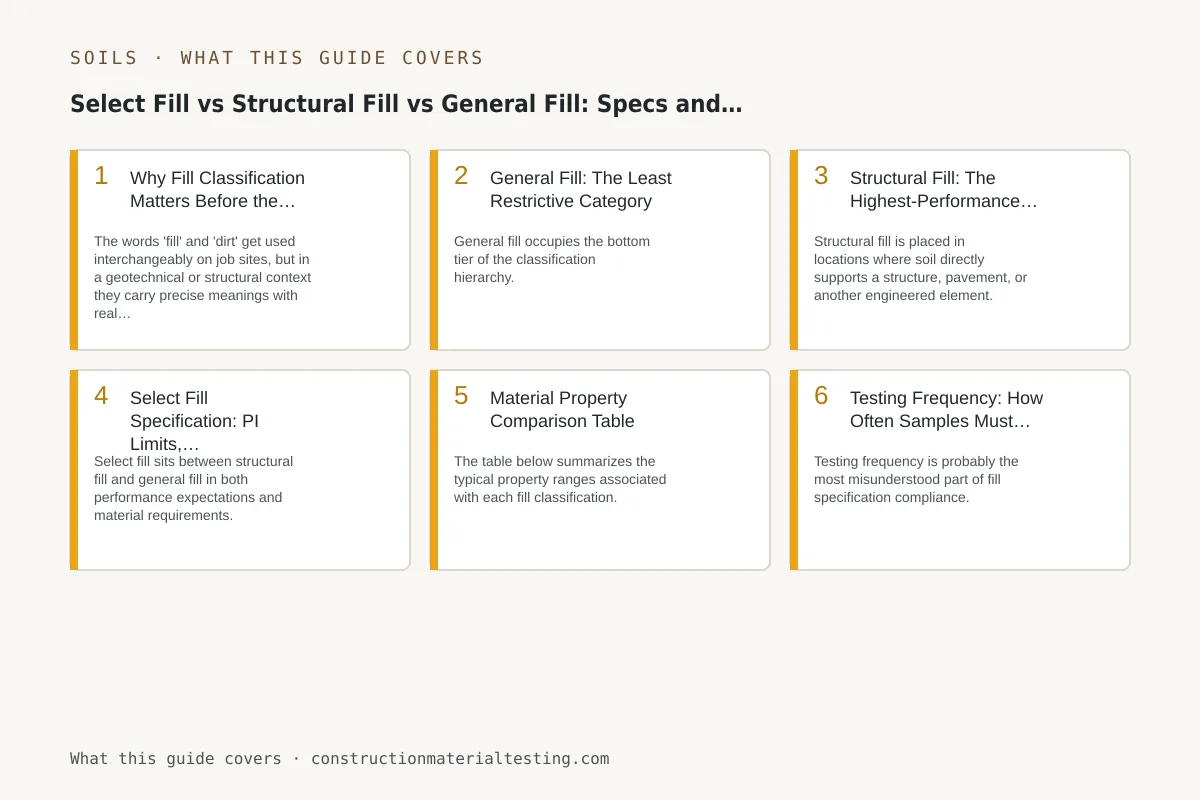
General fill occupies the bottom tier of the classification hierarchy. It is typically used for mass grading, landscape berms, detention pond embankments, and other locations where the soil is not directly supporting a structure or pavement section. Because the performance demands are lower, the material requirements are correspondingly relaxed. Most project specifications allow general fill to contain cohesive soils with plasticity indices well above 20, oversized particles up to a specified maximum, and organic content that would disqualify material from a higher classification.
That flexibility does not mean general fill is uncontrolled. Compaction is still required—typically 90 to 95 percent of standard Proctor maximum dry density per ASTM D698, depending on the application and governing specification. Lift thickness limits still apply. And the material must be free of trash, debris, frozen clods, and excessive organic matter, even when there are no formal gradation or PI limits in the spec. Our technicians still run nuclear density gauge or sand cone tests on general fill placements; the specification tier does not eliminate the need for in-place verification.
One edge case worth flagging: some specifications treat on-site cut material as automatically qualifying for general fill without additional testing, while others require at least a visual classification and a moisture-density relationship test before placement. When a spec is silent on this point, we recommend running a Standard Proctor on representative samples from the cut area—particularly in South Texas and the Gulf Coast region, where expansive clays can vary dramatically across a single site. Using the wrong moisture-density curve during compaction verification is a silent error that does not show up until the structure moves.
Structural Fill: The Highest-Performance Tier
Structural fill is placed in locations where soil directly supports a structure, pavement, or another engineered element. Common zones include footing subgrades, slab-on-grade subgrades, mechanically stabilized earth wall backfill, bridge approach embankments, and utility trench zones within pavement areas. Because a structural fill failure translates directly into structural distress, the material and testing requirements are the most demanding of the three categories.
Gradation requirements for structural fill vary by specification, but a common benchmark is material passing the No. 4 sieve at 50 percent or more, with a maximum particle size of three inches or less—sometimes much tighter. Plasticity index limits are typically strict: many highway and structural specifications cap PI at 10 or 12. The TxDOT Standard Specifications set specific gradation and PI requirements for select backfill and similar categories that are worth referencing directly when working on state-funded projects. You can find the current version of those specifications at TxDOT Standard Specifications.
Testing frequency for structural fill is more intensive than for any other category. A single Proctor test establishes the moisture-density relationship for each material type. In-place density testing follows at intervals specified in the geotechnical report or project specification—commonly every 2,000 to 5,000 square feet per lift, with at minimum one test per lift in confined areas. Every lift is tested before the next lift is placed. There is no retrospective correction once additional material is placed over an out-of-spec layer; the only fix at that point is excavation and rework.
Select Fill Specification: PI Limits, Gradation Envelopes, and Where This Material Lives
Select fill sits between structural fill and general fill in both performance expectations and material requirements. The term is widely used but not universally standardized; it appears in TxDOT specifications, municipal earthwork standards, and project-specific geotechnical recommendations with somewhat different numerical limits depending on the authority having jurisdiction. What is consistent across nearly all versions is the focus on two index properties: plasticity index and gradation.
A select fill specification almost universally includes a maximum PI requirement. The most common threshold is PI ≤ 15, though some specifications tighten this to PI ≤ 12 or loosen it to PI ≤ 20 for non-pavement applications. Plasticity index is measured per ASTM D4318 liquid limit and plasticity index procedure; the test determines the liquid limit, the plastic limit, and their difference—the PI. High-PI materials (expansive clays) are excluded from select fill zones because volume change with moisture fluctuation creates exactly the heave and settlement that select fill is meant to prevent. Our laboratory routinely runs Atterberg limits on samples collected during source approval and at re-test intervals during earthwork; we describe our testing protocol in more detail on our ASTM D4318 test method page.
Gradation requirements for select fill typically specify limits on the coarse and fine fractions—a maximum particle size (often 3 inches or 4 inches), minimum and maximum percent passing the No. 200 sieve, and sometimes requirements at intermediate sieve sizes. The governing test is particle-size distribution by sieve analysis per ASTM D6913 sieve analysis for soils. When more than 12 percent passes the No. 200 sieve, combined sieve and hydrometer analysis may be needed to characterize the fine fraction. We walk through the sieve method in detail on our ASTM D6913 gradation test method page.
Select fill is commonly specified in pavement subbase zones, utility backfill above the pipe zone, foundation backfill on residential and light commercial projects, and retaining wall backfill where the structural fill classification seems overreaching but general fill is clearly inadequate. On projects in the greater Houston region, where native soils are frequently high-plasticity clays, nearly all imported backfill must meet a select fill specification as a minimum, and the testing frequency reflects that—source sampling before hauling, reconfirmation tests at defined stockpile volumes, and in-place density verification lift by lift.
Material Property Comparison Table
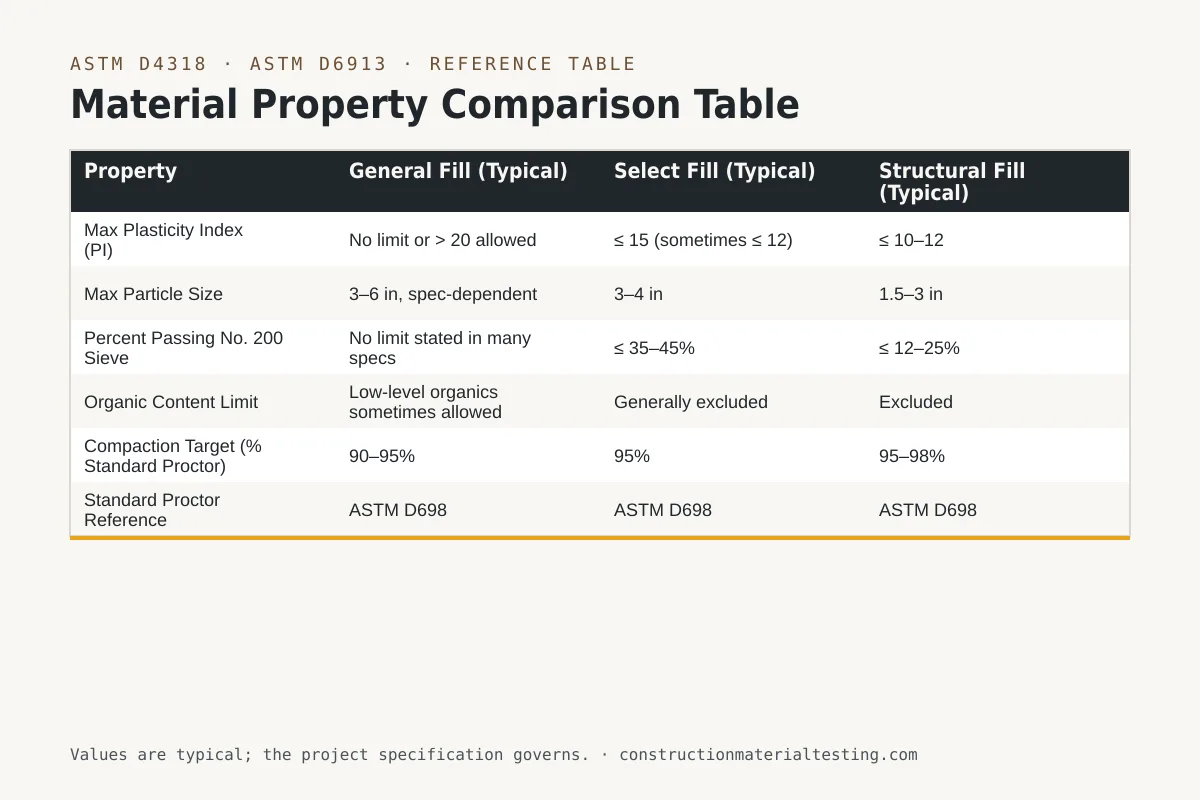
The table below summarizes the typical property ranges associated with each fill classification. These ranges reflect common practice across Texas municipal and TxDOT-aligned specifications and should be read as representative starting points, not as a substitute for the actual specification governing your project. Always verify the controlling document—geotechnical report, project specification, and agency standard—before purchasing or placing fill.
One point the table cannot capture is interaction effects. A material can have a PI of 14 (within select fill limits) but still fail gradation because it contains too many oversized particles or too high a fines content. Both criteria must be satisfied simultaneously. This is why source approval testing runs both Atterberg limits and gradation on the same sample set, not one or the other.
| Property | General Fill (Typical) | Select Fill (Typical) | Structural Fill (Typical) |
|---|---|---|---|
| Max Plasticity Index (PI) | No limit or > 20 allowed | ≤ 15 (sometimes ≤ 12) | ≤ 10–12 |
| Max Particle Size | 3–6 in, spec-dependent | 3–4 in | 1.5–3 in |
| Percent Passing No. 200 Sieve | No limit stated in many specs | ≤ 35–45% | ≤ 12–25% |
| Organic Content Limit | Low-level organics sometimes allowed | Generally excluded | Excluded |
| Compaction Target (% Standard Proctor) | 90–95% | 95% | 95–98% |
| Standard Proctor Reference | ASTM D698 | ASTM D698 | ASTM D698 |
Testing Frequency: How Often Samples Must Be Taken
Testing frequency is probably the most misunderstood part of fill specification compliance. Contractors often assume a single Proctor test covers all fill placed on a project, or that in-place density testing is spot-checked at the inspector's discretion. In reality, frequency requirements are driven by the fill category, the application, the volume or area of placement, and the governing standard or specification—and they can require far more testing than a contractor has budgeted for.
For source approval, a common requirement is one full index test suite (Atterberg limits, gradation, and Proctor) for each distinct material source or borrow location, with reconfirmation testing required if the source changes visually or if volume thresholds are exceeded. TxDOT specifications often require retesting at defined yardage intervals. Municipal and private project specifications may require reconfirmation every 1,000 to 5,000 cubic yards. We recommend establishing the retest trigger in writing during pre-construction rather than waiting for the inspector to call for it mid-pour.
In-place density testing frequency during placement varies similarly. Our technicians reference the project specification first; if it is silent, we default to the geotechnical report's recommendation. Where neither document addresses frequency, common professional practice for structural and select fill zones is one nuclear density test per 2,500 square feet per lift at minimum, with additional tests in areas of concern—soft spots, areas near structures, or zones where lift thickness varied from plan. For general fill, frequency is often reduced to one test per 5,000 square feet per lift, but never eliminated entirely.
| Testing Event | General Fill | Select Fill | Structural Fill |
|---|---|---|---|
| Source Approval (Proctor, PI, Gradation) | Recommended but sometimes waived | Required per source | Required per source |
| Reconfirmation Testing (PI + Gradation) | Infrequent or waived | Every 1,000–5,000 CY or per spec | Every 500–2,000 CY or per spec |
| In-Place Density per Lift | 1 test per 5,000 SF minimum | 1 test per 2,500–5,000 SF | 1 test per 2,000–2,500 SF |
| Proctor (Moisture-Density Curve) | 1 per material type | 1 per material type; retest if material changes | 1 per material type; retest if material changes |
| Atterberg Limits (PI) | Source approval | Source approval + reconfirmation | Source approval + reconfirmation |
| Gradation (Sieve Analysis) | Source approval | Source approval + reconfirmation | Source approval + reconfirmation |
Source Approval: The Step That Happens Before the Trucks Roll
Source approval is the process by which a fill material is evaluated and accepted for use on a specific project before it is delivered to the site. It is not optional on any project with a meaningful earthwork specification, yet it is skipped or compressed more often than any other step in the fill compliance process. The result is material arriving on site that does not meet the specification, leading to either a forced rejection and re-haul or—more commonly—placement of non-conforming material that is discovered later during final testing or after settlement occurs.
A proper source approval submission typically includes the borrow location or commercial quarry identification, representative samples collected from across the source (not just one spot at the surface), and laboratory results for gradation per ASTM D6913, Atterberg limits per ASTM D4318, and a Standard Proctor moisture-density relationship per ASTM D698. The geotechnical engineer of record reviews the results against the specification and issues approval or rejection in writing. This approval is source-specific—if the contractor switches borrow pits mid-project, the new source requires its own approval.
From our laboratory's standpoint, the fastest source approval turnarounds happen when contractors submit samples early with clear project specification requirements attached. When a sample arrives labeled only 'select fill sample' without the governing spec, we have to run the full index suite and still cannot confirm conformance because we do not know what limits apply. Including the spec section, the project name, and the required limits when submitting samples eliminates one round of back-and-forth and keeps the approval on schedule.
Compaction Verification and Lift Thickness in Practice
Compaction is the primary quality output of fill placement—it is why the fill classification and material testing exist in the first place. Every material category requires compaction verification, and the field procedure is consistent across categories: establish the moisture-density relationship with a Standard Proctor test in the laboratory, then measure in-place dry density at the field lift and express it as a percentage of the lab maximum. Results below the specified minimum (typically 95 percent of standard Proctor for select and structural fill) require rework before the next lift is placed.
Lift thickness limits are tied to compaction equipment capability and are stated in the specification, not improvised in the field. Most earthwork specifications allow 8-inch loose lifts for general fill placed with standard pad-foot or vibratory equipment, and 6-inch loose lifts for select and structural fill in confined areas like utility trenches or footing backfill. Exceeding lift thickness is one of the leading causes of failing density tests in the middle and lower portions of a lift. When we see a pattern of failures at consistent depths, lift thickness is the first variable we ask the contractor about. Our materials testing services include field density testing, moisture content determination, and coordination with the laboratory for same-shift Proctor comparisons within the Houston metro area.
Moisture control is the other half of the compaction equation. Fill compacted too dry of optimum moisture will achieve target density temporarily but may swell later if it gains moisture. Fill compacted too wet of optimum produces low density readings in the field and may not improve with additional roller passes. For select fill zones in high-plasticity clay regions, we often see contractors fighting moisture during wet seasons because the material arrives at the site already above optimum. Aeration—discing and allowing evaporation before rolling—is usually required, and placement may need to pause until moisture falls within the acceptable window defined by the Proctor curve and project specification.
Edge Cases: When Material Does Not Fit a Clean Category
Fill materials do not always fall neatly into one of the three categories. Crushed concrete or recycled asphalt pavement is increasingly used as a substitute for select fill in pavement subbase applications; it can meet gradation limits but may not have a well-defined Proctor relationship, and PI testing is not applicable to granular materials. When a project specification allows or excludes recycled material, that determination must be explicit—default material specs written around natural soil may not address recycled aggregate at all, leaving a gap that requires a project-specific determination from the geotechnical engineer.
Caliche, which is common across much of Texas, presents a different edge case. It often meets gradation and PI limits for select fill in its quarried form, but it can be moisture-sensitive and may slake when wetted during construction. Source approval testing should include slake durability evaluation if caliche is proposed for select fill zones, and the Proctor test must account for the material's tendency to break down under compaction energy. Using a caliche Proctor curve developed at initial testing on unbroken particles, then comparing field density on material that has partially slaked, produces unreliable results.
Engineered fill—material that is processed, blended, or amended to meet a specification—is another category that requires careful handling. Lime-treated or cement-treated subgrade is not the same as untreated structural fill and should not be tested against a standard Proctor curve for untreated soil. If the specification calls for treated material, a separate treated-material Proctor and an unconfined compressive strength test are needed to establish the correct acceptance criteria. Mixing testing protocols between treated and untreated material is an error we see on projects where the earthwork contractor and the geotechnical testing team are not communicating clearly before work begins.
Documentation and Nonconformance Response
Every test result—source approval, in-place density, moisture content, reconfirmation index test—becomes a project record. Special inspection for earthwork under IBC Chapter 17 requires that failing results be reported to the engineer of record and the owner promptly, not held until end-of-project reporting. The specific reporting requirements are set by the approved inspection program, but the underlying obligation is the same: a failing result triggers a required action before work proceeds, and that action must be documented.
When a density test fails, the required response is rework—additional rolling, moisture adjustment, or in some cases excavation and replacement of the lift. A failing result cannot be averaged with passing results from adjacent test locations to produce an acceptable mean. Each test location represents a discrete area of the fill, and that area must meet the minimum independently. After rework, a retest at the same location confirms correction. Both the original failing result and the passing retest result stay in the project record; the failing test is not erased.
PI or gradation failures on source approval or reconfirmation testing have a different response path. The non-conforming material is rejected and must not be placed in the fill zone for which it was tested. If it has already been placed, the engineer of record determines whether it must be excavated or whether the affected zone can be redesigned around the as-placed material properties—a determination that involves both cost and schedule impact and rarely resolves in the contractor's favor. The lesson from repeated field experience is that source testing is not a bureaucratic step; it is the mechanism that prevents the far more expensive rejection-after-placement scenario.
Where This Fits on Your Project
Whether you are a contractor managing an earthwork sub, a structural engineer reviewing a geotechnical report, or an owner trying to understand why your testing budget looks the way it does, the fill classification system exists to make performance predictable. The testing—gradation, Atterberg limits, Standard Proctor, and in-place density—is not red tape. It is the chain of evidence that connects the material specification to what is actually in the ground under your structure.
Our field and laboratory teams handle source approval sampling, moisture-density testing, and lift-by-lift density verification across the full range of fill categories described in this guide. If you are in the planning stage and want to understand what testing will be required for your specific earthwork specification, or if you are mid-project and have a nonconformance you need resolved quickly, reach out through our project proposal request page and a technician will follow up with specifics for your scope.
Get our guides in your Google results
Add Construction Materials Testing as a preferred source and Google shows our guides more often when you search for testing topics.