
What aggregate sieve analysis actually tells you
Aggregate sieve analysis is a particle-size distribution test: it tells you what fraction of an aggregate sample is retained on each of a series of nested wire-cloth sieves. The result is expressed as cumulative percent passing each sieve size, and that profile is what mix designers, inspectors, and specification writers care about. A gradation that falls outside specified limits changes paste demand, workability, bleed rate, and long-term durability — all before the first batch ever leaves the plant.
The two standards that govern this work are ASTM C136, which covers the mechanical sieving procedure, and ASTM C117, which prescribes wet washing to capture particles finer than 75 µm (the No. 200 sieve) that dry sieving cannot reliably separate. Neither standard alone gives you the complete picture for aggregates that carry clay, silt, or crusher dust. We run both together as a matter of course, and the sequence matters: wash first, dry second.
Understanding what each standard measures — and why the two are paired — is the right starting point before walking through the procedure itself.
Sampling: where gradation accuracy is won or lost
No laboratory procedure recovers information that was lost at the sampling stage. Aggregate segregates during transport and stockpiling — coarse particles roll to the edges and bottom of a pile while fines concentrate near the top. A single scoop taken from one location on a stockpile is not a representative sample; it is a point measurement that may be wildly unrepresentative of the material going into concrete.
We follow ASTM D75 protocols for field sampling, which require taking multiple increments from different locations and combining them into a single field sample. From that field sample, we reduce to a test portion using a mechanical splitter or the quartering method. The minimum test-portion mass is specified in C136 and is a function of the nominal maximum aggregate size — for a 37.5 mm (1½ in) top-size coarse aggregate, C136 requires at least 15 kg before splitting; for fine aggregate, the requirement drops considerably but precision still demands care. Using an undersized sample is a protocol failure, not a shortcut. Our aggregate sampling and testing services cover field splitting procedures in more detail.
Moisture condition matters too. The sample should arrive at the lab in a sealed container that prevents both moisture loss and contamination. If the aggregate will be washed per C117, the initial moisture state is less critical because we dry to constant mass before the wash anyway — but clay lumps that have already crumbled or dried out during transit can skew the minus-200 fraction.
Running the No. 200 wash (ASTM C117) before you touch the sieves
Fine particles smaller than 75 µm — clays, silts, and dust of fracture — have a tendency to coat coarser particles and to agglomerate. During dry mechanical sieving, some of this material stays stuck to the larger aggregate surface and never reaches the No. 200 sieve. The wash procedure in ASTM C117 breaks that coating loose. We place the dried, weighed test portion in a container, cover it with water, agitate, and then decant the wash water through a No. 200 sieve, catching everything that passes. We repeat until the wash water runs clear.
What comes off is often surprising. A washed aggregate sample and an identical unwashed sample sieved dry can differ by several percentage points in minus-200 content. Because ASTM C33 sets cleanliness limits on the minus-200 fraction — typically no more than 3% for fine aggregate used in concrete subject to abrasion, and tighter limits for certain coarse aggregates — that difference has real specification consequences. Dry sieving alone would let a noncompliant aggregate appear to pass.
After washing, we return the retained material to a pan, dry it in an oven at 110 ± 5 °C to constant mass, record the dried mass, and calculate the percent finer than 75 µm: it is simply the mass lost during washing divided by the original dry mass, expressed as a percentage. That washed and dried sample then becomes the test portion for the C136 dry sieve sequence that follows.
The combined procedure — C117 wash followed by C136 sieving — is what most project specifications reference when they call for a 'washed sieve analysis.' The ASTM C117 test method page on our site walks through the wash procedure in standalone detail if you need to understand it outside the context of a full gradation.
The ASTM C136 dry sieve procedure step by step
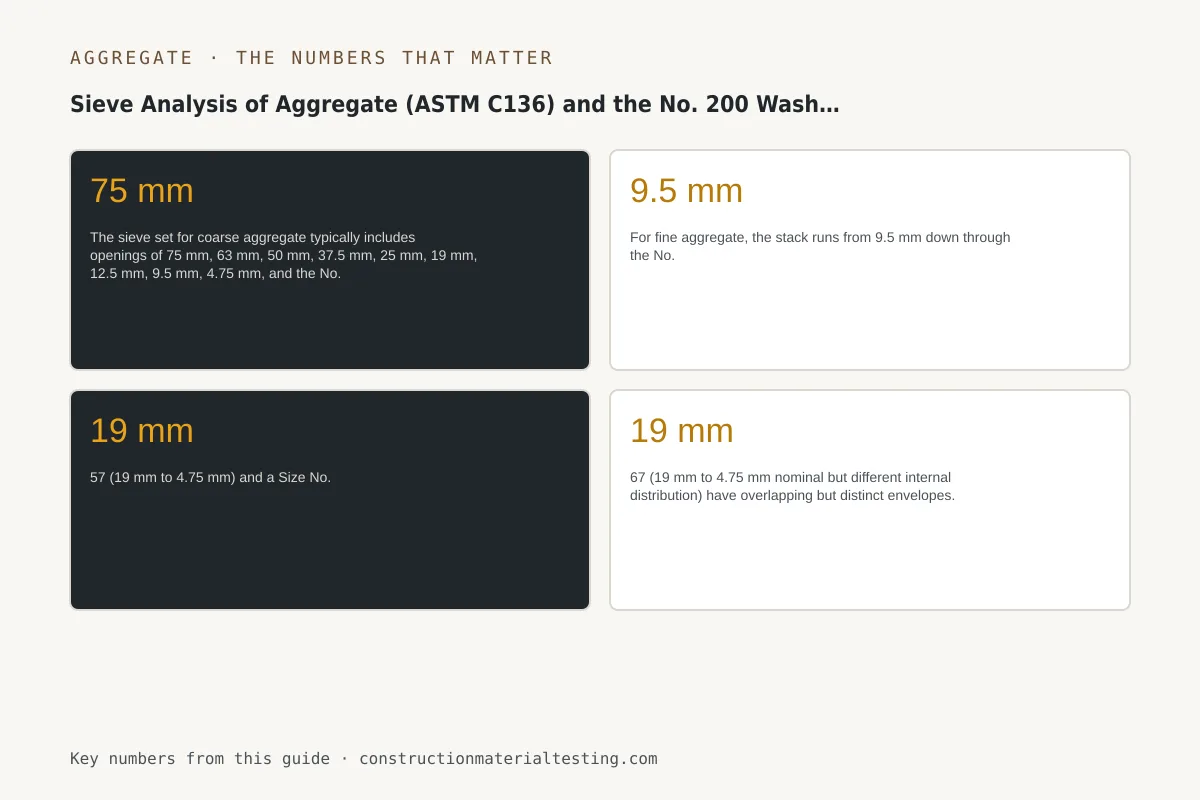
With the washed and dried test portion ready, we assemble the sieve stack in descending order — largest opening on top — and place it on the mechanical shaker. The sieve set for coarse aggregate typically includes openings of 75 mm, 63 mm, 50 mm, 37.5 mm, 25 mm, 19 mm, 12.5 mm, 9.5 mm, 4.75 mm, and the No. 200 at the bottom, with a pan below that. For fine aggregate, the stack runs from 9.5 mm down through the No. 4, No. 8, No. 16, No. 30, No. 50, No. 100, and No. 200. C136 specifies a sieving period adequate to reach the endpoint: no more than 0.5% of the total sample mass passes any individual sieve during 1 additional minute of hand sieving. We verify this for every test.
After shaking, we weigh the material retained on each sieve and in the pan. The sum of all retained masses plus the pan mass should equal the original test-portion mass within a tolerance — C136 allows a discrepancy of no more than 0.3% of the original sample mass. When that check fails, it usually means material was lost during the wash, retained on a damaged sieve wire, or the sample was not fully dry before weighing. We do not report results from a run that fails the mass-balance check; we investigate and re-run.
From the individual retained masses we calculate cumulative percent retained and cumulative percent passing for each sieve. Those numbers get compared directly against the gradation limits in ASTM C33 or the project specification, whichever is more restrictive. Our ASTM C136 test method page lists the standard sieve sizes and common test portion masses for reference.
Reading ASTM C33 gradation bands and calculating fineness modulus
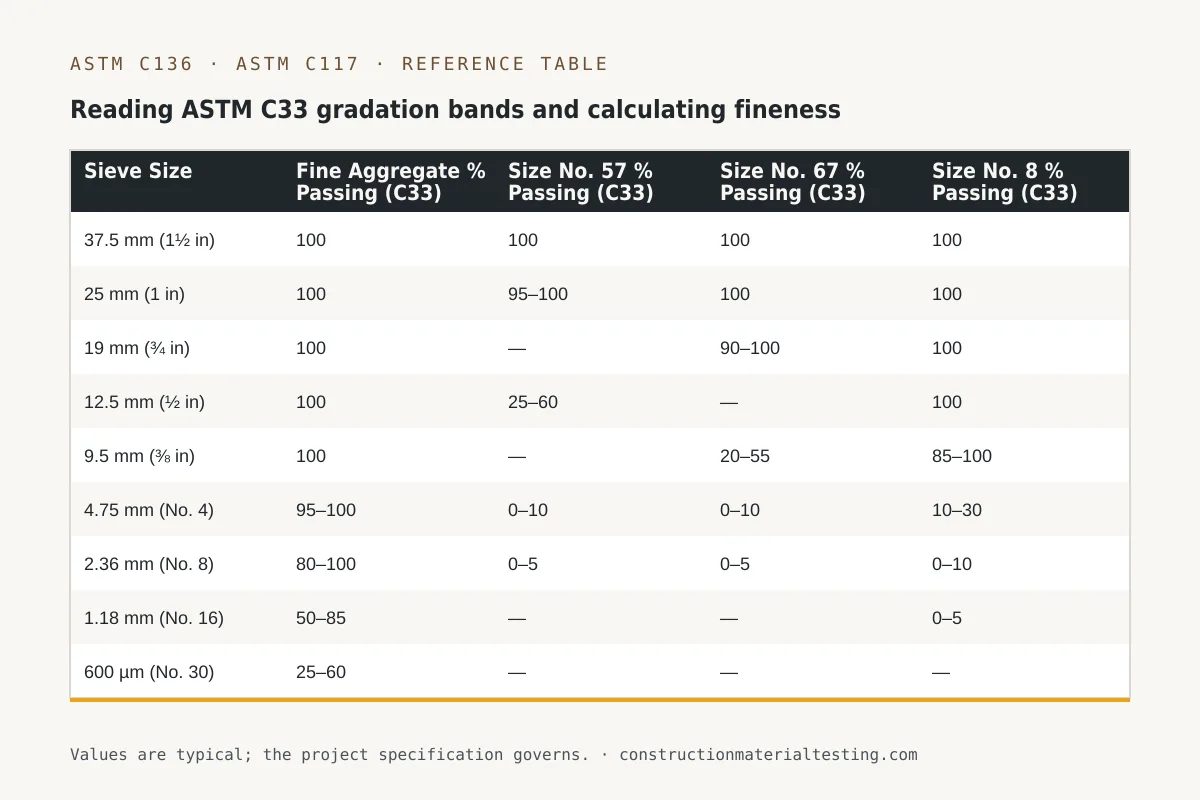
ASTM C33 provides separate gradation envelopes for fine aggregate and for each of eleven coarse aggregate size numbers (Size No. 1 through Size No. 8, plus several others). Specifying 'C33 coarse aggregate' without naming the size number is incomplete — a Size No. 57 (19 mm to 4.75 mm) and a Size No. 67 (19 mm to 4.75 mm nominal but different internal distribution) have overlapping but distinct envelopes. The table below shows the C33 gradation limits for fine aggregate and for the most commonly specified coarse size numbers on structural concrete projects.
Fineness modulus (FM) applies only to fine aggregate. It is calculated by summing the cumulative percentages retained on the following standard sieves — 150 µm (No. 100), 300 µm (No. 50), 600 µm (No. 30), 1.18 mm (No. 16), 2.36 mm (No. 8), and 4.75 mm (No. 4) — and dividing that total by 100. A higher FM means a coarser sand; a lower FM means a finer sand. ACI 318 mix design provisions and most ready-mix specifications target FM between 2.3 and 3.1 for fine aggregate intended for concrete. FM outside that band is not an automatic rejection, but it is a flag that the mix design proportions may need adjustment to maintain workability and water demand. Report FM to the nearest 0.01.
The gradation band chart illustrates how results plot against the C33 envelope in a way that a table of numbers cannot communicate as quickly. When a gradation trace hugs the coarse edge of the band, the mix will be harsh and prone to segregation. When it hugs the fine edge, water demand rises and shrinkage risk increases. The ideal trace threads the middle of the envelope with reasonable consistency from test to test.
| Sieve Size | Fine Aggregate % Passing (C33) | Size No. 57 % Passing (C33) | Size No. 67 % Passing (C33) | Size No. 8 % Passing (C33) |
|---|---|---|---|---|
| 37.5 mm (1½ in) | 100 | 100 | 100 | 100 |
| 25 mm (1 in) | 100 | 95–100 | 100 | 100 |
| 19 mm (¾ in) | 100 | — | 90–100 | 100 |
| 12.5 mm (½ in) | 100 | 25–60 | — | 100 |
| 9.5 mm (⅜ in) | 100 | — | 20–55 | 85–100 |
| 4.75 mm (No. 4) | 95–100 | 0–10 | 0–10 | 10–30 |
| 2.36 mm (No. 8) | 80–100 | 0–5 | 0–5 | 0–10 |
| 1.18 mm (No. 16) | 50–85 | — | — | 0–5 |
| 600 µm (No. 30) | 25–60 | — | — | — |
| 300 µm (No. 50) | 5–30 | — | — | — |
| 150 µm (No. 100) | 0–10 | — | — | — |
| 75 µm (No. 200) | ≤3 (or ≤5*) | — | — | — |
Common failures, interpretation pitfalls, and how inspectors use the data
A gradation that fails one interior sieve while passing all others is common and usually traceable to stockpile segregation rather than a production problem at the quarry. Before triggering a source rejection, special inspectors and project engineers should request a retest on a fresh, independently sampled portion. If the retest also fails, the conversation shifts to the aggregate supplier. Our materials testing services include source-approval gradation testing that can establish a baseline before material is delivered to site.
The minus-200 fraction is the most consequential single data point for durability. Clay particles in that fraction are expansive and reduce the bond between paste and aggregate. Crusher dust from manufactured fine aggregate is less harmful but still increases water demand. Distinguishing the two requires a sand equivalent or methylene blue test, not sieve analysis alone — but C117 is always the first screen. If a sample passes the C33 minus-200 limit comfortably on a washed analysis, additional fines testing is rarely needed. If it is borderline or fails, further investigation is warranted before accepting the material.
Inspectors working under IBC Chapter 17 special inspection programs will encounter gradation testing as part of concrete batch-plant inspection. The frequency of gradation sampling is set by the project's inspection program or the engineer of record, not by C136 itself. Results feed directly into mix design verification — if gradation shifts meaningfully from the mix design assumption, the mix designer needs to know so proportions can be adjusted before a strength problem appears in core or cylinder results weeks later.
Where aggregate sieve analysis fits on your project
Gradation testing is not a one-time approval event. Aggregate sources change over time, stockpile management varies by season, and deliveries to a busy project site are not always from the same source lot that was originally approved. Routine sieve analysis — run at a frequency tied to the volume of concrete being placed and the exposure class of the structure — is the mechanism that catches drift before it affects the finished work.
Whether you need source approval testing ahead of bid, batch-plant verification during production, or dispute resolution on a material that has already been placed, we can help. Our ASTM C136 test method page and ASTM C117 test method page describe what to expect from each procedure in detail. If you are ready to discuss a testing scope for your project, submit a proposal request and one of our technicians will follow up with a testing plan matched to your specification requirements and project schedule.
Get our guides in your Google results
Add Construction Materials Testing as a preferred source and Google shows our guides more often when you search for testing topics.