
What the LA Abrasion Test Actually Measures
The la abrasion test quantifies how much a coarse aggregate sample degrades when subjected to abrasion, impact, and grinding inside a rotating steel drum. The result — expressed as percent loss by mass — gives engineers a single number that reflects the aggregate's resistance to the mechanical breakdown it will experience during mixing, compaction, and service. ASTM C131 is the governing standard for small-size coarse aggregate (nominal maximum size ≤ 37.5 mm); results are used to qualify material for base course, subbase, and portland cement concrete. You can read the full scope of the method at our ASTM C131 test method page.
The machine itself is a hollow steel cylinder, roughly 500 mm in diameter and 500 mm in length, mounted horizontally on a shaft. A steel shelf inside the drum picks up the aggregate and steel spheres and drops them approximately every revolution, creating repeated impact. After the specified number of revolutions, the sample is wet-sieved over a No. 12 (1.70 mm) sieve, the retained fraction is dried and weighed, and the mass lost through that sieve — both by abrasion and impact fracture — becomes the reported percent loss.
Grading Groups, Steel Charge, and Revolution Count
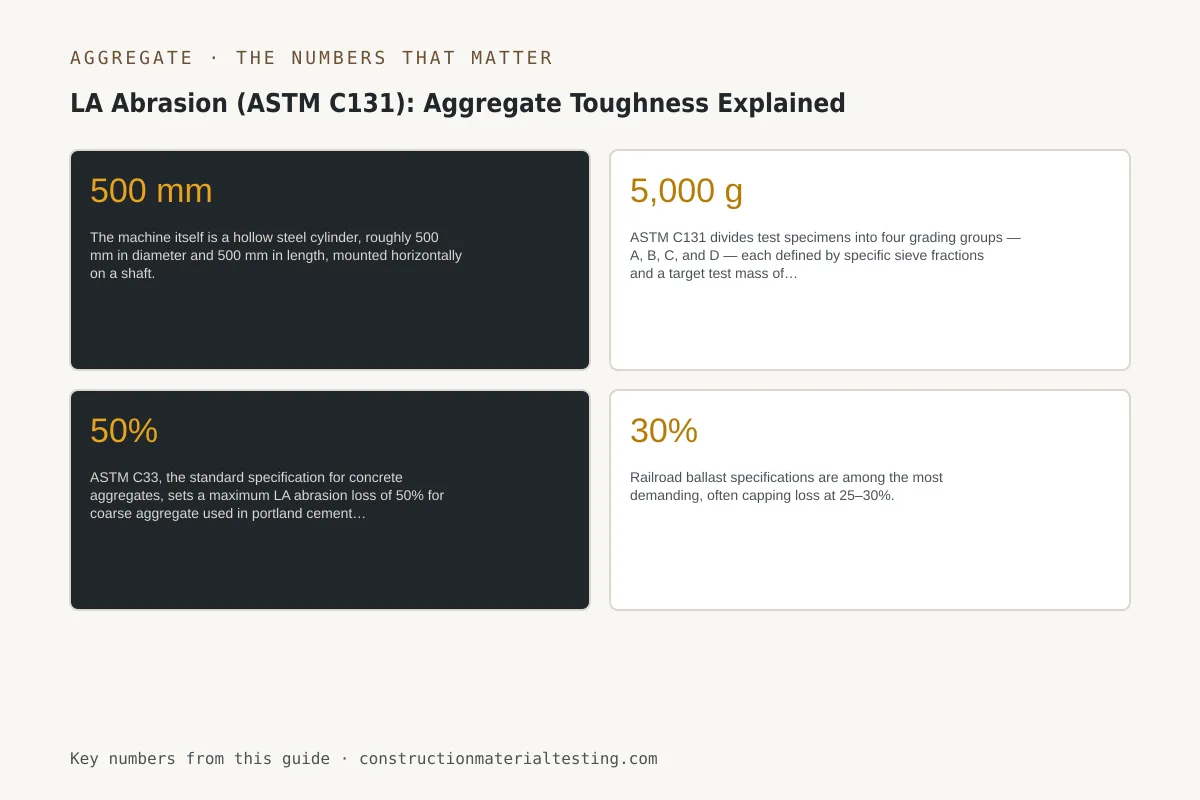
ASTM C131 divides test specimens into four grading groups — A, B, C, and D — each defined by specific sieve fractions and a target test mass of 5,000 g ± 10 g. Grading A uses aggregate passing 37.5 mm and retained on 19.0 mm and smaller sieves in proportions stated in the standard's Table 1; Grading D uses material passing 9.5 mm and retained on 4.75 mm. Because the aggregate size controls how effectively the steel spheres can impact the particles, the number of spheres loaded into the drum scales with the grading group: Grading A uses 12 spheres (mass 5,000 ± 25 g), while Grading D uses 6 spheres (mass 2,500 ± 15 g). Gradings B and C use 11 and 8 spheres, respectively.
The drum runs at 30–33 rpm for 500 revolutions for most applications. That revolution count is standard for percent-loss determination. Some agency specifications reference 100-revolution results for a preliminary degradation index, but unless the project documents explicitly request the 100-revolution reading, 500 revolutions is the default. Before we can assign a grading group, we need a gradation on the stockpile — which is why ASTM C136 sieve analysis is typically run first. If the sample's grading doesn't fit neatly into one of the four groups, the material may need to be proportioned to match a specified gradation, or the test may not be applicable as received.
LA Abrasion Loss Limits: Base Course vs. Concrete Aggregate
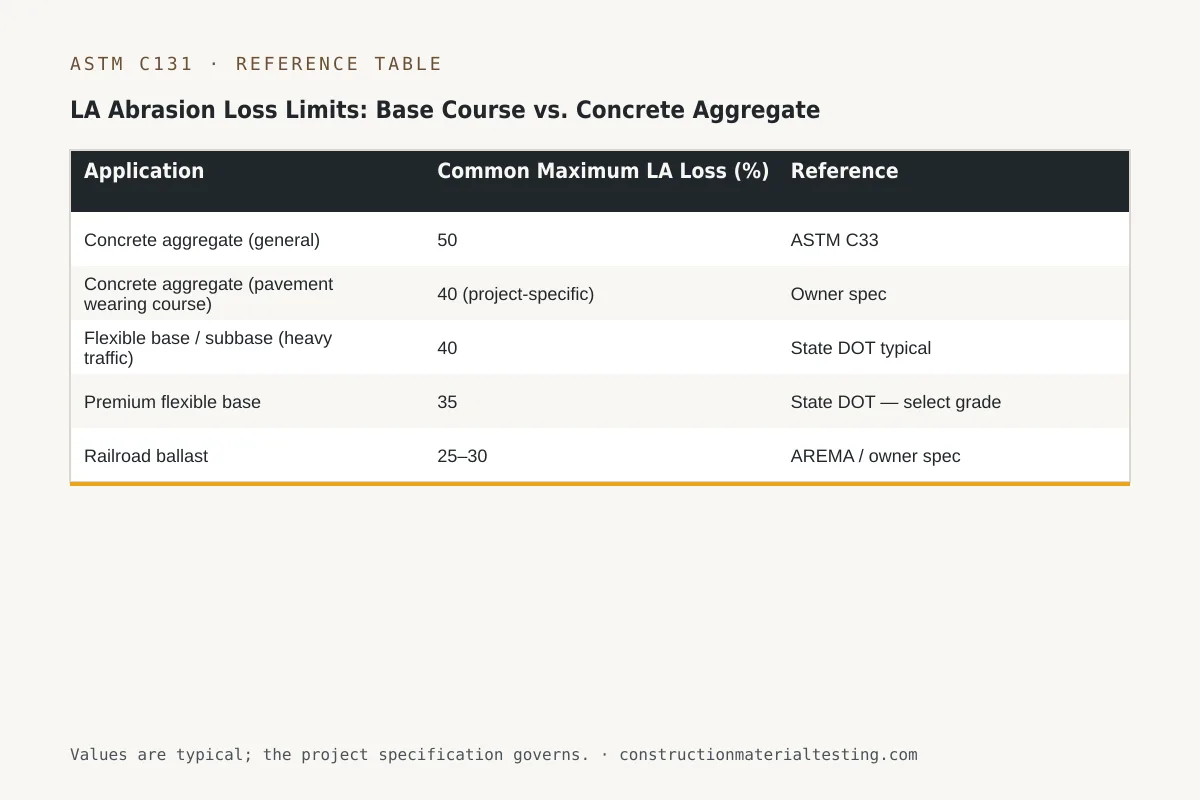
Acceptable percent loss depends entirely on end use, and limits vary between material specifications and owner agencies. ASTM C33, the standard specification for concrete aggregates, sets a maximum LA abrasion loss of 50% for coarse aggregate used in portland cement concrete. That limit is relatively permissive because concrete encapsulates the aggregate, limiting further abrasion in service. For wearing-surface concrete or high-traffic pavement, project-specific requirements are often tighter — commonly 40% or less — especially where freeze-thaw durability is also a concern.
Base course and subbase applications typically carry stricter limits because aggregate particles are exposed to direct compaction stress and ongoing traffic-induced movement without a binding matrix. TxDOT and most other state DOT specifications for flexible base require LA abrasion loss no greater than 40% for heavily trafficked layers, and some premium base classifications require 35% or less. Railroad ballast specifications are among the most demanding, often capping loss at 25–30%. Our materials testing services cover the full range of these agency requirements, so we know which limit applies before we run the test rather than after.
| Application | Common Maximum LA Loss (%) | Reference |
|---|---|---|
| Concrete aggregate (general) | 50 | ASTM C33 |
| Concrete aggregate (pavement wearing course) | 40 (project-specific) | Owner spec |
| Flexible base / subbase (heavy traffic) | 40 | State DOT typical |
| Premium flexible base | 35 | State DOT — select grade |
| Railroad ballast | 25–30 | AREMA / owner spec |
Where This Fits on Your Project
An LA abrasion result without a gradation is incomplete — if the aggregate doesn't meet the grading requirements that define the charge and test mass, the number is meaningless against a specification. We run ASTM C131 alongside gradation and, where the spec requires it, soundness and flat-and-elongated testing as a coordinated aggregate qualification package. For projects sourcing from multiple quarries or switching suppliers mid-job, retesting each new source is not optional — the same aggregate class from different sources can vary by 10 percentage points or more in LA loss.
If you have an aggregate source that needs qualification, a base course that failed inspection, or a mix design aggregate approval pending, submit a proposal request and include the applicable specification or agency name. We'll confirm which grading group applies, turn around the test, and report the result against your specific acceptance limit.
Get our guides in your Google results
Add Construction Materials Testing as a preferred source and Google shows our guides more often when you search for testing topics.