
Why a Concrete Mix Design Review Happens Before Anything Is Batched
The mix design submittal is one of the few quality-control opportunities where a problem can be resolved entirely on paper. Once concrete is in the truck, the batch is the batch. A producer cannot retroactively lower the water-to-cementitious-materials ratio or swap a coarse aggregate gradation. The only leverage the engineer, contractor, and special inspector have is the review that happens before the first scheduled pour — and that review has a defined scope governed by the project specification, ACI 318, and ASTM C94, the standard specification for ready-mixed concrete.
In practice, submittals arrive with varying levels of completeness. Some producers include full trial-batch data with cylinder breaks at 7, 28, and 56 days, aggregate gradation curves, and admixture technical data sheets. Others submit a one-page batch ticket summary and assume approval will follow. Our job as the reviewing technicians and laboratory staff is to define what constitutes a complete submittal and to work through it systematically — the same way every time — so nothing falls through the cracks under schedule pressure.
This guide walks through the review in the order we actually do it: starting with the exposure classification and specification requirements, moving through the fresh-concrete properties, the cementitious content and SCM limits, the admixture list, and finally the historical strength data. The table in the next section shows the key parameters and where their limits come from.
Reading the Specification Before You Read the Submittal
Before you open the C94 submittal, you need to know what it is being compared against. Pull the structural drawings, the project specification section covering concrete (typically a Division 03 section), and the applicable portions of ACI 318. The spec will identify the exposure classes for each element — footings, slabs, walls, columns — and those classes drive the maximum w/cm, minimum cementitious content, minimum air content, and minimum specified compressive strength that apply to each mix. ACI 318 Table 19.3.3.1 organizes exposure categories (F for freezing and thawing, S for sulfate, W for water permeability, C for corrosion protection of reinforcement), and each category has severity levels with discrete limits. A coastal tilt-wall panel in an aggressive chloride environment carries completely different requirements than an interior slab-on-grade, even if the owner asked for the same 4,000 psi on both.
In Southeast Texas, the sulfate and chloride exposure classes often govern rather than the freeze-thaw categories, but that determination belongs to the engineer of record. Our role in the review is to verify that the mix as submitted satisfies the limits the engineer has already established. If the spec is silent on exposure class or does not reference ACI 318 Chapter 19 at all, that is itself a flag worth raising with the engineer before approval moves forward. Approving a submittal against an incomplete benchmark is a gap in the quality system, not a shortcut.
Document the applicable limits for each mix designation before you mark a single line on the submittal. If the project has six mix designs — a foundation mix, a slab mix, a wall mix, and so on — each one needs its own reference column. Reviewers who skip this step tend to catch strength and slump but miss the exposure-driven durability requirements, which are often the more consequential omission.
What the Concrete Mix Design Review Checks: Parameter by Parameter
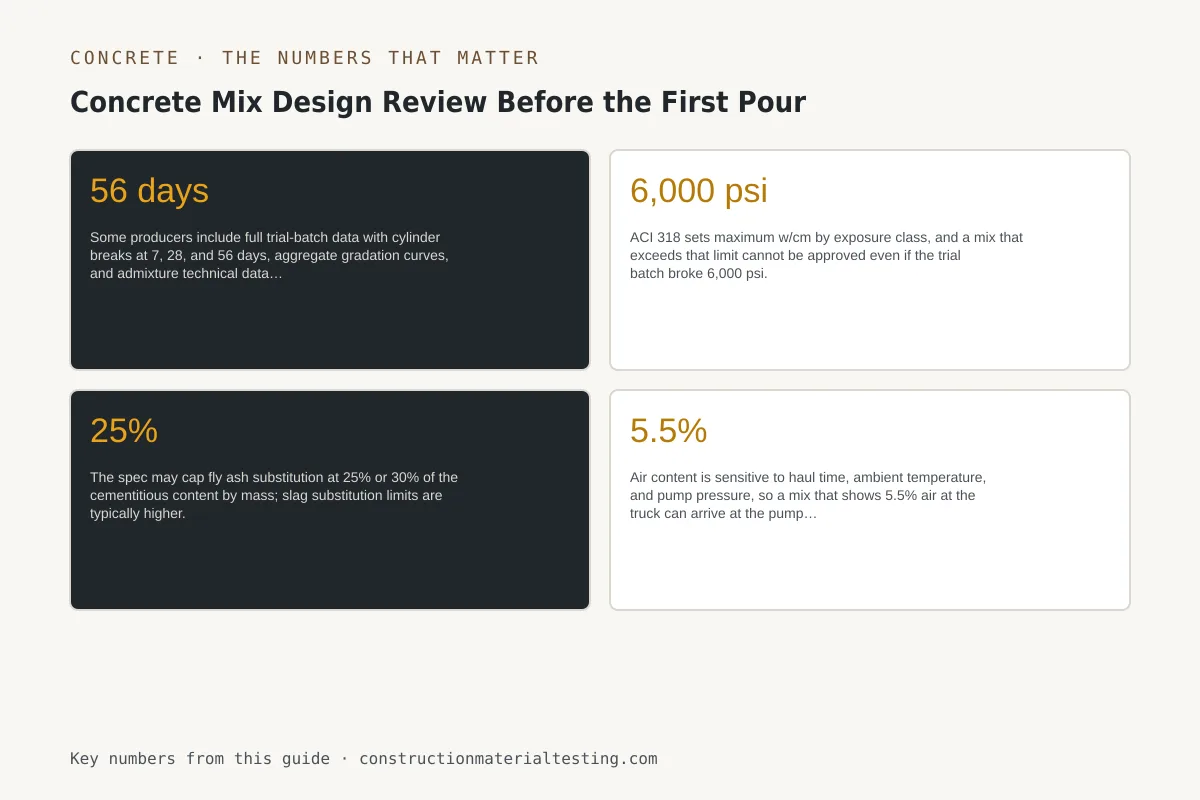
The w/cm ratio is the first hard number we verify, and it is non-negotiable regardless of what the 28-day strength shows. ACI 318 sets maximum w/cm by exposure class, and a mix that exceeds that limit cannot be approved even if the trial batch broke 6,000 psi. High strength can coexist with a porous paste structure if the water content is too high relative to the cementitious material — and that porosity is what allows aggressive ions to penetrate the concrete over time. Calculate the w/cm from the batch weights shown on the submittal, not from the producer's stated value. Divide the total water content (including ice and free moisture on aggregates if shown) by the total cementitious content. If those numbers match the producer's label, you have confirmation. If they do not, ask for a corrected submittal.
Air content requirements depend on the exposure class and the nominal maximum aggregate size. The spec may prescribe a target value and a field tolerance, but ACI 318 also sets minimums for freeze-thaw exposure. In the Gulf Coast region, freeze-thaw is rarely the controlling concern, but some project specifications import the ACI 318 air table regardless. For mixes where air entrainment is specified, the review should confirm that an air-entraining admixture is listed, that it carries an ASTM C260 qualification, and that the dosage shown is consistent with achieving the target air content at the stated slump. Field verification using ASTM C231 pressure meter testing on the first loads is how you confirm the mix performs as submitted.
Supplementary cementitious materials — fly ash, slag cement, silica fume, natural pozzolans — must be evaluated against both the specification limits and the applicable ASTM material standard. The spec may cap fly ash substitution at 25% or 30% of the cementitious content by mass; slag substitution limits are typically higher. If the mix uses both fly ash and slag simultaneously, some specs apply a combined SCM limit. Verify the SCM type against the ASTM designation shown on the submittal: Class C and Class F fly ash behave differently with respect to sulfate resistance, and that distinction matters in the exposure classes common to this region. Also check that the producer has included the SCM in the cementitious content denominator when calculating w/cm — some submittals carry it as a separate line and then compute w/cm against cement only, which produces an artificially favorable ratio.
The admixture list should identify each product, its ASTM standard qualification (C494 for chemical admixtures, C260 for air entraining, C1017 for flowing concrete), and the dosage range. Review the technical data sheets when they are provided. Incompatibilities between admixtures — particularly certain retarders combined with accelerators — occasionally appear in submittals where a producer has templated from a prior project without reconsidering the combination. Flag any admixture that lacks a documented ASTM qualification or whose dosage exceeds the manufacturer's published limit.
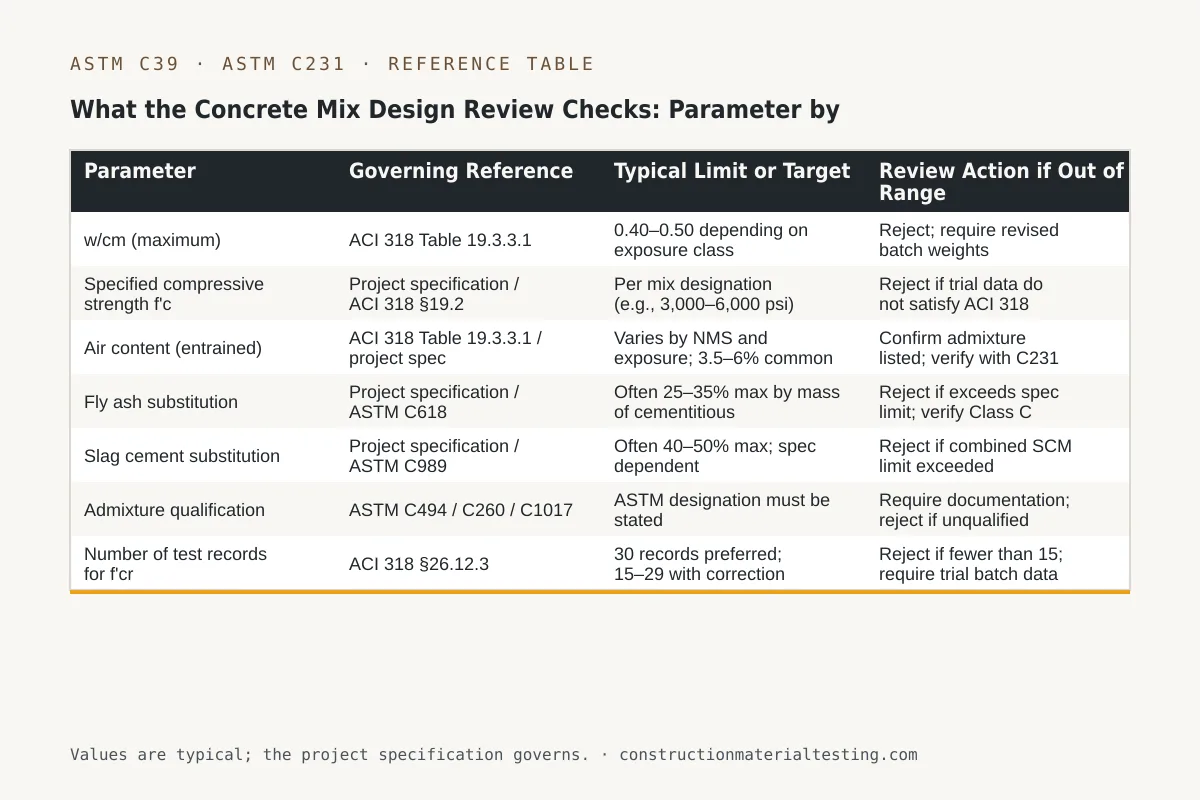
| Parameter | Governing Reference | Typical Limit or Target | Review Action if Out of Range |
|---|---|---|---|
| w/cm (maximum) | ACI 318 Table 19.3.3.1 | 0.40–0.50 depending on exposure class | Reject; require revised batch weights |
| Specified compressive strength f'c | Project specification / ACI 318 §19.2 | Per mix designation (e.g., 3,000–6,000 psi) | Reject if trial data do not satisfy ACI 318 §26.12 |
| Air content (entrained) | ACI 318 Table 19.3.3.1 / project spec | Varies by NMS and exposure; 3.5–6% common | Confirm admixture listed; verify with C231 in field |
| Fly ash substitution | Project specification / ASTM C618 | Often 25–35% max by mass of cementitious | Reject if exceeds spec limit; verify Class C vs. F |
| Slag cement substitution | Project specification / ASTM C989 | Often 40–50% max; spec dependent | Reject if combined SCM limit exceeded |
| Admixture qualification | ASTM C494 / C260 / C1017 | ASTM designation must be stated | Require documentation; reject if unqualified |
| Number of test records for f'cr | ACI 318 §26.12.3 | 30 records preferred; 15–29 with correction factor | Reject if fewer than 15; require trial batch data |
Evaluating Historical Strength Data and Trial Batch Records
The required average compressive strength (f'cr) that a mix must target is higher than the specified compressive strength (f'c) to provide a statistical buffer against low test results. ACI 318 Section 26.12.3 sets the method for establishing f'cr. If the producer has 30 or more test records from the same mix or a similar mix produced under similar conditions, they can calculate f'cr using the standard deviation from that record set. If they have 15 to 29 records, the standard deviation is multiplied by a correction factor from the ACI 318 table. Fewer than 15 records are not sufficient for a statistical qualification; in that case, f'cr must be established from trial batch data, and the ACI 318 Table 26.12.3.1(b) margins apply — typically f'c plus 1,200 psi for strengths below 5,000 psi.
When you receive historical strength records with the submittal, check them for the following: the records should come from the same or very similar mix proportions, produced using the same aggregate sources, and tested under a consistent protocol. Records from a different plant, a different aggregate source, or a substantially different cementitious blend are not directly applicable. The ASTM C39 compressive strength test is the basis for all cylinder break records in this evaluation, so the testing lab that generated those records should have followed C39 procedures. Aging of the data matters too — records that are five or more years old may not reflect the current aggregate source or cement mill performance.
Trial batch cylinders are the preferred data set when historical records are thin or inapplicable. A proper trial batch is batched under controlled conditions, sampled at the mixer, and tested at the ages the specification requires — most commonly 28 days, though the project may also require 56-day or 90-day breaks for SCM-rich mixes where strength gain is slower. If the project is on a schedule that does not allow waiting for 28-day trial batch data, the engineer of record needs to make a documented decision about how to proceed, not the inspector.
Common Grounds for Rejection and How to Document Them
A complete concrete mix design review results in one of three outcomes: approval, conditional approval pending specific corrections, or rejection. Conditional approval is appropriate when the issue is administrative — a missing data sheet, an unlabeled aggregate gradation curve — and the technical parameters are otherwise in order. Rejection is required when a parameter falls outside a non-negotiable limit: w/cm exceeds the exposure class maximum, the specified air content is absent for a freeze-thaw exposure, the strength data are insufficient and no trial batch data are offered, or a mix includes an unqualified admixture at an undocumented dosage.
Document every finding in writing, referencing the specific requirement that was not met and the value shown on the submittal. Vague rejection language — 'mix does not meet project requirements' — forces the producer to guess what to correct and delays resubmittal. Specific language — 'w/cm calculated from submitted batch weights is 0.48; project specification Section 03310 and ACI 318 Table 19.3.3.1 for Exposure Class C2 limit w/cm to 0.40; resubmit with revised batch weights or request engineer review of exposure classification' — allows the producer to respond precisely and gets concrete in the ground faster.
Keep a copy of every version of the submittal in the project file alongside the review notes. If a field test later produces a failing cylinder break or a durability issue surfaces, the submittal review record is part of the paper trail that establishes what was approved and on what basis. Our materials testing services are built around documentation discipline as much as technical execution — an accurate record protects the contractor, the engineer, and the owner equally.
Coordinating the Review with Field Testing Before the Pour
The submittal review and the field testing program are two halves of the same quality loop. The review establishes what the concrete is supposed to be; the field testing confirms what it actually is. Before the first pour, the special inspector and the contractor should agree on sampling frequency, the number of cylinders per set, curing conditions, and the testing age schedule. IBC Section 1705 and the project specification typically define the minimum inspection and testing frequency for concrete, but the project structural engineer may impose additional requirements.
For air-entrained mixes, pressure meter testing per ASTM C231 should be performed on the first load of each mix designation and periodically thereafter. Air content is sensitive to haul time, ambient temperature, and pump pressure, so a mix that shows 5.5% air at the truck can arrive at the pump outlet measurably lower. The submittal review should have already confirmed what the target and tolerance are — field testing just closes the loop. For compressive strength, cylinder sets are cast from the same sample used for fresh-concrete testing, cured under field-cured or standard-cured conditions as the spec requires, and transported to the laboratory for testing at the specified ages under ASTM C39 procedures. The American Concrete Institute publishes guidance on both field sampling and interpretation of strength test results that is worth having on hand when questions arise during a pour.
Where This Review Fits on Your Project
A concrete mix design review is most useful when it happens early enough to allow resubmittal without compressing the pour schedule. Submittals that arrive two days before the first truck is scheduled rarely give the producer time to obtain trial batch data or recalculate batch weights and get engineering review. Build the submittal deadline into the project schedule the same way you build in lead time for reinforcing steel or formwork. Our laboratory and field staff review submittals as part of the special inspection scope — we work through each parameter against the project specification and ACI 318, issue written comments, and coordinate with the field testing plan so the first pour has the documentation backing it needs from the first cylinder cast.
If your project is approaching the concrete phase and you need a review scope defined or a testing program established, use our proposal request form to describe the work. Include the number of mix designations, the pour schedule, and the exposure conditions if you know them — that information lets us give you a testing plan that fits the actual project rather than a generic template.
Get our guides in your Google results
Add Construction Materials Testing as a preferred source and Google shows our guides more often when you search for testing topics.