
What IBC Chapter 17 Actually Requires
Special inspection is a code-mandated quality-verification program that sits between the design engineer's drawings and the contractor's field work. The 2021 International Building Code dedicates Chapter 17 entirely to special inspections and tests, establishing when they are required, who performs them, what qualifications those people must hold, and how results flow to the authority having jurisdiction. If your project is permitted under any edition of the IBC—which covers most commercial, industrial, and multi-family construction across the country—Chapter 17 applies unless a specific exemption in Section 1705 removes that obligation.
The fundamental premise is straightforward: for work that is concealed before final inspection or that is structurally critical, the building department cannot rely on its own periodic inspections to verify compliance. Special inspection fills that gap. An independent, qualified inspector observes the work while it is happening, samples materials, and documents results. The building official receives those results and can act on them. The word 'special' distinguishes this from the routine inspections a jurisdiction's own inspectors perform; it refers to the technical specialty required, not to any optional or premium service.
Understanding this structure matters for owners and project managers because the obligations are not trivial. Failure to implement the required special inspection program can result in a stop-work order, rejection of completed work, or refusal to issue a certificate of occupancy. We have seen projects delayed significantly because the special inspection program was treated as an afterthought rather than a permit deliverable. The time to understand the requirements is during design, not after the foundation pour is scheduled.
Who Hires the Special Inspector—and Why It Matters
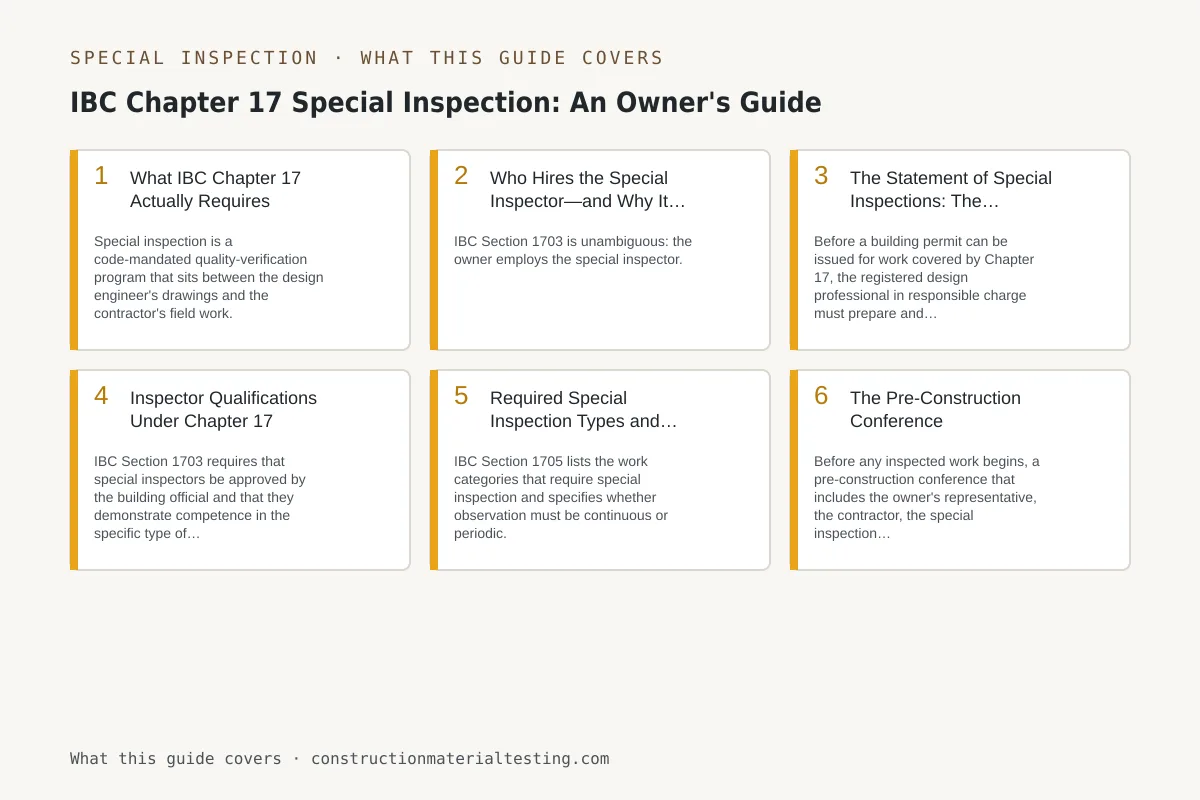
IBC Section 1703 is unambiguous: the owner employs the special inspector. This is not a formality. The code places responsibility on the owner deliberately, so that the inspector's loyalty and reporting obligations run to the building official and to code compliance, not to the contractor whose work is being evaluated. When a contractor hires and pays the inspector—a practice that unfortunately still occurs on some projects—the independence that Chapter 17 is designed to create is compromised, and the arrangement can void the inspection program in the eyes of the jurisdiction.
In practice, the owner typically delegates the selection and administration of the special inspection program to the engineer of record or to an owner's representative, but the contractual relationship remains between the owner and the special inspection firm. The contract should reference the approved Statement of Special Inspections and the specific IBC edition under which the permit was issued. Some jurisdictions require the owner to sign a Special Inspection Agreement as part of the permit package, acknowledging their responsibility and listing the approved special inspection agency.
For design-build projects, public-private partnerships, or projects where the general contractor holds the owner's role in the contract structure, clarifying who bears the Chapter 17 obligation is worth a specific agenda item in the pre-construction meeting. We have worked on projects where three different parties believed someone else had engaged the special inspector—the kind of ambiguity that only surfaces when the first critical inspection is due and no one is on site.
The Statement of Special Inspections: The Document That Drives Everything
Before a building permit can be issued for work covered by Chapter 17, the registered design professional in responsible charge must prepare and submit a Statement of Special Inspections. IBC Section 1705 describes this document and what it must contain. At minimum it must list each type of special inspection required, the applicable referenced standards, the frequency of observation (continuous or periodic), and the name or firm designated to perform each type of inspection. Some jurisdictions also require that the statement identify which portions of the work are covered and reference the specific drawing sheets or specifications that govern each inspection type.
The distinction between continuous and periodic inspection is significant and has real cost and schedule implications. Continuous inspection means the special inspector is on site for the full duration of the work being inspected. High-strength concrete placement in a transfer beam, welding of moment connections, and driven pile installation are examples where continuous observation is typically required. Periodic inspection means the inspector appears at defined intervals or at defined stages of work—enough to verify that procedures are being followed and materials comply, but not necessarily for every minute of every related work activity.
The Statement of Special Inspections is a living document in the sense that it should be updated when the design changes materially. If a structural system is redesigned after permit issuance—say, a cast-in-place shear wall is substituted for a CMU wall—the statement should be revised, and the building official should receive a copy. We carry approved copies of the statement in the field file and reference them when writing inspection reports; if our scope in the field begins to diverge from what the statement describes, that is a flag to stop and confirm direction with the engineer of record before proceeding.
Inspector Qualifications Under Chapter 17
IBC Section 1703 requires that special inspectors be approved by the building official and that they demonstrate competence in the specific type of inspection they perform. In practice, most jurisdictions accept ICC certification as evidence of that competence, and many require it explicitly. ACI Field Testing Technician certification and NICET certification are similarly recognized for concrete and geotechnical work, respectively. The key point for owners is that qualifications are inspection-type specific: an inspector certified for reinforced concrete observation is not automatically qualified to perform structural masonry inspection or ultrasonic testing of welds.
Our technicians hold relevant ACI and NICET certifications matched to the inspection types they perform, and we track certification renewal dates to ensure no expired credential enters the field. When a jurisdiction requires a specific certification or approval number, we obtain that pre-approval before the first mobilization, not on the morning of the first pour. Owners and project managers should verify this during the pre-inspection conference rather than assuming it has been handled.
The engineer of record does not serve as the special inspector for work they designed, except in limited circumstances permitted by the code. The independence requirement is real. An engineer reviewing their own shop drawings while also serving as the inspector of record for the steel erection those drawings govern is not an independent check—it is the same set of eyes that created the design confirming that the design is correct. The building official can and sometimes does reject inspection reports submitted by parties without the required independence.
Required Special Inspection Types and Frequencies
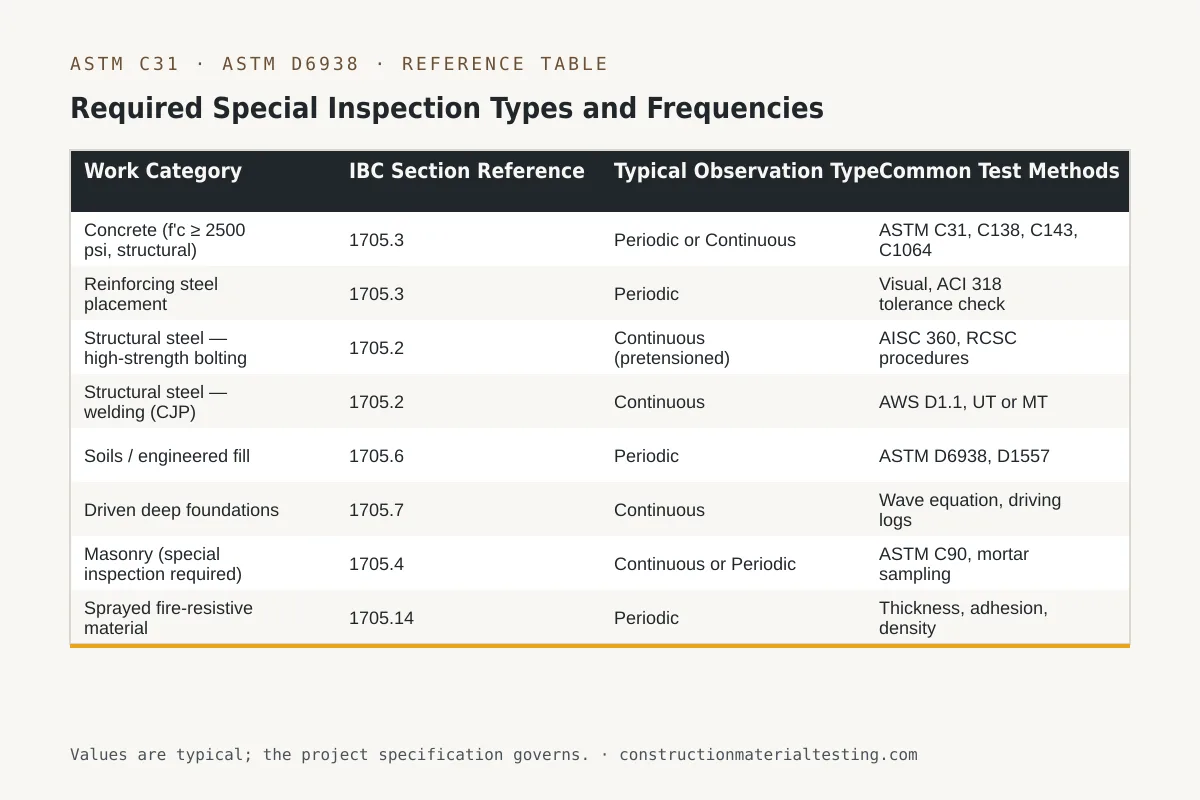
IBC Section 1705 lists the work categories that require special inspection and specifies whether observation must be continuous or periodic. The list covers a wide range of structural and geotechnical work, and the specific requirements vary with the structural system, design loads, occupancy category, and materials involved. Owners and contractors working on complex projects should read Section 1705 with the engineer of record rather than assuming that one project's inspection program transfers directly to another.
Concrete work is one of the most common triggers. Section 1705.3 addresses concrete, and the requirements tie to the design compressive strength, the structural system (ordinary, intermediate, or special), and the seismic design category. At minimum, inspection of concrete placement includes verification of mix design compliance, observation of placement and consolidation, and sampling for strength specimens. Our procedure for making and curing those specimens follows ASTM C31, which governs cylinder fabrication, initial curing temperatures, and transport to the laboratory—details that directly affect whether the cylinder results are valid or suspect.
Structural steel erection, reinforcing steel placement, masonry, soils and foundation work, sprayed fire-resistive materials, and driven deep foundations each have their own subsection within 1705. For soils, compaction verification by nuclear density gauge follows ASTM D6938; periodic inspection of fill placement is required when fill supports a structure or is used to modify site grades that affect drainage patterns around a structure. The frequency table below summarizes common inspection types as the IBC describes them; always verify against the current adopted edition in your jurisdiction because states and municipalities sometimes amend the base code.
| Work Category | IBC Section Reference | Typical Observation Type | Common Test Methods |
|---|---|---|---|
| Concrete (f'c ≥ 2500 psi, structural) | 1705.3 | Periodic or Continuous | ASTM C31, C138, C143, C1064 |
| Reinforcing steel placement | 1705.3 | Periodic | Visual, ACI 318 tolerance check |
| Structural steel — high-strength bolting | 1705.2 | Continuous (pretensioned) | AISC 360, RCSC procedures |
| Structural steel — welding (CJP) | 1705.2 | Continuous | AWS D1.1, UT or MT |
| Soils / engineered fill | 1705.6 | Periodic | ASTM D6938, D1557 |
| Driven deep foundations | 1705.7 | Continuous | Wave equation, driving logs |
| Masonry (special inspection required) | 1705.4 | Continuous or Periodic | ASTM C90, mortar sampling |
| Sprayed fire-resistive material | 1705.14 | Periodic | Thickness, adhesion, density |
The Pre-Construction Conference
Before any inspected work begins, a pre-construction conference that includes the owner's representative, the contractor, the special inspection firm, and the engineer of record is worth every hour it takes. The agenda should walk through the approved Statement of Special Inspections line by line, confirm that everyone holds a copy, establish the contractor's notification protocol, and document who receives inspection reports. Jurisdictions that require a Special Inspection Agreement typically want evidence that this coordination occurred.
Notification protocol is not a minor detail. If the contractor schedules a pour without notifying the special inspector in time for the inspector to mobilize, the inspector cannot legally retroactively certify the placement. In that scenario, the building official may require core sampling or other destructive verification of the in-place concrete—expensive and disruptive compared to a phone call placed 24 hours in advance. We ask that all project contacts be provided in writing, including after-hours numbers, because structural concrete does not always pour on Monday morning.
The contractor should also understand that special inspection reports are submitted directly to the building official, not through the contractor's office. This is by design. Contractors sometimes express concern that nonconformance notices will create problems with their client—that is exactly what Chapter 17 intends. The building official needs to know about deficiencies while the work can still be corrected, not after a slab is poured over noncompliant reinforcement. Making this expectation explicit at the pre-construction conference reduces friction later.
How Special Inspection Reports Are Written and Distributed
Each inspection visit generates a written inspection report. IBC Section 1703 requires that reports be prepared and distributed to the contractor, the engineer of record, and the building official. Reports must clearly identify the project, the date and time of inspection, the work observed, the applicable standard or specification, whether the work conforms or does not conform, and any action items. Verbal reports are not compliant. If we observe a problem and tell the foreman on site but do not document it in the written report, that observation does not exist in the code enforcement record.
When nonconforming work is observed, we issue a written nonconformance notice immediately. The notice describes the specific condition, references the applicable requirement (IBC section, ACI 318 clause, project specification section), and states what corrective action is needed. The contractor has the opportunity to correct the deficiency before it is covered or before the next pour proceeds; we re-inspect and document the correction. If the contractor believes the condition is acceptable and disputes our finding, the resolution path runs through the engineer of record and ultimately the building official—not through negotiation between the inspector and the superintendent.
Laboratory test reports—concrete cylinder breaks, compaction test results, mortar cube strengths—are issued as supplements to the field inspection reports and are distributed to the same parties. Test reports reference the inspection visit during which samples were taken, so the building official can correlate field observations with laboratory results. We retain inspection records for the period required by the jurisdiction, typically the duration of the project plus a specified number of years after final approval.
Dealing with Nonconformances and Disputed Findings
A nonconformance notice is not a stop-work order by itself—the special inspector does not have the authority to stop work, only to document and report. However, the building official, upon receiving a nonconformance notice, does have that authority and may exercise it if the condition is serious enough. In practice, many nonconformances are resolved quickly: a reinforcing bar placed at the wrong cover gets repositioned, an out-of-tolerance anchor bolt is sleeved and repositioned, a batch of concrete with insufficient slump is rejected before placement. The documentation trail is what matters.
More complex situations arise when the contractor has already placed concrete over reinforcement that failed inspection, or when a weld is found to be defective after the connected member is fully loaded by subsequent construction. In these cases, the engineer of record must evaluate whether the as-built condition meets structural performance requirements, possibly with additional analysis, testing, or remediation. The special inspector's role is to present the factual record of what was observed and what was tested—engineering judgment about acceptability belongs to the engineer, not to us.
Owners sometimes ask whether they can pressure the special inspection firm to overlook or modify a finding to avoid a schedule delay. The answer is no, and the owner should not want that answer to be otherwise. A modified or suppressed nonconformance report shifts liability squarely onto the owner if the condition later causes a structural failure. The integrity of special inspection records is not a bureaucratic nicety; it is a chain of evidence that protects everyone involved—except those who try to work around it.
The Final Report and Certificate of Occupancy
IBC Section 1703 requires that the special inspector of record submit a final report to the building official before the certificate of occupancy is issued. This report is a summary statement that the work requiring special inspection was observed in accordance with the approved Statement of Special Inspections, that all test results comply with the applicable standards, and that all nonconformances were either corrected or resolved by the engineer of record. It is the capstone document of the special inspection program.
The final report cannot be a form letter. It must reflect the actual scope of inspections performed, reference the specific test reports and inspection visit logs that support its conclusions, and address any items that are still outstanding. If work was partially complete at the time of CO application—a not uncommon situation on phased projects—the final report must clearly state which portions are covered and which are not, and the building official must be satisfied that the uncovered portions do not affect the occupiable portion's structural integrity.
We coordinate the timing of the final report with the project team well in advance of the CO application, because assembling the full record—field reports, lab reports, nonconformance notices and their resolutions, and any engineer-of-record letters addressing disputed conditions—takes time. Projects where inspection records have been carefully maintained throughout fare far better than projects where records are reconstructed from memory in the week before CO. The difference is usually a documentation discipline established at the pre-construction conference and maintained throughout construction.
| Phase | Required Action | Responsible Party | IBC Reference |
|---|---|---|---|
| Design / Pre-permit | Prepare Statement of Special Inspections | Registered design professional | IBC 1705 |
| Permit issuance | Submit approved SSI; execute owner-inspector agreement | Owner | IBC 1703 |
| Pre-construction | Hold pre-construction conference; confirm qualifications | Owner / Special Inspection Firm | IBC 1703 |
| Construction | Provide advance notice before inspected work begins | Contractor | IBC 1703 |
| Construction | Perform inspection; issue reports to contractor, EOR, BO | Special Inspector | IBC 1703 |
| Construction | Resolve nonconformances; issue acceptance or remediation letters | Engineer of Record | IBC 1703 |
| Pre-CO | Submit final report to building official | Special Inspector of Record | IBC 1703 |
| CO issuance | Issue certificate of occupancy | Building Official | IBC 111 |
Common Gaps That Create Problems in the Field
The most frequent issue we encounter is late notification. The contractor's schedule moves faster than the inspection coordination system, and by the time the special inspection firm is notified, the work is already in progress or complete. This is avoidable. The solution is embedding inspection notification requirements directly in the contractor's submittal and scheduling procedures, not relying on a subcontractor's foreman to remember to call. We recommend that the general contractor designate a single point of contact for special inspection coordination and that this person receive a copy of the approved Statement of Special Inspections.
The second common gap is scope creep on the contractor's side—work that is added, substituted, or modified after the SSI is approved, without anyone updating the inspection program. A structural slab pour that shifts from normal-weight to lightweight concrete changes the mix design verification requirements. A foundation type change from drilled piers to driven piles changes the inspection type entirely. When these changes happen without notification to the special inspection firm, inspection coverage can lapse for the new work.
A third gap is jurisdictional variability. States and municipalities frequently amend the IBC, and the adopted edition varies. Texas, for example, adopts the IBC with state-specific amendments, and local jurisdictions may layer additional requirements on top. We work in multiple jurisdictions across a wide service area, and we maintain current information about local amendments. Owners working across multiple jurisdictions should not assume that the inspection program that satisfied the building department in one city will automatically satisfy the building department in another.
Where This Fits on Your Project
Special inspection is a code obligation that runs from permit application to certificate of occupancy, and the costs and schedule impacts of getting it wrong far exceed the costs of setting it up correctly at the start. If you are in the design phase, now is the time to confirm that the Statement of Special Inspections reflects the actual structural system and that the inspection types and frequencies match what IBC Chapter 17 requires for your occupancy category and seismic design category. If you are in construction, verify that your general contractor understands the notification protocol and that every inspected work type has an inspector confirmed and credentialed.
Our construction materials testing services support special inspection programs across concrete, soils, structural steel, masonry, and related work categories. Our technicians carry current ACI and NICET certifications, our laboratory operates under a documented quality system, and our field reports are formatted to satisfy building department requirements across the jurisdictions we serve. We coordinate directly with engineers of record and building officials, and we maintain organized project records that support the final report without last-minute scrambles.
If you are ready to discuss the inspection scope for an upcoming project or need a proposal for an existing program, submit a project inquiry and a member of our field desk will follow up with specific questions about your permit set, structural system, and schedule. The earlier we are involved, the better positioned we are to synchronize inspection coverage with your construction sequence.
Get our guides in your Google results
Add Construction Materials Testing as a preferred source and Google shows our guides more often when you search for testing topics.