
What Aggregate Moisture Content Actually Measures
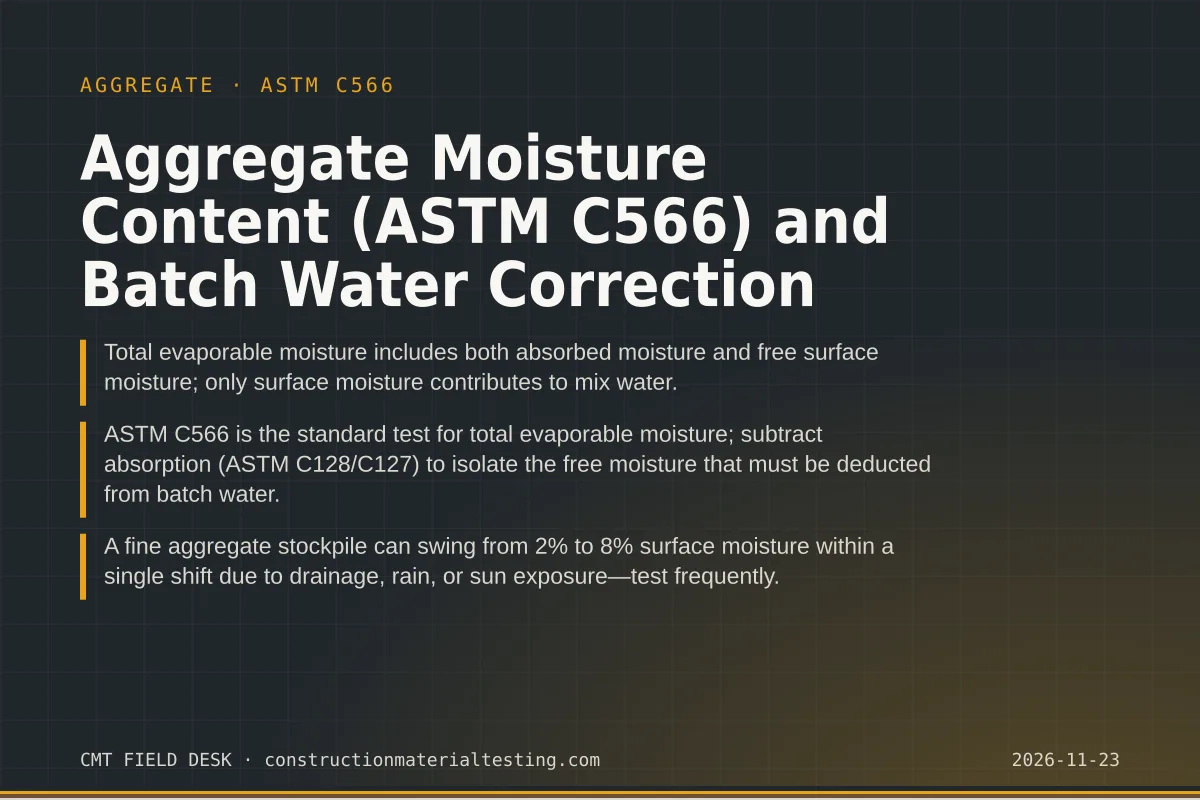
Aggregate moisture content is the total mass of evaporable water present in an aggregate sample expressed as a percentage of the oven-dry mass of that sample. ASTM C566 defines and governs that measurement. The result by itself, however, does not tell you how much water the aggregate is contributing to your concrete mix—for that, you need to separate total moisture into two components: absorbed moisture and free surface moisture. Absorbed moisture fills the permeable pores within the aggregate particles and does not become part of the mix water. Free surface moisture—everything above the saturated surface-dry (SSD) condition—does become mix water and must be deducted from the batch water you add.
Absorption is a fixed property of the aggregate source, determined by ASTM C128 for fine aggregate and C127 for coarse. Once you have the absorption value, the math is straightforward: free surface moisture equals total evaporable moisture minus absorption. If your fine aggregate has an absorption of 1.8% and you measure 5.2% total moisture by ASTM C566, the free moisture contributing to mix water is 3.4%. On a 1,400-lb batch of fine aggregate that is 47.6 lb of water—roughly 5.7 gallons—that must come out of the design batch water or your w/cm rises immediately.
Running the ASTM C566 Test in the Field
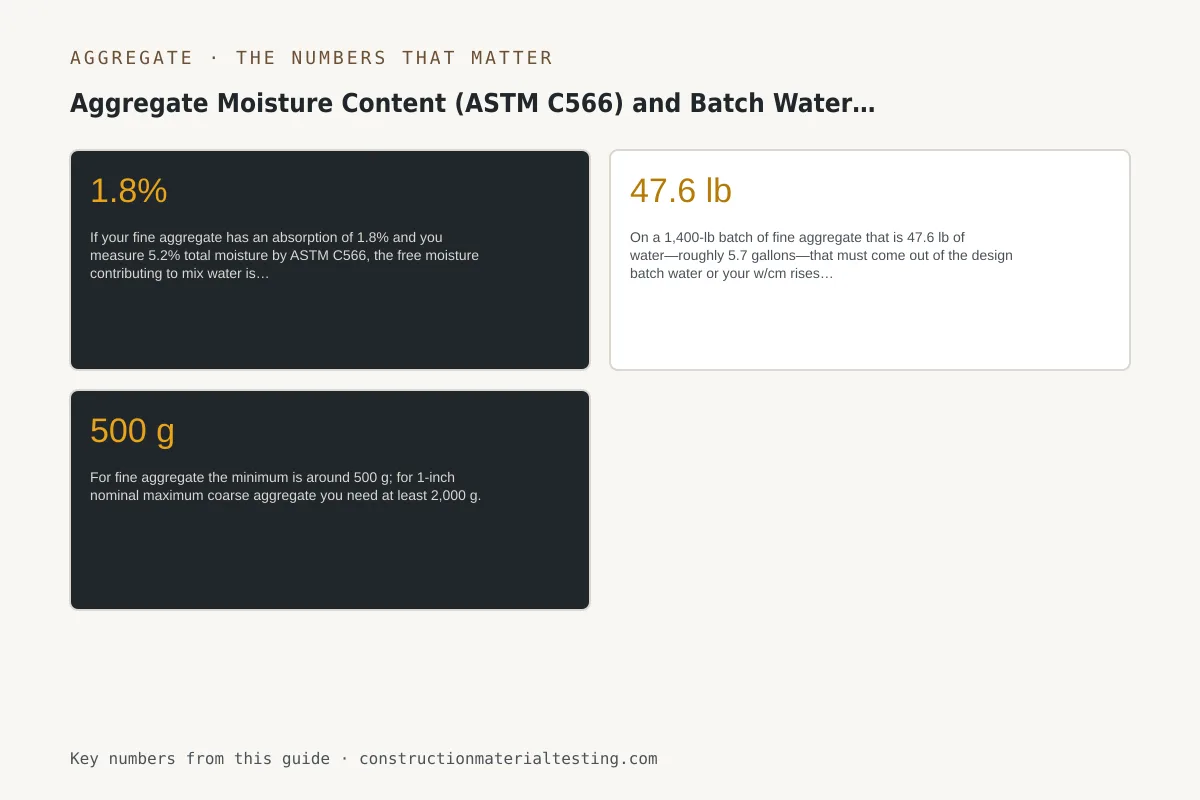
The ASTM C566 total evaporable moisture test is intentionally simple so it can be performed at the batch plant or on the job site. You weigh a representative sample, dry it to constant mass using a hot plate, microwave, or ventilated oven, then reweigh. The moisture percentage is ((wet mass − dry mass) / dry mass) × 100. The standard allows microwave and hot-plate drying precisely because speed matters in production—you need the number before the next batch, not the next morning. Sample size matters: ASTM C566 specifies minimum sample masses tied to nominal maximum aggregate size. For fine aggregate the minimum is around 500 g; for 1-inch nominal maximum coarse aggregate you need at least 2,000 g. Under-sampling is the most common error we see in the field, and it produces results that swing artificially because a small sample can't represent the moisture gradient across a pile.
Stockpile sampling location is the second major source of error. Moisture in a fine aggregate stockpile is not uniform. The top surface dries quickly in Texas heat; the bottom drains slowly and can stay saturated for hours after rain. Sampling consistently from the same face at mid-height, away from the drainage zone and away from the sun-bleached surface, is the minimum practice. For high-volume production, we recommend sampling at the conveyor feed point rather than the pile itself—by that point the material is reasonably blended and the result is more representative of what actually enters the mixer.
Correcting Batch Water for Aggregate Moisture Content
Once you have the free surface moisture percentage for each aggregate, the batch water correction is a simple mass balance. For each aggregate in the mix, calculate the free moisture mass (aggregate batch mass × free moisture percentage as a decimal), sum those values across all aggregates, and subtract the total from the design mix water quantity. If your aggregates are below SSD—meaning they will absorb water from the paste—you add water instead of subtracting. This situation, called a moisture deficit, is less common with stockpiled materials but does occur with kiln-dried or very porous lightweight aggregates.
ASTM C94, the standard specification for ready-mixed concrete, explicitly requires that mix water be adjusted for aggregate moisture. The batch ticket water quantity must reflect the corrected value, not the design value. When a special inspector reviews batch tickets against the approved mix design, one of the key checks is whether the recorded water—adjusted for aggregate moisture—falls within the design w/cm limits. ACI 318 sets the maximum w/cm for durability exposure categories, and those limits have no tolerance buffer for aggregate moisture that wasn't measured or corrected. A batch that looks right on paper but was made with wet aggregate and unadjusted water is a batch with elevated w/cm, reduced strength, and potential durability problems that won't show up until cores or cylinders break low weeks later.
The practical implication is that moisture testing cannot be a once-a-day ritual. Aggregate moisture changes throughout the day as material is loaded, as rain moves through, and as stockpiles settle and drain. For structural concrete where strength and durability matter, we recommend testing fine aggregate moisture at least at the start of each production run and after any interruption, weather event, or change in stockpile draw location. Some plants with automated moisture probes still run manual ASTM C566 checks to verify probe calibration—the probe gives frequency, the drying test gives ground truth.
Where This Fits on Your Project
Aggregate moisture content testing is a routine part of concrete mix design verification, batch plant audits, and field quality control programs. If your project specifications require mix design submittals, ASTM C566 results are part of establishing the baseline absorption values and verifying that the plant's moisture correction procedures are functioning. If you're seeing unexplained low-break patterns on cylinder tests, uncontrolled aggregate moisture and uncorrected batch water is one of the first things to investigate—it's quiet, it's common, and it's entirely preventable with consistent testing.
Our construction materials testing services include ASTM C566 moisture testing, aggregate absorption by ASTM C128, and mix design review through our laboratory and field technician network. If you have a concrete program that needs a structured QC plan or you want an independent check on batch plant moisture correction practices, submit a proposal request and we'll outline the scope with you.
Get our guides in your Google results
Add Construction Materials Testing as a preferred source and Google shows our guides more often when you search for testing topics.