
Start With the Field Data, Not the Break
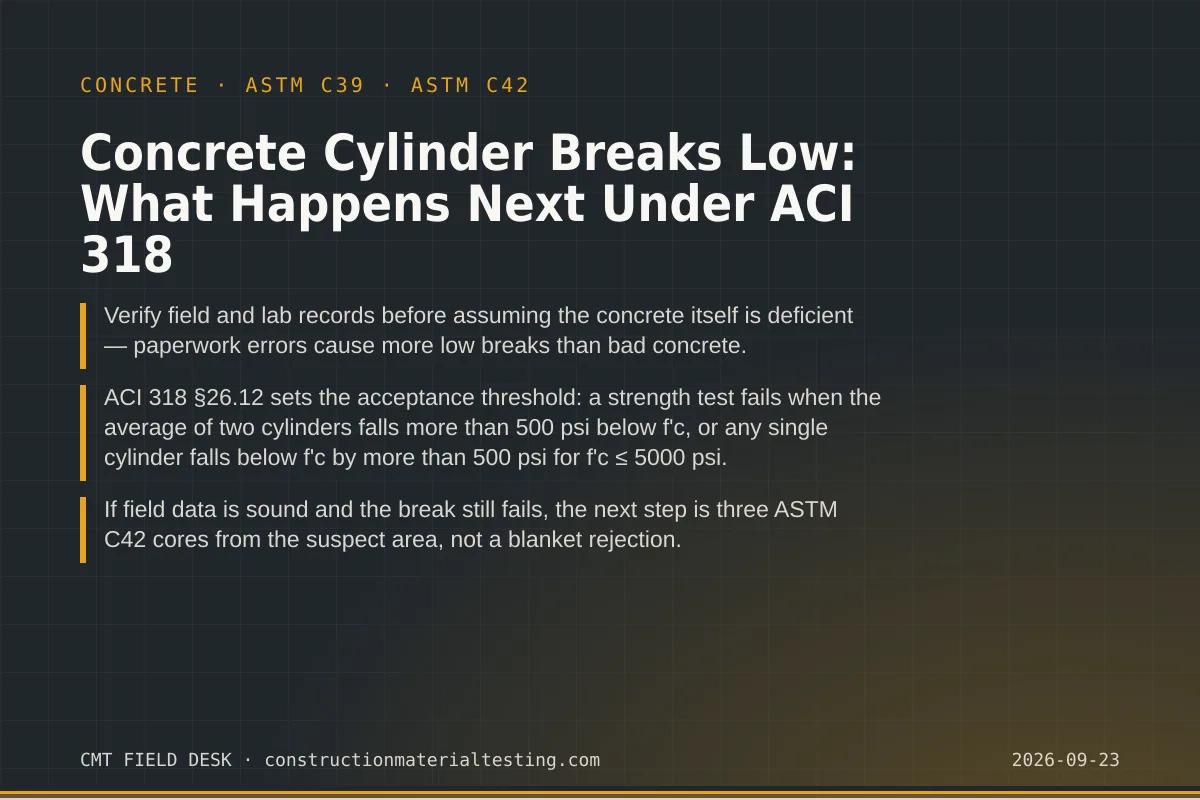
When a compressive strength report comes back low, the first move is to pull the field paperwork, not call the ready-mix plant. A surprising share of apparent low concrete cylinder breaks trace back to documentation problems: cylinders held too long before initial curing, stored in direct sunlight or against a vibrating surface, transported without adequate protection, or capped with worn neoprene pads that have long exceeded their useful life. Check the field log against the cylinder transport record and the lab receipt time. If any link in that chain is broken, you have an explanation that has nothing to do with the concrete in the slab.
Under ASTM C39, cylinders must be standard 4×8 or 6×12 specimens, cured initially in insulated boxes at 60–80°F for the first 24 hours, and delivered to the lab without damage. If the field record shows any deviation, that context belongs in the investigation file before cores are ever discussed. The engineer of record needs that information to weigh options.
Low Concrete Cylinder Breaks and the ACI 318 §26.12 Trigger
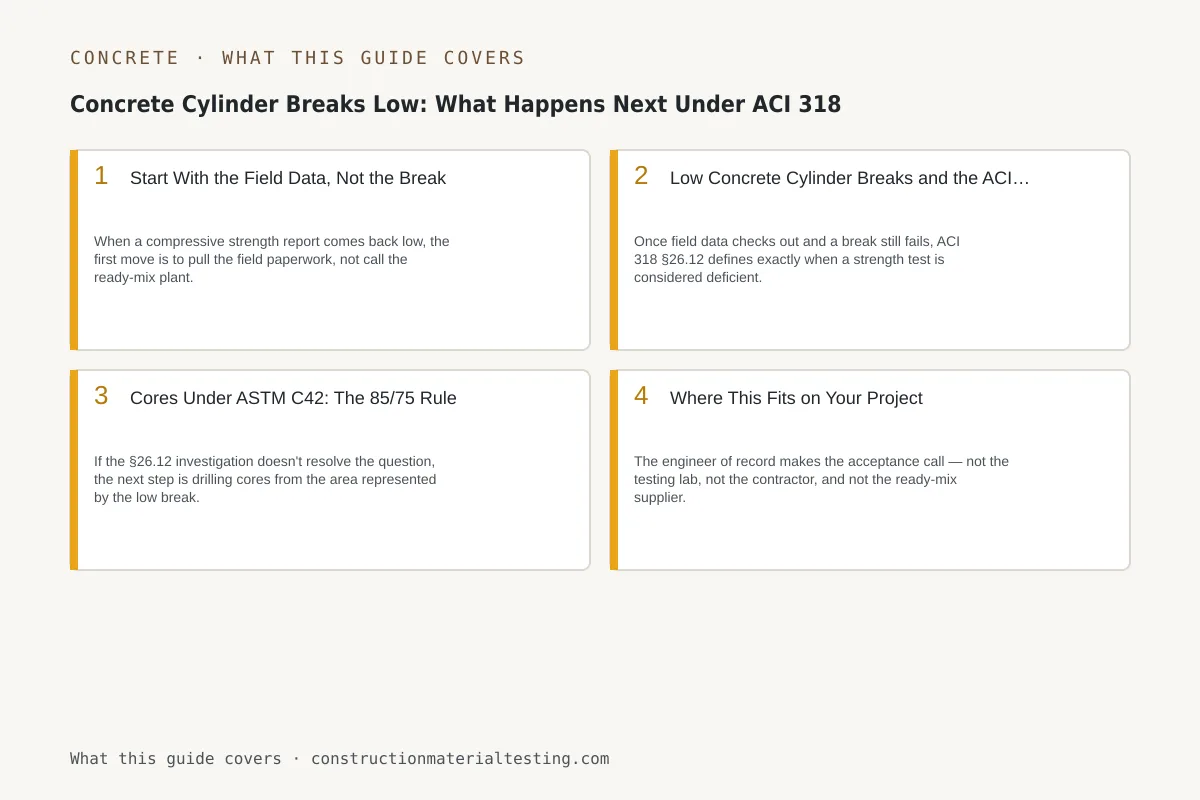
Once field data checks out and a break still fails, ACI 318 §26.12 defines exactly when a strength test is considered deficient. A strength test — meaning the average of at least two cylinders broken at 28 days from the same load — fails acceptance when: the average drops more than 500 psi below the specified compressive strength (f'c) for concrete with f'c of 5000 psi or less, or any individual cylinder is more than 500 psi below f'c. For higher-strength mixes, the tolerance shifts; consult the code language directly because the thresholds tighten. What §26.12 does not do is dictate demolition. It requires an investigation — and that investigation has a prescribed order.
The investigation begins with a review of the mix design, batch tickets, and any available early-break data. If the 7-day breaks were also low proportionally, and field conditions during placement and curing were unusual — high air temperature, wind, low humidity — the picture becomes clearer. If everything else looked normal and only the 28-day cylinders are low, that contrast itself is data worth noting in the investigation file before cores are ordered.
- Pull batch tickets and verify water-cement ratio against the approved mix design
- Confirm cylinder fabrication followed ASTM C31 initial curing requirements
- Check lab records for break age — cylinders broken significantly past 28 days tend to read higher, not lower, but timing anomalies still matter
- Review 7-day break trends to assess whether the pattern is consistent with 28-day results
- Document ambient conditions during placement from field logs or weather records
Cores Under ASTM C42: The 85/75 Rule
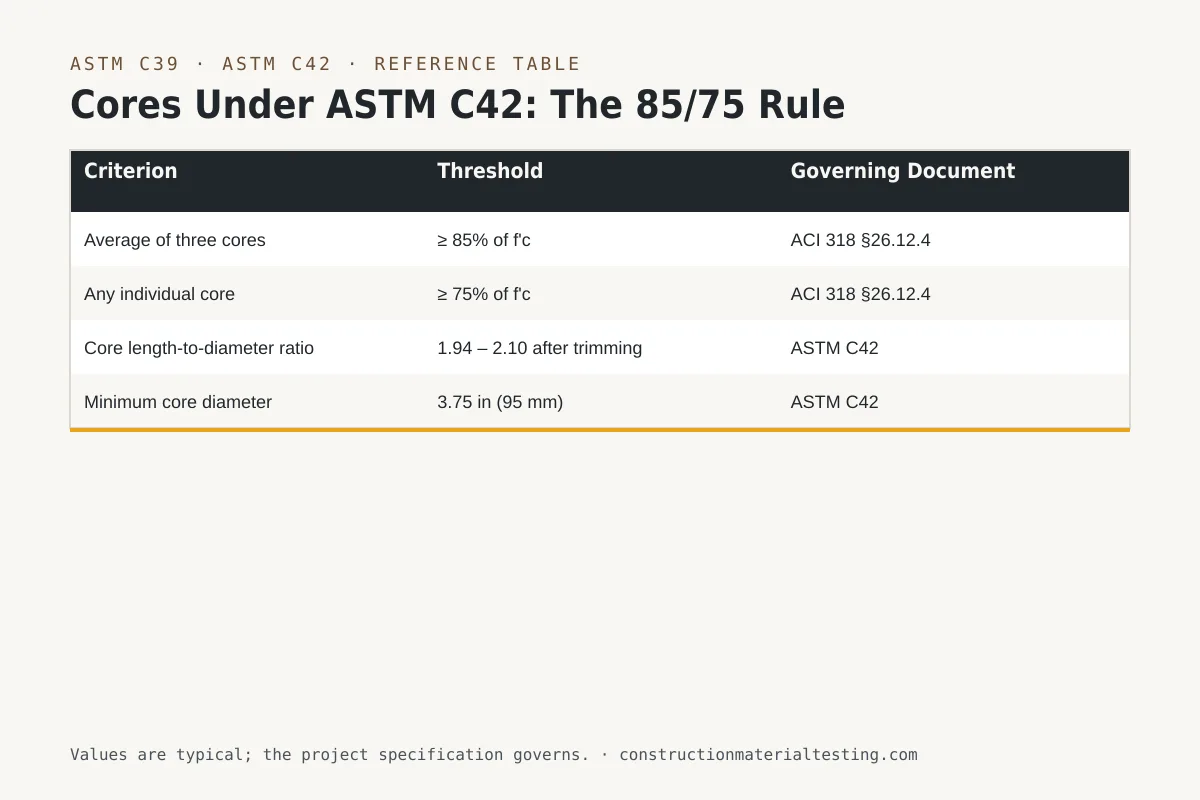
If the §26.12 investigation doesn't resolve the question, the next step is drilling cores from the area represented by the low break. ASTM C42 governs how those cores are obtained and tested. The standard requires a minimum of three cores from each suspect area. Core diameter should be at least 3.75 inches (95 mm), and the length-to-diameter ratio after trimming must be between 1.94 and 2.10; cores outside that range require correction factors that reduce the result. Saw-cut or ground ends are strongly preferred over sulfur mortar caps for cores because cap quality variability can artificially lower results. Our ASTM C42 testing process follows the end-preparation and moisture-conditioning requirements in the standard, including the 40-hour soak for cores tested in a moist condition.
The acceptance benchmark for cores comes from ACI 318 §26.12.4: the concrete in the area represented by the cores is considered structurally adequate if no individual core falls below 75% of f'c and the average of three cores is at least 85% of f'c. These thresholds exist because in-place concrete is expected to be somewhat lower than standard-cured cylinder strength — real slabs don't cure in a 73°F fog room. If cores clear both thresholds, the structural engineer of record has a sound basis to accept the work. If they don't, the code path moves to load testing or structural analysis, neither of which is a technician decision.
| Criterion | Threshold | Governing Document |
|---|---|---|
| Average of three cores | ≥ 85% of f'c | ACI 318 §26.12.4 |
| Any individual core | ≥ 75% of f'c | ACI 318 §26.12.4 |
| Core length-to-diameter ratio | 1.94 – 2.10 after trimming | ASTM C42 |
| Minimum core diameter | 3.75 in (95 mm) | ASTM C42 |
Where This Fits on Your Project
The engineer of record makes the acceptance call — not the testing lab, not the contractor, and not the ready-mix supplier. What materials testing provides is the data chain that makes that call defensible: documented field conditions, properly fabricated and transported cylinders, and cores obtained and tested in strict accordance with ASTM C42. If the cores still leave structural questions open, forensic engineering services can carry the analysis further, including load testing protocols under ACI 318 Chapter 27.
If you're working through a low-break situation now, or want to set up a testing program that captures the field data needed to defend results before questions arise, reach out through our proposal request page. We can mobilize core drilling crews across our regional dispatch network and return compressive strength results under the timelines your schedule requires.
Get our guides in your Google results
Add Construction Materials Testing as a preferred source and Google shows our guides more often when you search for testing topics.