
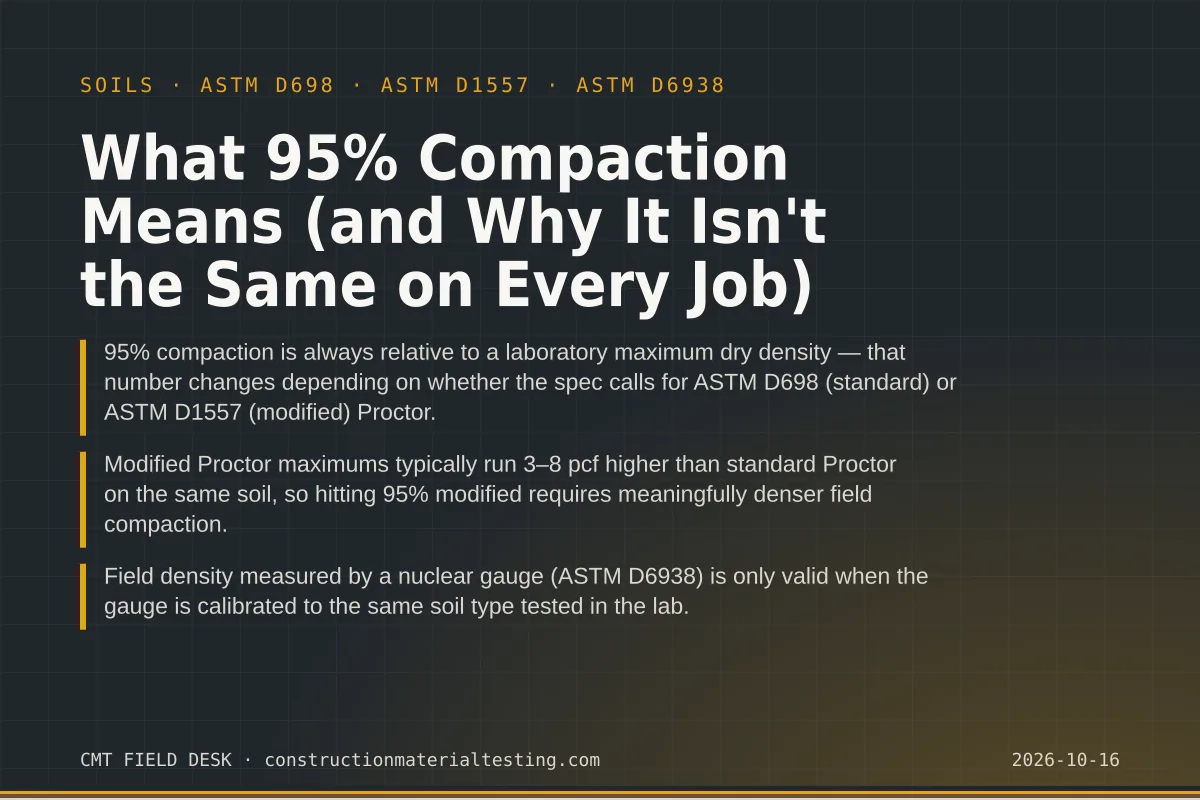
Percent Compaction Is Always a Ratio — But a Ratio to What?
Percent compaction is the ratio of a soil's field dry density to its laboratory maximum dry density, expressed as a percentage. When a specification says 95%, it means the soil in place must reach at least 95% of that lab-determined peak. The critical question every contractor and engineer should ask immediately is: which laboratory test establishes the maximum? The two most common references are ASTM D698 (Standard Proctor) and ASTM D1557 (Modified Proctor), and they produce very different numbers for the same soil.
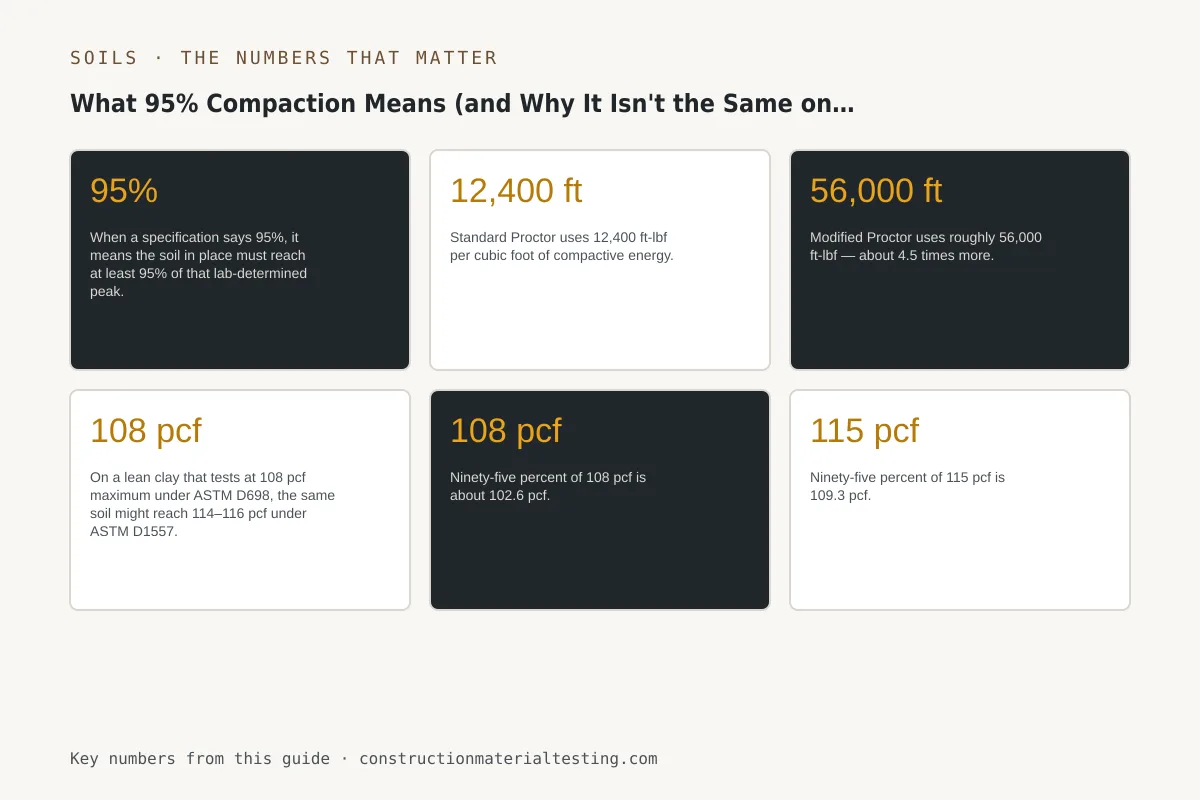
Standard Proctor uses 12,400 ft-lbf per cubic foot of compactive energy. Modified Proctor uses roughly 56,000 ft-lbf — about 4.5 times more. That extra energy pushes maximum dry density higher and shifts optimum moisture content lower. On a lean clay that tests at 108 pcf maximum under ASTM D698, the same soil might reach 114–116 pcf under ASTM D1557. Ninety-five percent of 108 pcf is about 102.6 pcf. Ninety-five percent of 115 pcf is 109.3 pcf. That 6.7 pcf gap is not trivial — it can be the difference between four roller passes and eight, or between a viable moisture range and one that is essentially impossible in wet gulf coast conditions.
Moisture Window and Why Dry or Wet Both Fail
The Proctor curve is not a spike — it is a hump, and the peak sits at optimum moisture content (OMC). Soil compacts most densely at OMC because water lubricates particles into a tighter arrangement. Compact too dry and particle friction resists rearrangement; the soil shakes under roller pressure but the density ceiling stays low. Compact too wet and pore water carries load that should be carried by the soil skeleton; density stalls and you can pump or shove the fill instead of densifying it.
Most specifications allow a moisture window of OMC minus 2 to OMC plus 2 percentage points, though pavement subgrade work under some TxDOT sections tightens that range. In practice, Texas soils — particularly the high-plasticity clays common from Houston west through the Brazos valley — have narrow achievable windows during wet seasons. When field moisture runs 4 or 5 points above OMC, no practical compactor will close the gap without drying. Waiting for drying or aerating and recompacting is not optional; it is the only path to compliance. This is where our materials testing services and real-time field reporting matter — knowing actual moisture before the roller makes another pass prevents wasted effort.
Lift Thickness, Compactor Type, and the Depth-of-Influence Problem
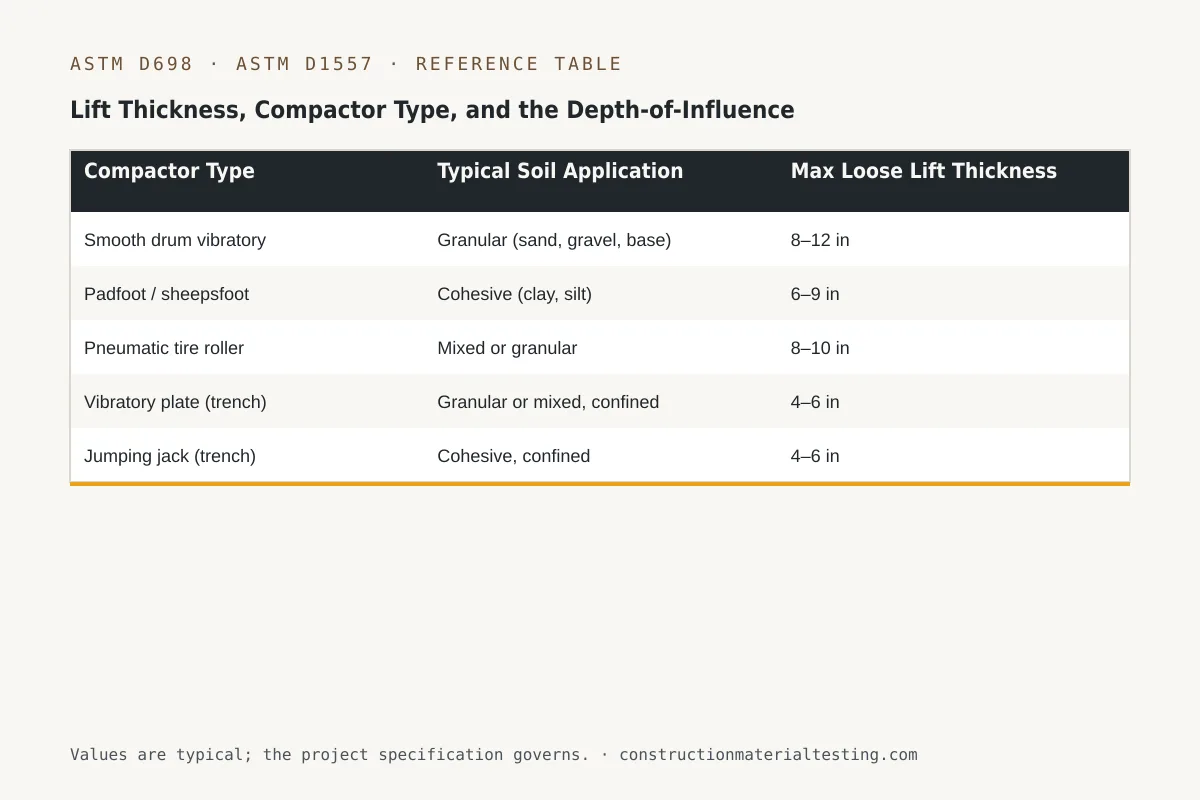
Every compactor has an effective depth of influence — the thickness of soil it can densify uniformly from top to bottom. Exceed that thickness and the bottom of the lift stays loose, even if a nuclear gauge reading at the surface looks acceptable. The gauge itself only reads to a fixed depth, so a passing number can mask a failing condition just a few inches lower. The FHWA geotechnical guidance ties effective compaction depth to equipment type: smooth drum rollers on granular fill typically work in 8–12 inch loose lifts; sheepsfoot or padfoot rollers on cohesive soils are often limited to 6–9 inches loose before compaction. Vibratory plate compactors used in trenches are often restricted to 4–6 inch lifts depending on plate size and soil type.
Compactor type also matters because different soils respond to different mechanisms. Sheepsfoot rollers work clay from the bottom up — the feet punch through and knead lower layers first, which is why a freshly rolled clay lift looks rough on top initially. Smooth vibratory drums work granular fill through impact and vibration. Using a smooth drum on fat clay typically achieves poor results regardless of pass count. Field technicians running ASTM D6938 nuclear gauge tests need to know what compactor was used and at what lift thickness so density results can be evaluated in proper context.
| Compactor Type | Typical Soil Application | Max Loose Lift Thickness |
|---|---|---|
| Smooth drum vibratory | Granular (sand, gravel, base) | 8–12 in |
| Padfoot / sheepsfoot | Cohesive (clay, silt) | 6–9 in |
| Pneumatic tire roller | Mixed or granular | 8–10 in |
| Vibratory plate (trench) | Granular or mixed, confined | 4–6 in |
| Jumping jack (trench) | Cohesive, confined | 4–6 in |
Where Percent Compaction Fits on Your Project
Compaction testing is not a formality — it is the checkpoint between placed fill and a foundation, pavement, or embankment that performs as designed. Getting the reference Proctor right, verifying field moisture is within the acceptable window, and confirming lift thickness matches compactor capability are three independent requirements that all have to align before a percent compaction number is meaningful. A result of 97% sounds excellent until you learn it was measured against standard Proctor on a spec that requires modified, or that the lift was 14 inches under a rubber-tire roller with a 10-inch effective depth.
If your project spec is ambiguous about which Proctor method applies, resolve it with the engineer of record before the first lift goes down — changing reference methods mid-project creates documentation problems and retesting costs that are avoidable. When you are ready to schedule laboratory Proctor testing, field density observation, or need a technician dispatched from one of our regional hubs, submit a proposal request and we will confirm scope, method references, and coverage for your site.
Get our guides in your Google results
Add Construction Materials Testing as a preferred source and Google shows our guides more often when you search for testing topics.