
What IBC 1705.1.1 Actually Requires
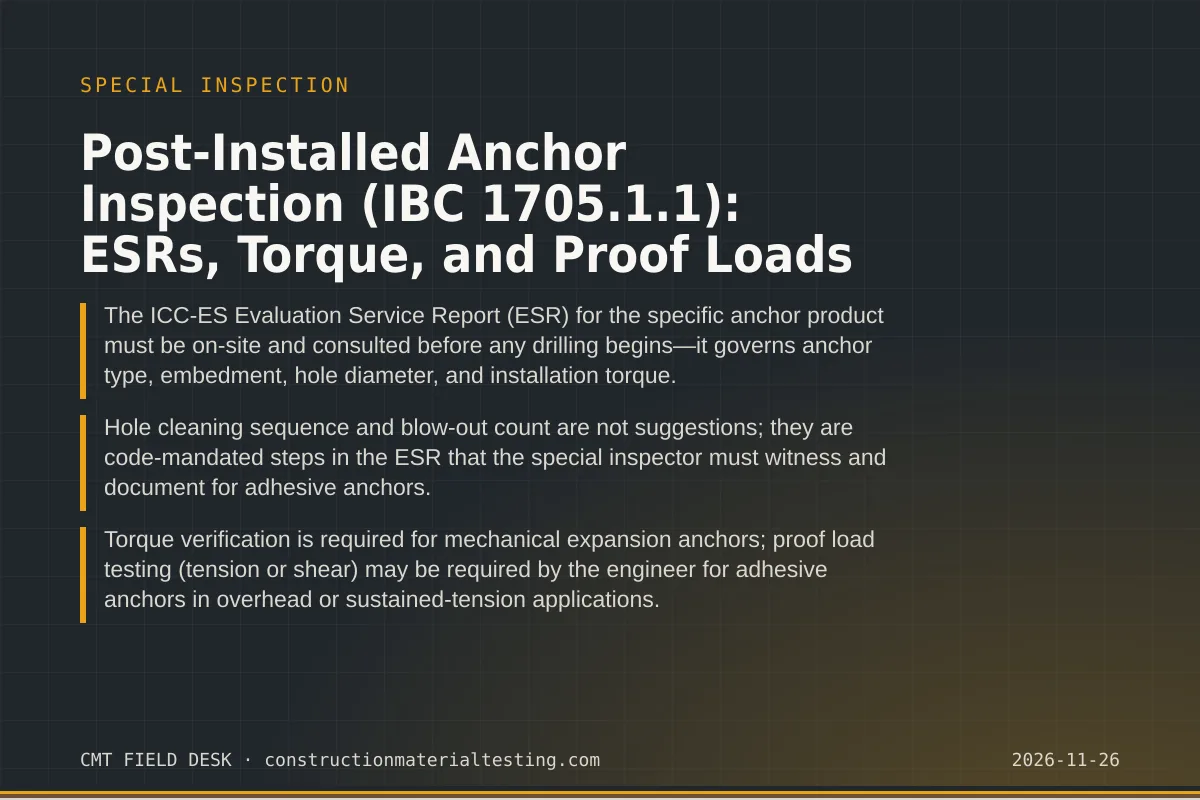
Post-installed anchor inspection is a mandatory special inspection category under IBC Section 1705.1.1 whenever anchors are installed in concrete or masonry for structural purposes. The code distinguishes between expansion anchors, undercut anchors, and adhesive anchors, and it assigns continuous or periodic inspection frequency based on how the anchor is loaded. Anchors resisting sustained tension—such as those connecting overhead mechanical equipment or hanging structural members—require continuous inspection during installation. Anchors loaded primarily in shear or in intermittent tension may qualify for periodic inspection, but that determination belongs to the engineer of record and must be reflected in the project's Statement of Special Inspections before any work begins.
The standard does not create a blanket exemption for small or lightly loaded anchors. If the structural drawings call for special inspection on anchors and the Statement of Special Inspections echoes that requirement, the inspection must happen regardless of anchor diameter or embedment depth. We see projects where contractors assume a quarter-inch drop-in anchor doesn't need an inspector because it looks minor. If it's on the structural drawings and in the Statement, it needs documentation. Skipping it creates a code-compliance gap that can stall a Certificate of Occupancy or trigger costly remediation.
ACI 318 Chapter 17 provides the design framework that engineers use to size post-installed anchors, and it explicitly references qualification testing performed under ACI 355.2 (mechanical anchors) or ACI 355.4 (adhesive anchors). Those qualification tests are the basis for the ICC-ES Evaluation Service Report. When an inspector arrives on-site, those three documents—the structural drawings, the ESR, and the Statement of Special Inspections—should be in hand or readily accessible.
Reading the ICC-ES Evaluation Service Report Before the Drill Touches Concrete
An ICC-ES Evaluation Service Report is a product-specific technical document published by ICC Evaluation Service that confirms a proprietary anchor system meets the requirements of the adopted building code and the applicable ACI qualification standard. The ESR is not marketing literature; it contains binding installation parameters that supersede a contractor's general experience with similar products. Each ESR includes the approved concrete strength range, the required hole diameter and tolerance, the minimum and maximum embedment depth, the drill bit type (rotary hammer vs. core drill), the cleaning procedure, the installation torque for torque-controlled anchors, and any installer certification requirements.
Before the first hole is drilled, the inspector should confirm the ESR number and revision date matches what is listed on the structural drawings or in the anchor submittal. Products update. An older revision of an ESR may carry different embedment requirements or a different approved concrete range than the current version listed on the ICC Evaluation Service website. If the contractor has a previous revision on-site, that is a non-conformance worth flagging immediately—not after a hundred anchors are installed.
Pay particular attention to the concrete condition requirements listed in the ESR. Many adhesive anchor products carry separate load tables for cracked and uncracked concrete, and some are only evaluated in uncracked conditions. If the structural engineer designed to uncracked values in a zone where the concrete may crack under service loads, that is a design coordination issue—but the inspector who notes it protects everyone. Similarly, the ESR will specify whether the product is approved for water-saturated holes, submerged installation, or specific temperature ranges, all of which matter when anchoring into slabs on grade or below-grade walls during Texas summers.
Installer Certification and Pre-Drill Verification
For adhesive anchors resisting sustained tension loads, IBC 1705.1.1 requires that installers hold certification from an approved program—typically the manufacturer's training program documented in the ESR, or a program such as the one administered through Concrete Anchor Manufacturers Association. This is not a credential the inspector can waive because the installer seems experienced. We ask to see the installer's card or certificate before work begins, record the certification number and expiration date on the inspection form, and note it in the job file. If nobody on the crew can produce documentation, work on those anchors stops.
Before drilling begins, verify the substrate. Confirm the existing concrete or masonry strength meets the minimum specified in the ESR. For new construction poured in the field, we cross-reference the compressive strength results from cylinder breaks against the ESR's minimum concrete strength. For existing construction, the engineer of record should have specified the assumed in-place strength; if there's any uncertainty, cores or rebound hammer surveys may be warranted before anchor installation proceeds. Verifying rebar locations with a cover meter or ground-penetrating radar before drilling protects both the structure and the installation from hitting reinforcement that would prevent full embedment.
Hole Drilling, Cleaning, and Adhesive Injection
The hole cleaning sequence for adhesive anchors is where most field failures originate, and it is the step that most clearly separates continuous from periodic inspection. A typical ESR cleaning sequence for a dry concrete hole might require: blow compressed air into the hole for a minimum number of passes from bottom to top, then brush with a wire brush for a specified number of strokes, then repeat the air-blow sequence. The number of repetitions, the direction, and whether a water rinse is required for wet or water-saturated conditions are all product-specific. We follow the ESR, not habit. Shortcutting a single blow-out cycle can leave concrete dust and debris that reduces adhesive bond strength by a significant margin—a loss that isn't visible and won't show up until a load is applied.
Adhesive injection must follow the ESR's mixing instructions. Cartridge-based adhesives require a specific number of wasted strokes to purge any unmixed material from the nozzle before the first usable injection. The gel consistency and color should match the manufacturer's description of fully mixed material. The hole should be filled from the bottom upward to avoid air pockets. Anchor rods or threaded studs are then inserted with a steady rotating motion to ensure complete coverage of the rod profile. Disturbing the anchor during the gel time listed in the ESR—which varies with concrete temperature—will compromise the cure. We mark installed anchors with tape and advise the crew to treat them as off-limits until the ESR cure time has elapsed.
For mechanical expansion anchors—wedge anchors, sleeve anchors, and drop-in anchors—hole cleaning is less critical than for adhesive systems, but embedment depth and set procedure still must match the ESR exactly. Wedge anchors require a specific torque to properly expand the clip against the hole wall. Drop-in anchors must be fully set with the setting tool until the tool bottoms out; a partially set drop-in can look fine visually but carry almost no load.
Post-Installed Anchor Inspection: Torque Verification and Proof Load Testing
Torque verification is the standard field check for torque-controlled mechanical expansion anchors. The ESR specifies the installation torque in foot-pounds or Newton-meters for each anchor diameter and embedment. We use a calibrated torque wrench and apply the ESR value to each anchor. An anchor that reaches the specified torque without spinning or pulling suggests the expansion mechanism has engaged the concrete adequately. An anchor that spins, pulls down, or cracks the surface concrete fails inspection and must be removed if possible or abandoned in place with a replacement anchor installed at an adequate edge and spacing distance. All torque readings and outcomes go on the inspection form.
Proof load testing takes the verification a step further by applying a direct tensile or shear load to the installed anchor and confirming it holds without displacement exceeding a specified limit. The engineer of record specifies whether proof testing is required, the percentage of anchors to be tested, and the proof load value—typically a fraction of the anchor's rated capacity so the test does not damage the anchor intended to remain in service. We use a hollow-core hydraulic jack reacting against a reference plate to apply and measure the load. Displacement is monitored with a dial gauge or digital sensor at the anchor head. The pass/fail criterion and allowable displacement are established in the project documents or the ESR; we do not invent limits in the field.
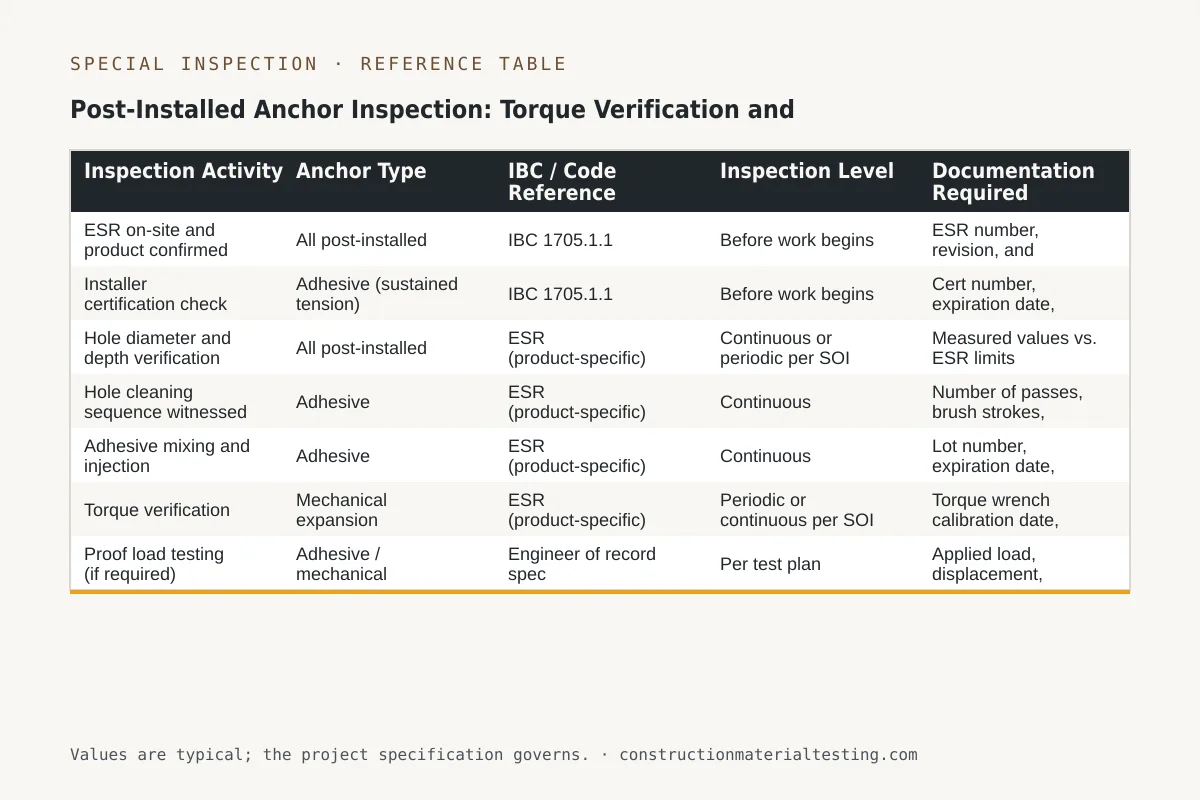
The table below summarizes the typical inspection activities, applicable anchor types, and documentation requirements. Note that the engineer of record and the Statement of Special Inspections govern the actual project requirements—this table reflects common practice, not a universal specification.
| Inspection Activity | Anchor Type | IBC / Code Reference | Inspection Level | Documentation Required |
|---|---|---|---|---|
| ESR on-site and product confirmed | All post-installed | IBC 1705.1.1 | Before work begins | ESR number, revision, and product lot on inspection form |
| Installer certification check | Adhesive (sustained tension) | IBC 1705.1.1 | Before work begins | Cert number, expiration date, installer name |
| Hole diameter and depth verification | All post-installed | ESR (product-specific) | Continuous or periodic per SOI | Measured values vs. ESR limits |
| Hole cleaning sequence witnessed | Adhesive | ESR (product-specific) | Continuous | Number of passes, brush strokes, condition noted |
| Adhesive mixing and injection | Adhesive | ESR (product-specific) | Continuous | Lot number, expiration date, ambient temp, gel time noted |
| Torque verification | Mechanical expansion | ESR (product-specific) | Periodic or continuous per SOI | Torque wrench calibration date, readings, pass/fail |
| Proof load testing (if required) | Adhesive / mechanical | Engineer of record spec | Per test plan | Applied load, displacement, pass/fail, instrument cal date |
Documenting Non-Conformances and Disposition
Every anchor installation that deviates from the ESR or project documents is a non-conformance, and the inspector's job is to document it accurately and promptly—not to resolve it unilaterally. Common non-conformances we encounter include wrong anchor product substituted without an approved submittal revision, insufficient embedment depth due to hitting aggregate or rebar, missed cleaning cycles, adhesive installed in holes with water present without an ESR approval for wet conditions, and anchors disturbed during gel time. Each gets a written non-conformance notice with the anchor location, the specific deviation, the applicable ESR or specification requirement, and a hold on further installation in the affected area until the engineer of record provides disposition.
Disposition options depend on the severity and the engineer's judgment. Minor embedment shortfalls may be evaluated against the ESR's load tables and found acceptable if the actual depth still meets the minimum. More severe deviations—adhesive pulled from wet holes without approval, completely missed cleaning in overhead sustained-tension applications—may require removal and reinstallation, supplemental testing, or engineering analysis. The inspector documents the disposition in the same report and closes the non-conformance only when written direction from the engineer has been received and followed. We never verbally clear a non-conformance and move on.
Where Post-Installed Anchor Inspection Fits on Your Project
Post-installed anchor inspection touches a wider range of project types than many teams realize: structural steel base plates, overhead MEP hangers, elevator rail brackets, curtain wall embed attachments, and seismic bracing all commonly depend on post-installed anchors whose inspection must be coordinated with the schedule. The inspection cannot be a last-minute call—the special inspector needs the Statement of Special Inspections, the approved anchor submittal with the ESR, and the structural drawings before work begins, not after the first anchors are already grouted over.
Our technicians operate from construction materials testing services capabilities that span concrete, masonry, steel, and special inspection disciplines, so anchor inspection work integrates naturally with ongoing concrete and structural observation on the same project. If you are in the Houston area, our Houston materials testing team supports both new construction and renovation projects across Harris County and surrounding counties. For projects outside the metro area, our regional dispatch network covers the broader Gulf Coast region. To discuss inspection scope, mobilization, and scheduling for your anchor program, submit a proposal request so we can review the project documents and confirm coverage before your installation crew mobilizes.
Get our guides in your Google results
Add Construction Materials Testing as a preferred source and Google shows our guides more often when you search for testing topics.