
Why Moisture Is the Lever That Controls Compaction
Compaction is the mechanical process of forcing soil particles closer together, but particles cannot rearrange themselves efficiently without water acting as a lubricant between grains. Too little water and friction between particles resists rearrangement; too much water and incompressible pore fluid occupies space that particles need to fill. The result is a bell-shaped curve — the Proctor curve — with a single peak density at a single optimum moisture content. Every soil type has its own curve, which is why a Standard Proctor test per ASTM D698 must be run on representative material from each borrow source before field operations begin.
The practical consequence is that the soil moisture content test is not a standalone quality check — it is one half of a two-variable system. Field density without a paired moisture reading tells you almost nothing useful; a density result can look acceptable while the soil is actually too wet or too dry, meaning the apparent density came from a fluke of test location rather than from well-compacted material. Inspectors who treat moisture as a secondary concern tend to discover that problem after the slab is poured.
We emphasize this sequencing to contractors and project engineers alike: establish the Proctor curve first, know your optimum moisture content, and then use field moisture testing to confirm that material arriving at the grade is inside the target window before the roller makes its first pass. That sequence prevents rework far more reliably than accepting fills based on density alone.
How the Soil Moisture Content Test Works: ASTM D2216 Step by Step
The ASTM D2216 procedure is straightforward in principle: weigh a sample of field soil, dry it completely, weigh it again, and express the mass of water lost as a percentage of the dry soil mass. That ratio — water mass divided by dry soil mass, multiplied by 100 — is the gravimetric moisture content. The standard requires drying at 110 ± 5 °C until the specimen reaches constant mass, which in practice means a minimum of about 12–16 hours in a forced-draft oven for most fine-grained soils. Larger specimens or high-plasticity clays can need longer.
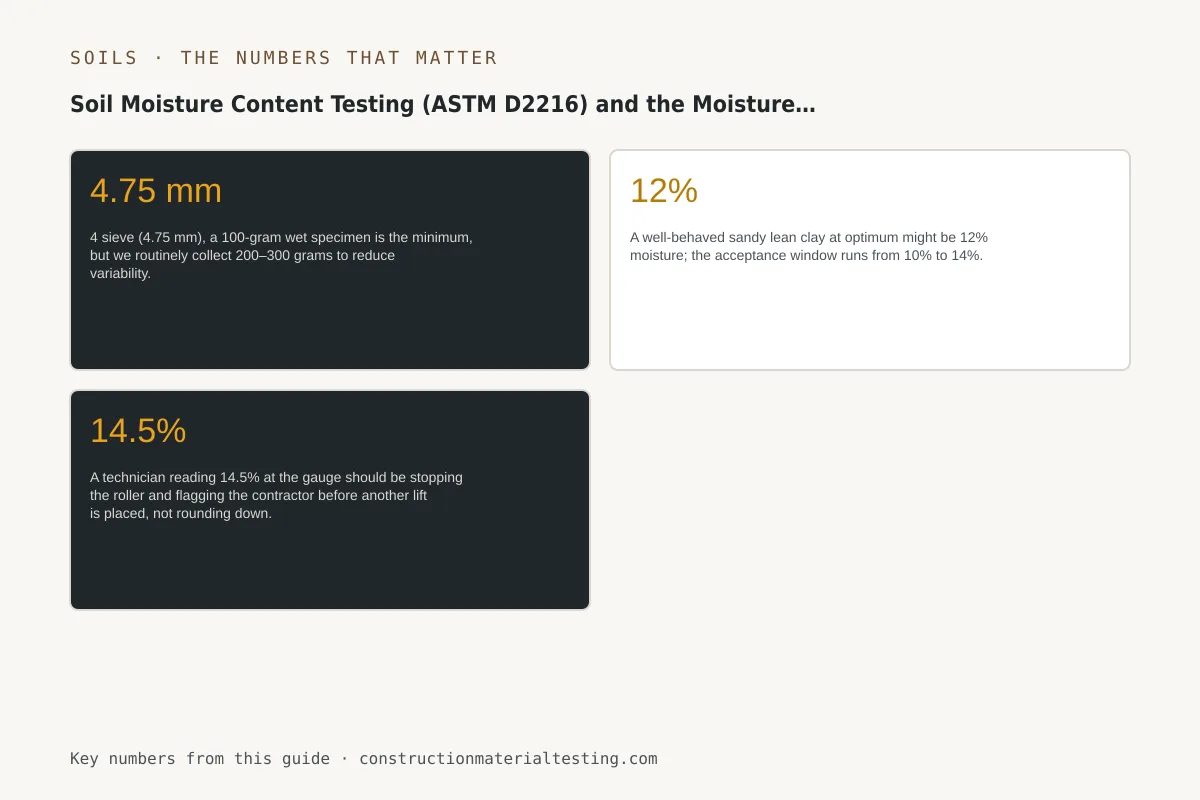
Sample mass matters. ASTM D2216 tables specify minimum specimen sizes based on maximum particle size; for a soil with maximum particles passing the No. 4 sieve (4.75 mm), a 100-gram wet specimen is the minimum, but we routinely collect 200–300 grams to reduce variability. We use pre-weighed, numbered tare containers — steel tins or aluminum dishes — and record the tare weight, wet weight, and oven-dry weight for each specimen. The arithmetic is simple, but the chain of custody on tare numbers is where field errors most often occur, so our technicians log each tin on the field data sheet at time of collection rather than at the end of the day.
The standard also requires that organic soils, soils containing gypsum, and other chemically sensitive materials be dried at 60 °C rather than 110 °C, because higher temperatures can drive off chemically bound water or alter the composition of certain minerals, giving a falsely high moisture reading. When we encounter dark, fibrous, or highly plastic material that may contain organics, we flag it on the chain of custody and the laboratory dries it at the lower temperature, noting the deviation in the report.
Oven, Microwave, or Nuclear Gauge: Choosing the Right Field Method
ASTM D2216 is a laboratory method. Results take overnight, which creates a lag between compaction and acceptance that not every schedule can absorb. Two field alternatives — microwave drying per ASTM D4643 and nuclear gauge moisture per ASTM D6938 — give results in minutes, but each comes with conditions that contractors and inspectors should understand before relying on them.
Microwave drying works by heating the sample in short bursts, weighing between intervals until mass stabilizes. Done carefully on uniform soils, it agrees well with oven results. The problem is that microwaves heat unevenly, and soils with significant gravel or with high clay mineral content can scorch locally before the bulk of the sample is dry, giving a falsely high moisture reading. We treat microwave results as field screening values and confirm with oven drying when results are near the edge of the acceptance window. ASTM D4643 itself recommends correlation with D2216 whenever the method is applied to a new soil type.
Nuclear gauges measure moisture by counting slow neutrons that have been thermalized — slowed down — by hydrogen atoms in soil water. The gauge is fast and non-destructive, but its calibration is inherently tied to the hydrogen content of the specific soil mineralogy and organic matter, not just to free water. A gauge calibrated on a sandy fill will overread or underread on a high-plasticity clay with different hydrogen-bearing minerals. For any new borrow source, we run side-by-side comparisons — oven D2216 versus gauge — across the expected moisture range and develop a site-specific offset before the gauge is used for acceptance. Skipping that step is one of the most common sources of systematic moisture error we see on earthwork projects.
- ASTM D2216 (oven): reference method, overnight result, used for laboratory compaction correlation and dispute resolution
- ASTM D4643 (microwave): 5–15 minute result, valid for screening on uniform soils, requires correlation with D2216 on new soil types
- ASTM D6938 (nuclear gauge): real-time result, simultaneous density and moisture, requires source-specific calibration before acceptance use
- All three methods express moisture as a percentage of dry soil mass — the number means the same thing; what differs is reliability and required verification
The Moisture Window: Optimum ±2% and What Happens Outside It
Most earthwork specifications written to IBC or project-specific geotechnical requirements call for compaction to a minimum relative compaction — commonly 95% of maximum dry density per ASTM D698 for structural fills — with field moisture within a band around optimum, frequently expressed as optimum moisture content ±2%. That two-percentage-point band is narrower than it sounds. A well-behaved sandy lean clay at optimum might be 12% moisture; the acceptance window runs from 10% to 14%. A technician reading 14.5% at the gauge should be stopping the roller and flagging the contractor before another lift is placed, not rounding down.
Dry of optimum, soil particles resist densification. You can apply the same compaction energy and achieve lower density — or achieve nominally acceptable density in the upper few inches while leaving the middle of the lift undercompacted. Subgrades compacted too dry are also brittle and tend to ravel or crack when loaded, particularly problematic under rigid pavement. Wet of optimum, the opposite problem appears: pore pressure from excess water prevents particles from packing together, and the compactive effort is partially absorbed by displacing water laterally rather than increasing density.
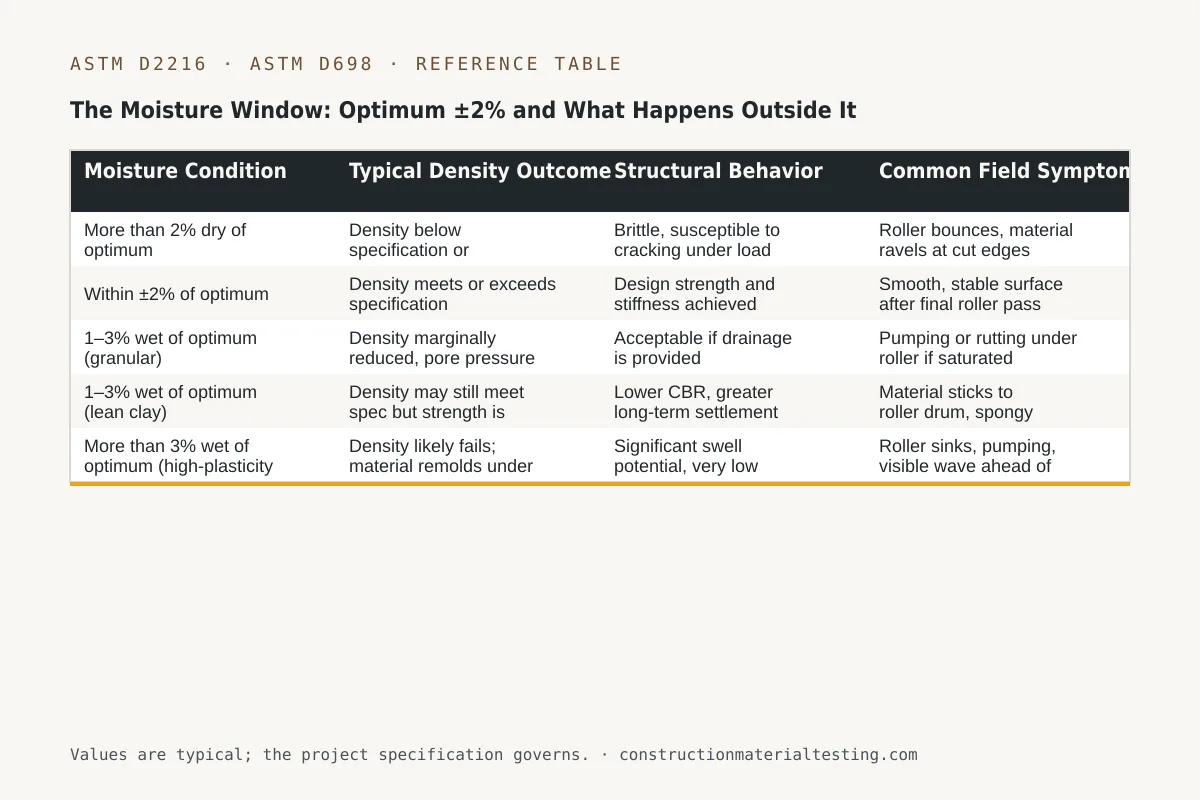
The table below summarizes the practical effects of moisture relative to optimum for common earthwork scenarios, based on soil mechanics principles well documented in geotechnical literature.
| Moisture Condition | Typical Density Outcome | Structural Behavior | Common Field Symptom |
|---|---|---|---|
| More than 2% dry of optimum | Density below specification or variable by depth | Brittle, susceptible to cracking under load | Roller bounces, material ravels at cut edges |
| Within ±2% of optimum | Density meets or exceeds specification consistently | Design strength and stiffness achieved | Smooth, stable surface after final roller pass |
| 1–3% wet of optimum (granular) | Density marginally reduced, pore pressure dissipates quickly | Acceptable if drainage is provided | Pumping or rutting under roller if saturated |
| 1–3% wet of optimum (lean clay) | Density may still meet spec but strength is reduced | Lower CBR, greater long-term settlement risk | Material sticks to roller drum, spongy underfoot |
| More than 3% wet of optimum (high-plasticity clay) | Density likely fails; material remolds under roller | Significant swell potential, very low shear strength | Roller sinks, pumping, visible wave ahead of drum |
Wet-of-Optimum Clays: A Special Case Worth Slowing Down For
High-plasticity clays — the CH and MH soils common in the Texas Gulf Coast region — behave differently from granular soils and from lean clays when moisture exceeds optimum. Their structure at wet-of-optimum moisture is oriented or dispersed rather than flocculated, which means lower unconfined compressive strength, higher swell potential upon wetting, and greater sensitivity to freeze-thaw cycles compared with the same soil compacted dry of optimum. These effects were documented in foundational compaction research and are why geotechnical reports for projects underlain by expansive clays frequently specify a target moisture of optimum to 2% wet of optimum — or in some cases, optimum to 2% dry — depending on whether swell control or strength governs the design.
The practical challenge is that expansive clay in Texas often arrives at grade already near or above optimum during wet seasons, and drying it back down requires either mechanical aeration with a disk or blade, time, or the addition of lime to reduce plasticity and shift the optimum curve. We flag this condition at the first moisture test rather than waiting for density failures, because the window to correct a wet-of-optimum clay fill closes fast once the next lift is placed on top. Our field reports identify both the measured moisture and its position relative to optimum so the contractor and engineer can make an informed decision without having to look up the Proctor curve themselves.
For structural fills under slabs on expansive clay subgrades, geotechnical engineers frequently specify moisture conditioning to a target 1–2% above optimum combined with proof rolling — the combination of controlled moisture and traffic-induced stress reveals soft spots that density testing alone can miss. This is one of the scenarios where having both nuclear gauge results in real time and oven-confirmed moisture content before concrete placement gives the owner the clearest picture of what is under the slab.
Field Sampling and Common Errors That Invalidate Results
A technically correct D2216 procedure produces a wrong answer if the sample is not representative. The most common sampling error on compacted fill is collecting surface material that dried out during the delay between compaction and testing. The top half-inch of a clay fill can lose 1–2% moisture to evaporation within an hour on a Texas summer afternoon while the compacted material below it remains at the as-compacted moisture. We collect samples from the middle third of the compacted lift — typically at the same depth as the density gauge source rod — using a sampling spoon driven horizontally into the lift face or into the hole made by the nuclear gauge. Material scrape from the surface is not acceptable for moisture correlation with density.
Sealing samples immediately matters. We use self-sealing plastic bags inside labeled tins for field samples sent to the laboratory, and for samples weighed in the field before oven drying, tins with tight-fitting lids. Samples left open in a truck cab during a long drive lose measurable moisture before the initial wet weight is recorded, which will report a falsely low moisture content and make a wet-of-optimum condition appear compliant. It is a small discipline — bag it the moment you collect it — with a large impact on data quality.
Our materials testing services include field sampling protocols as part of the inspection scope, not as an add-on, because the test result is only as trustworthy as the sample it started with. The laboratory procedure described in ASTM D2216 is precise enough that sample handling in the field is almost always where variability enters the system.
Where This Fits on Your Project
Moisture content testing is not a box to check after compaction — it is decision-support information that should arrive before the next lift goes down. Whether you are conditioning borrow material at the stockpile, managing a wet-season clay subgrade, or verifying that imported granular base is within specification before paving, the moisture window is where the work either succeeds or has to be redone. Our technicians in the field and the laboratory team processing specimens operate under a documented quality system, so when a result leaves our office, the chain of custody from sampling tin to final report is intact.
If you have a project starting up — an earthwork package with multiple borrow sources, a slab-on-grade over expansive clay, or a paving structure requiring documented subgrade compaction — connect with our field desk early. We will identify which moisture methods are appropriate for your soil types, establish correlation testing before field operations begin, and set up a testing frequency schedule that keeps your schedule moving without gaps in documentation. Request a proposal and let us know the soil types and schedule so we can size the scope correctly.
Get our guides in your Google results
Add Construction Materials Testing as a preferred source and Google shows our guides more often when you search for testing topics.