
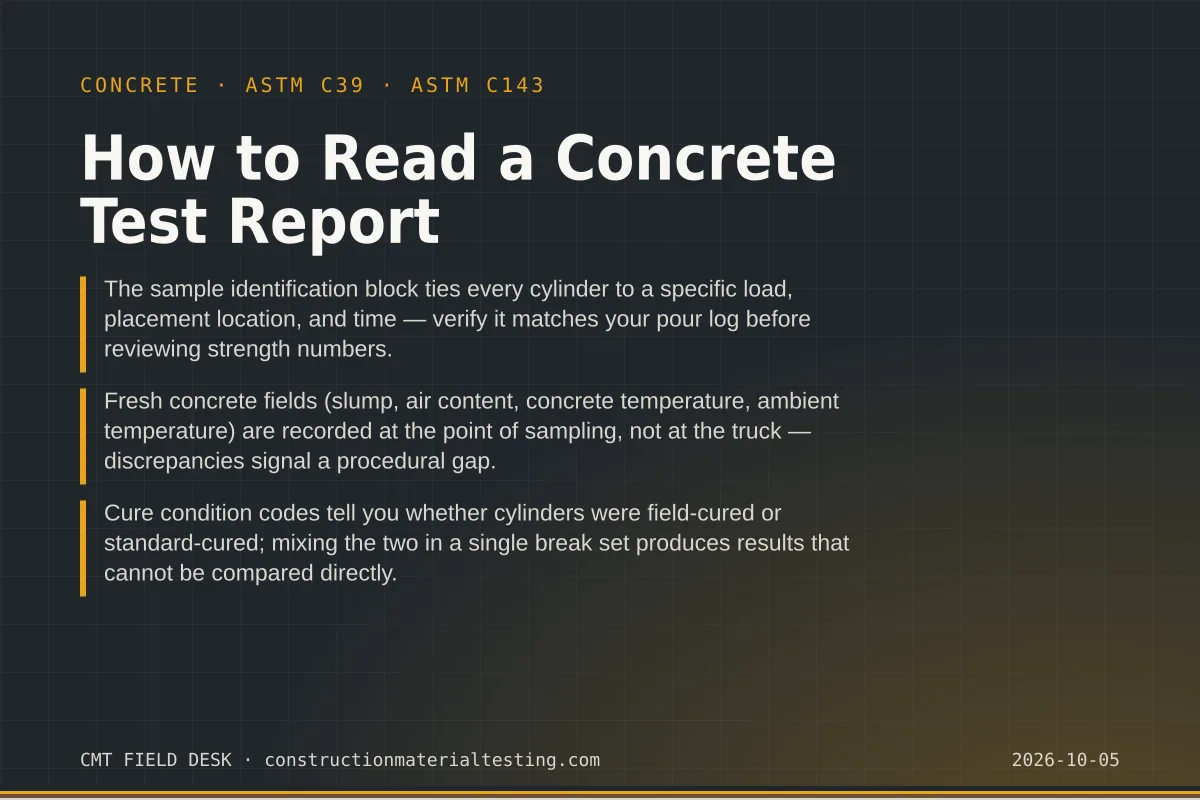
What Every Field on a Concrete Test Report Actually Means
A concrete test report is the written record that connects a specific batch of concrete to the structural element it became. The top block — sometimes called the project or sample identification block — carries the project name, permit or contract number, element description (footing, slab on grade, column, etc.), pour date, and the ticket number from the ready-mix delivery. That ticket number is the link back to the batch plant's mix design and material certifications. If the ticket number is missing or illegible, the report cannot be fully traced, and you should request a corrected copy before the report enters the project file.
Directly below the identification block, the report records fresh-concrete field data captured at the time of sampling: slump per ASTM C143, air content per ASTM C231, concrete temperature, and ambient (air) temperature. These are point-in-time measurements taken from the sample used to cast the cylinders — not from the truck as a whole. The technician also records the time of sampling, which matters because ASTM C31 sets a 5-minute limit from obtaining the composite sample to starting the slump test. If the time stamps on the report are inconsistent with that window, the fresh-concrete data may not be valid.
Cylinder IDs, Cure Conditions, and the Chain of Custody
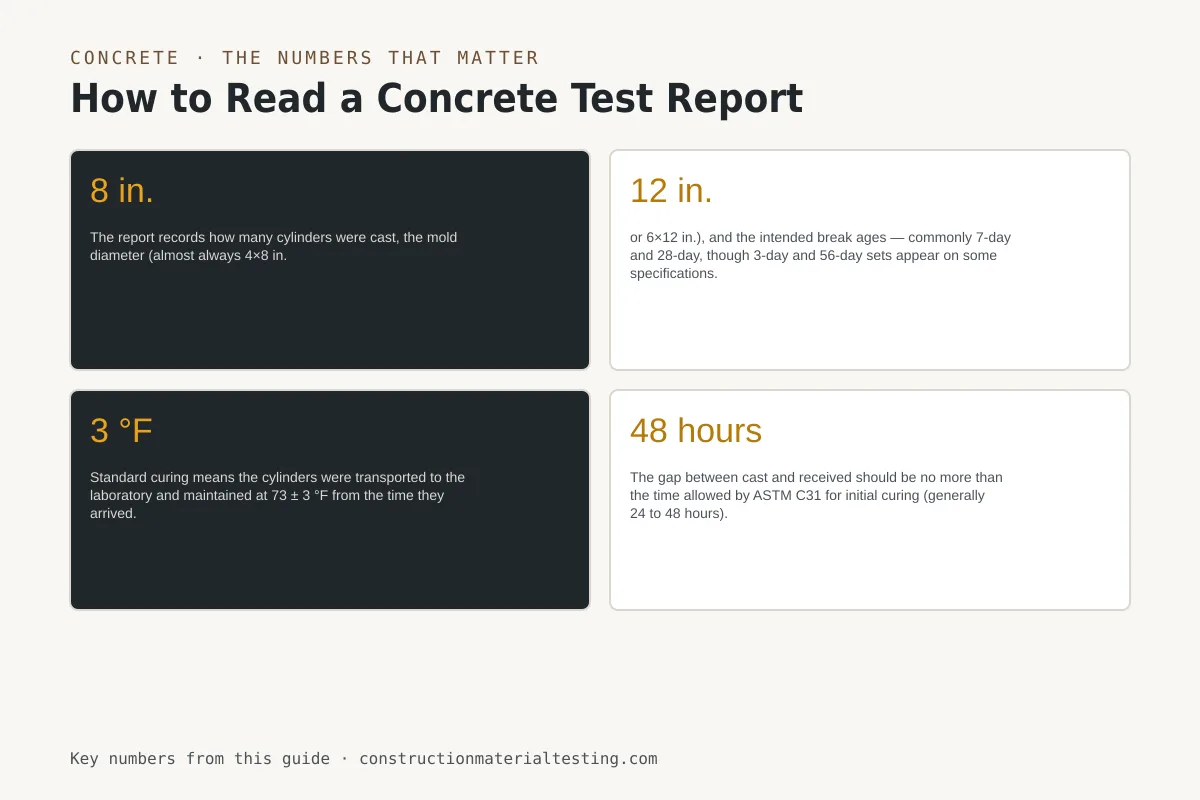
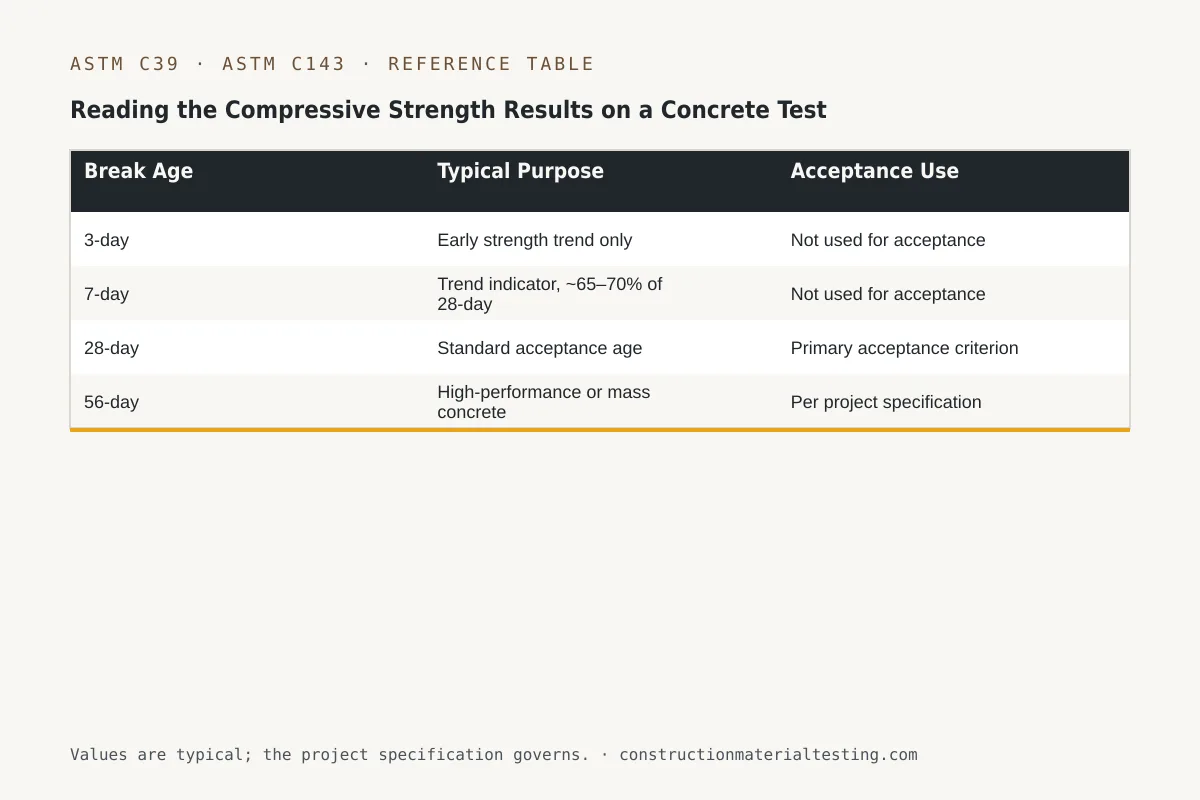
Each set of cylinders cast from a single sample gets a unique cylinder identification, usually a sequential number or an alphanumeric code that appears on both the report and the physical label applied in the field. The report records how many cylinders were cast, the mold diameter (almost always 4×8 in. or 6×12 in.), and the intended break ages — commonly 7-day and 28-day, though 3-day and 56-day sets appear on some specifications. A 7-day break is a trend indicator, not an acceptance criterion; 28-day results govern acceptance under most structural specifications.
Cure condition is one of the most consequential fields on the report and one of the most frequently misread. Standard curing means the cylinders were transported to the laboratory and maintained at 73 ± 3 °F from the time they arrived. Field curing means the cylinders stayed on the jobsite, in conditions matching what the in-place concrete experienced, for the duration specified — typically used for form-stripping or post-tension decisions, not for specification acceptance. ASTM C31 prohibits comparing a field-cured result to a standard-cured strength requirement as though they are equivalent. When you see both cure conditions in a single report set, confirm with the engineer of record which results apply to which decision.
Chain of custody is established by three dates: the cast date recorded in the field, the received date logged when the laboratory takes custody of the cylinders, and the break date. The gap between cast and received should be no more than the time allowed by ASTM C31 for initial curing (generally 24 to 48 hours). A received date that is days after the cast date — or a received date that precedes the cast date, which does happen through data-entry error — is a flag that needs resolution. Our materials testing services include custody logging at each transfer point so these gaps are caught before the report is issued.
Reading the Compressive Strength Results on a Concrete Test Report
The strength summary section lists the break load in pounds-force (lbf), the calculated cross-sectional area of the cylinder in square inches, and the resulting compressive strength in pounds per square inch (psi). The area is computed from a measured diameter taken immediately before the break, per ASTM C39, not assumed from the nominal mold size. A cylinder that experienced damage during transport may have a non-circular cross section; a note in the "fracture type" or "remarks" column will indicate whether the failure pattern was acceptable (cone, cone and shear, cone and split) or anomalous (columnar, shear). Anomalous fracture patterns do not automatically invalidate a result, but they warrant a closer look at the end preparation.
The specification comparison column — often labeled "f'c" or "required strength" — shows the design compressive strength the mix must meet. Per the ACI 318 Building Code, a strength test is the average of two cylinders broken at the same age from the same sample. A single test (that average) is considered to fall below the specified strength if it is more than 500 psi below f'c for concrete with f'c of 5,000 psi or less, or more than 0.10 × f'c below for higher-strength concrete. One failing test triggers an investigation procedure under ACI 318, not immediate rejection of the in-place concrete. Additional testing — cores, load tests, or revised analysis — may demonstrate that the structure is adequate even when cylinder breaks are low. Understanding this distinction is important: the cylinder break and the in-place concrete are not the same thing.
Our technicians are ACI-certified and follow the ASTM C39 procedure for capping or grinding, centering, and loading rate. We detail those steps in our ASTM C39 test method page for anyone who wants to understand how the number on the report was produced. The reviewer signature at the bottom of the report — and the report issue date — confirm that a qualified staff member has checked the data for internal consistency before release. An unsigned report is a draft; treat it as such.
| Break Age | Typical Purpose | Acceptance Use |
|---|---|---|
| 3-day | Early strength trend only | Not used for acceptance |
| 7-day | Trend indicator, ~65–70% of 28-day | Not used for acceptance |
| 28-day | Standard acceptance age | Primary acceptance criterion |
| 56-day | High-performance or mass concrete | Per project specification |
Where This Fits on Your Project
Reading a concrete test report correctly is a basic quality-control discipline, not a specialty skill — but it requires knowing what each field is supposed to contain and what deviation looks like. If your project team is receiving reports with missing ticket numbers, inconsistent cure codes, or no reviewer signature, those are process problems that compound when a low break arrives and no one can reconstruct what happened in the field. Our technicians record fresh-concrete data, cast and label cylinders, maintain custody logs, and issue reports through a documented quality system precisely so that the report can be defended if a result is questioned.
If you want to understand how slump testing or air content measurement fit into the broader picture of concrete field testing, those pages walk through the procedures in the same level of detail. When you are ready to set up testing for an upcoming pour or want a second opinion on a report your current laboratory produced, request a proposal and we will respond with scope, frequency recommendations, and regional dispatch availability.
Get our guides in your Google results
Add Construction Materials Testing as a preferred source and Google shows our guides more often when you search for testing topics.