
What the Code Actually Requires
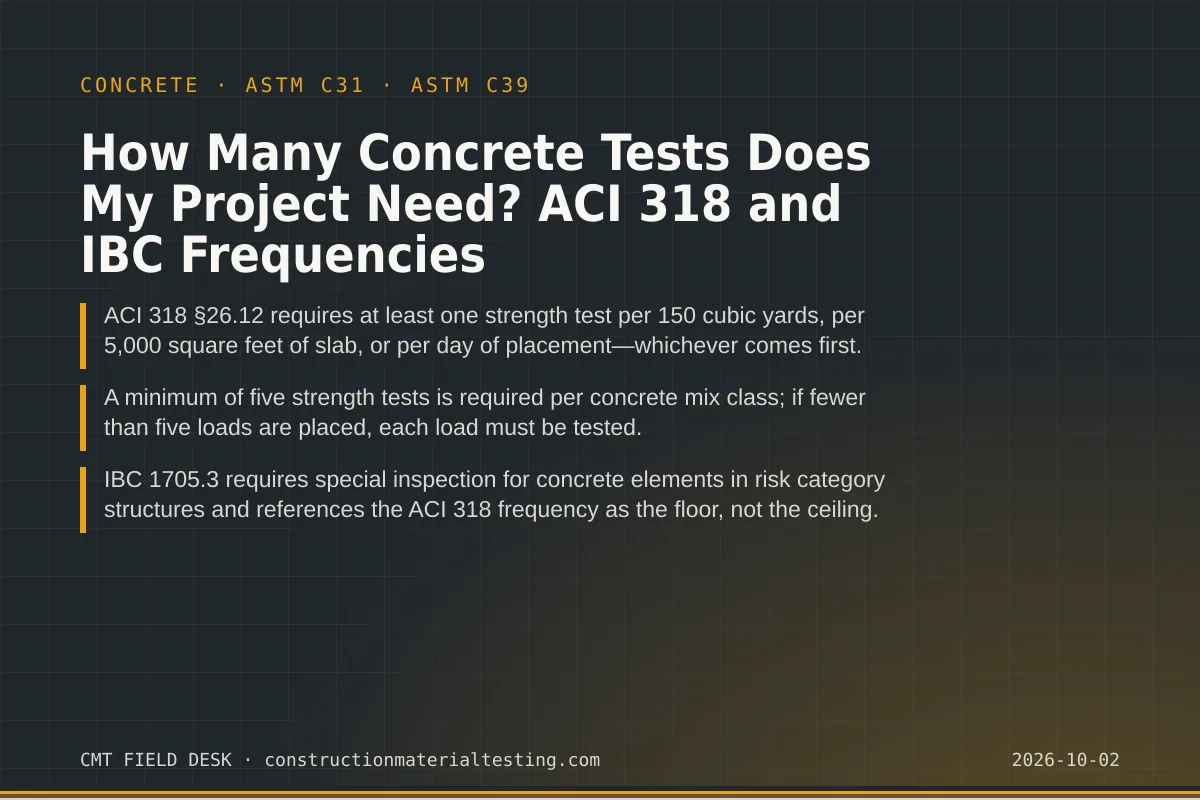
The direct answer: under ACI 318 Building Code §26.12, a strength test is required once per day of concrete placement, once per 150 cubic yards placed, and once per 5,000 square feet of slab or wall panel—whichever of those three triggers fires first. On top of that, a minimum of five strength tests must be obtained for each class of concrete used on a project. If the total volume of a given mix class is small enough that fewer than five loads are placed, every single load requires a test. These are floors, not targets.
A 'strength test' under ACI 318 is not a single cylinder. It is the average compressive strength of at least two cylinders made from the same sample of concrete at the same time, cured under the same field conditions, and broken at 28 days. We make those cylinders in the field following ASTM C31 specimen fabrication procedures and break them in the lab following ASTM C39 compressive strength procedures. The distinction matters when you are counting tests for specification compliance—one pour, one sample, two or more cylinders, one test result.
How IBC 1705.3 Layers On Top of ACI 318
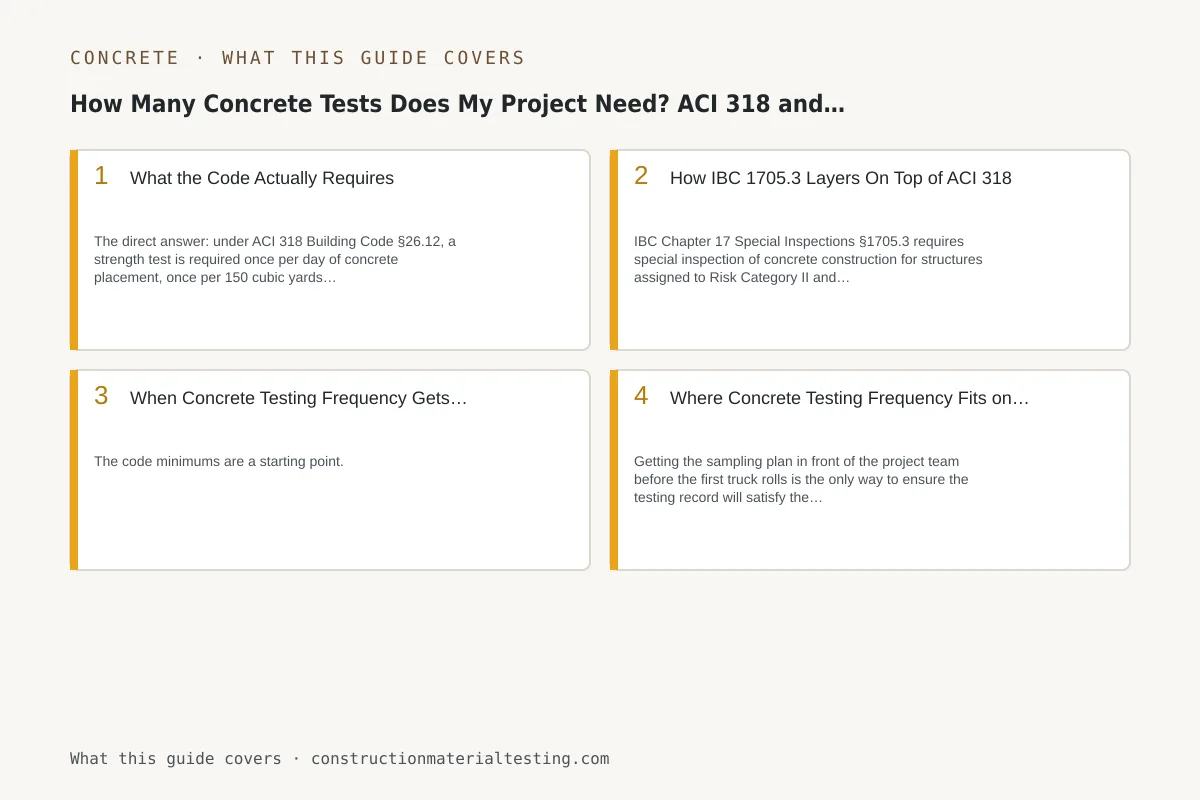
IBC Chapter 17 Special Inspections §1705.3 requires special inspection of concrete construction for structures assigned to Risk Category II and above—which captures virtually every commercial, institutional, and multi-family building. The section calls out continuous or periodic inspection depending on the operation, and it ties strength testing directly to the statement of special inspections prepared by the registered design professional. What this means in practice is that the testing frequency documented in the statement of special inspections becomes a contractual and code requirement, not just a quality recommendation.
IBC 1705.3 does not invent a different frequency than ACI 318—it adopts the ACI 318 §26.12 triggers and makes compliance with them a special inspection item. Failure to perform the required tests is a special inspection deficiency. On permitted projects, that deficiency has to be resolved before a certificate of occupancy issues. We document every sampling event on our field reports, and those reports feed directly into the special inspection record the engineer of record assembles at project closeout.
When Concrete Testing Frequency Gets Tighter Than Code
The code minimums are a starting point. Project specifications—especially on public work, transportation structures, or projects with a structural engineer who has reason to be cautious about a mix design—frequently compress the interval. Common tightened intervals we encounter include one test per 100 cubic yards, one test per 50 cubic yards for high-strength or post-tensioned elements, and one test for every truck on the first day of a new mix class. None of those are unusual, and none require a variance or waiver; the design team simply writes them into the project specification.
Mix class matters too. A project using a 4,000 psi mix for footings, a 5,000 psi mix for columns, and a 4,000 psi lightweight mix for elevated slabs has three classes—each requiring its own minimum of five tests. We track this by mix design submittal number, not just by strength, because two mixes can share a nominal design strength but have different cement factors, admixtures, or aggregate sources, and ACI treats them separately. Confusing mix classes is one of the more common errors we see when a contractor tries to self-administer the testing count.
Pre-pour planning is the most effective cost control. When we know the pour schedule and the mix classes in advance, we can place technicians to avoid redundant mobilizations and ensure the sample is pulled at the right discharge point—not at the end of a truck that has been sitting in traffic. Our materials testing services cover the full concrete testing scope, and early coordination with the field schedule prevents the gaps that require remedial testing later.
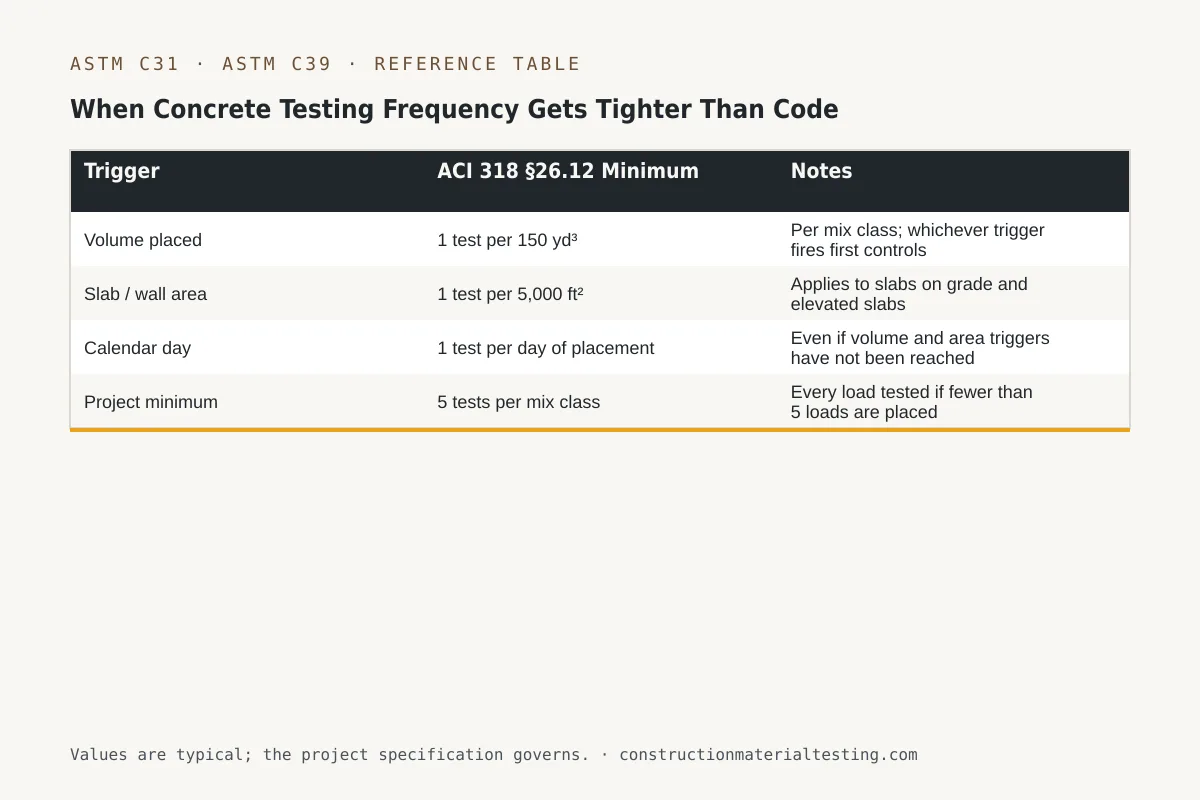
| Trigger | ACI 318 §26.12 Minimum | Notes |
|---|---|---|
| Volume placed | 1 test per 150 yd³ | Per mix class; whichever trigger fires first controls |
| Slab / wall area | 1 test per 5,000 ft² | Applies to slabs on grade and elevated slabs |
| Calendar day | 1 test per day of placement | Even if volume and area triggers have not been reached |
| Project minimum | 5 tests per mix class | Every load tested if fewer than 5 loads are placed |
Where Concrete Testing Frequency Fits on Your Project Schedule
Getting the sampling plan in front of the project team before the first truck rolls is the only way to ensure the testing record will satisfy the structural engineer of record and the building department at closeout. We review the statement of special inspections, the mix design submittals, and the pour schedule to produce a testing plan that meets both the ACI 318 §26.12 minimums and any tighter specification requirements. If your project is still in preconstruction, that is the right time to request a proposal so the testing scope and mobilization logistics are priced against an actual schedule rather than a rough estimate.
Get our guides in your Google results
Add Construction Materials Testing as a preferred source and Google shows our guides more often when you search for testing topics.