
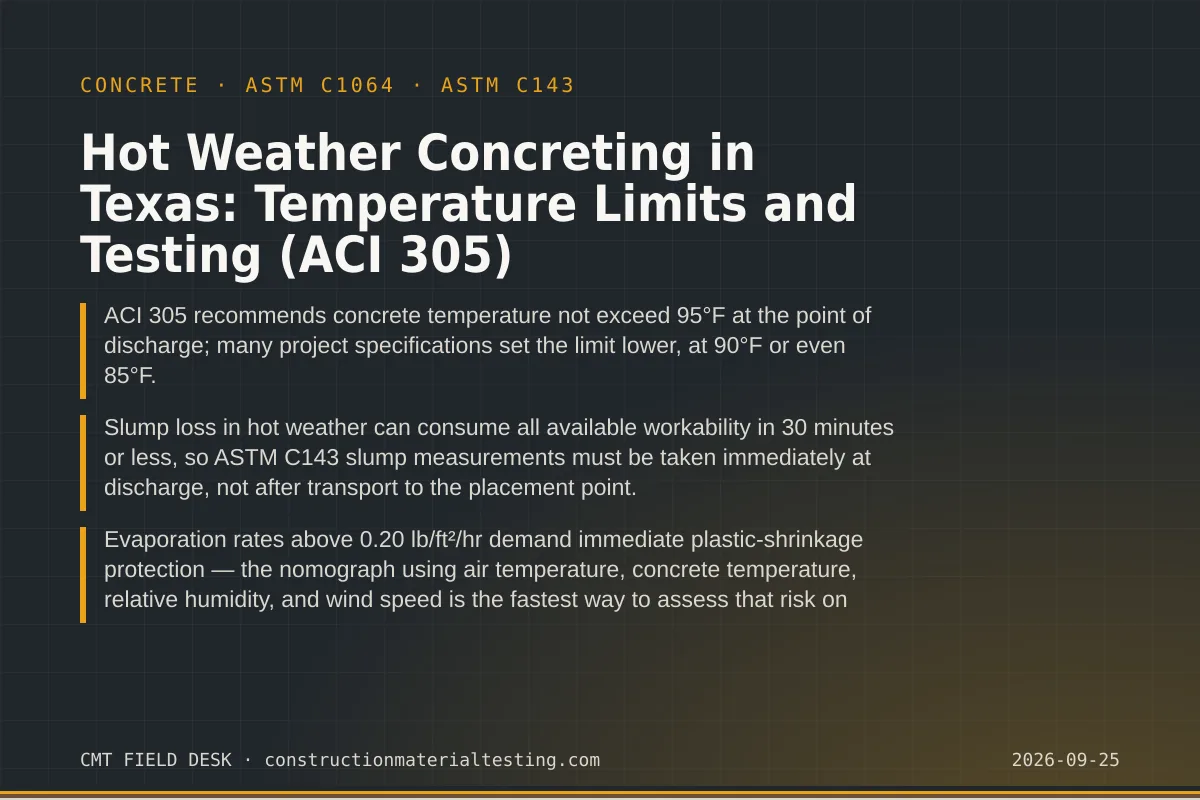
Why Hot Weather Concrete Is a Year-Round Texas Problem
Most of the continental United States treats hot weather concreting as a seasonal concern bracketed by Memorial Day and Labor Day. In Texas, the window is far wider. Afternoon air temperatures above 90°F arrive in April across the Houston metro and linger through October. In the inland basins around Dallas and San Antonio, radiant heat from pavement and tilt-wall panels can push ambient conditions into hot-weather territory even on days when the thermometer reads only 85°F. Any project team that treats ACI 305 as a summer-only document will eventually pay for that assumption with cracked slabs, failed cylinders, or both.
ACI 305R, the committee report that governs hot weather concreting, defines hot weather not strictly by air temperature but by any combination of conditions — high temperature, low humidity, high wind, or solar radiation — that accelerates moisture loss or hydration to a degree that compromises the concrete's fresh or hardened properties. That definition matters because it means a cloudy 88°F day in Galveston with no wind may present fewer risks than a sunny 82°F day in Abilene with a 20-mph southwest wind. Understanding which environmental variables matter most, and how they interact, is the starting point for every hot-weather concrete plan.
Our technicians dispatch from hubs across the state and see both extremes regularly. The practical difference between the Gulf Coast and North Texas is not just temperature — it is the dominant failure mode. In Houston, the risk is heat accumulation and retarded or accelerated set time depending on admixture chemistry. In Dallas and West Texas, the risk skews toward plastic shrinkage cracking driven by evaporation. The testing and mitigation strategies overlap, but the emphasis shifts. This guide addresses both environments and the specifications that govern both.
ACI 305 Temperature Limits and Where 95°F Comes From
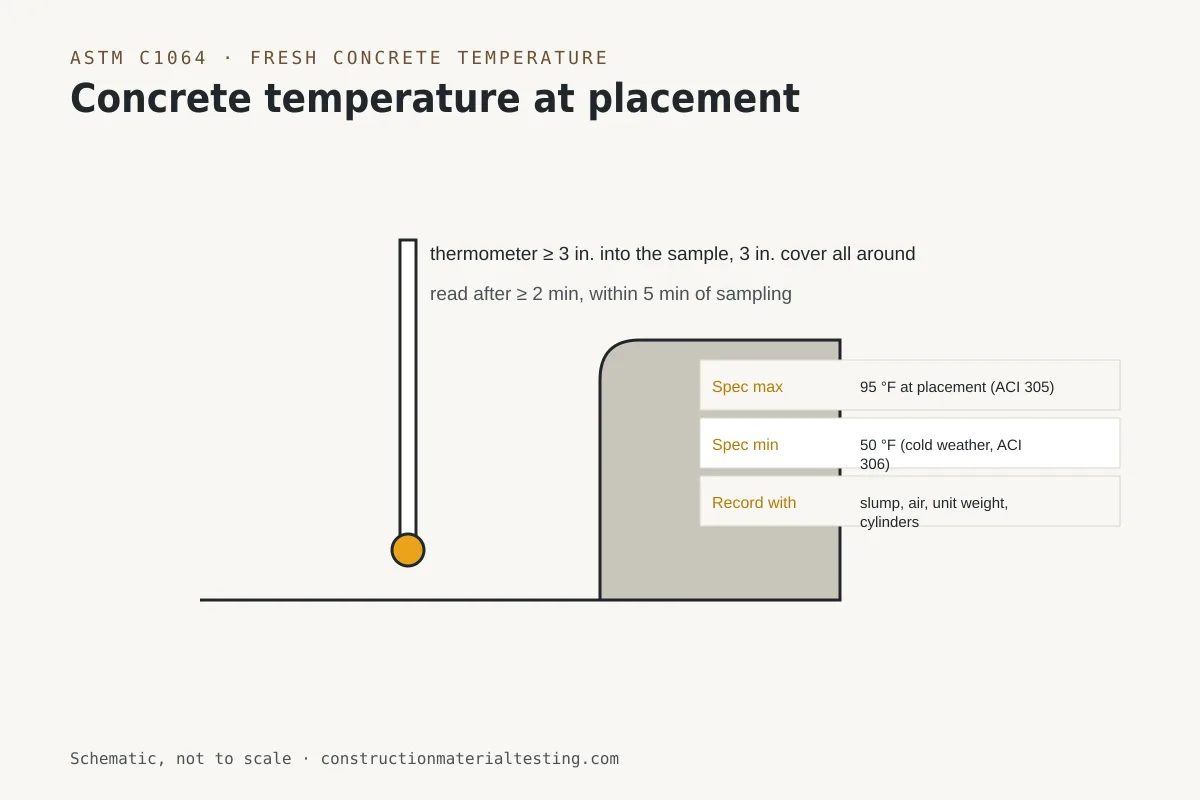
ACI 305R recommends that concrete temperature at the point of discharge not exceed 95°F (35°C). That number is not arbitrary. Laboratory research cited in the committee report shows that cement hydration accelerates nonlinearly above roughly 77°F, and that concrete mixed and placed at temperatures approaching 95°F produces lower 28-day compressive strength, higher water demand, and reduced durability compared with concrete placed at 65–75°F — even when the water-cement ratio and slump are held constant at the time of placement.
The 95°F limit is a ceiling, not a target. Many Texas DOT projects and petrochemical-sector specifications require concrete temperature at discharge to remain at or below 90°F, and some mass concrete placements or post-tensioned deck pours carry 85°F limits. The engineer of record sets the project limit; the testing agency's job is to measure it objectively using ASTM C1064 and report what the thermometer reads. There is no rounding, and the result is not subject to negotiation at the truck.
It is also worth noting that concrete temperature and air temperature are related but not the same. Aggregate stockpiles in direct sun can reach 130°F or higher, and aggregate makes up roughly 70–75% of concrete's mass. A plant cooling only its mix water will often find the delivered concrete temperature still exceeds the spec limit because the rock is the dominant heat source. Effective pre-cooling programs address aggregate temperature through stockpile shading, water sprinkling, or direct chilling, combined with ice substitution for a portion of the mix water. Our materials testing services can include pre-placement concrete temperature verification as part of a full special inspection scope.
The American Concrete Institute publishes ACI 305R as part of its concrete practice document library. Project teams should reference the current edition; committee reports are updated on irregular cycles, and note content — especially sections on evaporation rate and admixture guidance — does evolve between editions.
ASTM C1064: Taking Concrete Temperature Correctly in the Field
The measurement procedure under ASTM C1064 sounds straightforward — insert a calibrated thermometer into fresh concrete, wait at least one minute, and record. The field reality is more nuanced. The probe must be embedded at least three inches into the concrete and must not contact the drum, the chute, or any metal surface that has been sitting in the sun. A probe resting against a steel chute that has been baking for two hours will read 10–15°F higher than the actual concrete temperature, producing a false fail that sends trucks back to the plant unnecessarily — or worse, a false pass if the probe is cooled by shade.
Sample location matters as well. ASTM C1064 requires the temperature be measured on a representative sample of concrete discharged from the mixer. We take temperature on the same composite sample used for slump and air content testing, withdrawn after discarding the first portion of the load. The measurement should be completed within five minutes of sample collection. If the technician takes slump first, then tracks down the thermometer, then measures temperature, the reading may already reflect three to four minutes of additional heat gain from ambient exposure — a meaningful error on a 90°F day.
Calibration of the temperature probe is not optional. Our technicians verify thermometer calibration against a NIST-traceable reference at the beginning of each day or whenever a probe is replaced. A one-degree-Celsius error in a thermometer seems trivial until the project limit is 90°F and the actual concrete temperature is 89.5°F. External sources confirm the standard: the full ASTM C1064 specification is available at ASTM's official standards portal.
Slump Loss, Set Time, and What the Clock Really Looks Like in Hot Weather Concrete
Slump loss in hot weather concrete is not gradual and linear. It follows a curve that is relatively flat for the first 15–20 minutes after batching, then drops steeply. On a 95°F day with concrete delivered at 90°F, a mix that leaves the plant with 5 inches of slump may arrive at the site with 3.5 inches 30 minutes later — still within spec — but fall to 1.5 inches after another 20 minutes of waiting for the pump to be repositioned. The contractor who orders concrete to arrive 15 minutes before needed on a cool November day is setting up a serious problem in August.
ASTM C143 slump testing must be performed on concrete as discharged, not after it has sat in a buggy or been conveyed through a pump. Our ASTM C143 slump test procedure requires that slump be measured within five minutes of obtaining the composite sample, which itself must be collected within the first and last tenth of the load's discharge. On hot-weather pours, we emphasize this timing requirement to foremen during pre-placement meetings because the instinct to wait until a convenient break in placement can easily convert a passing result into a failing one — or hide a failing result that was already failing when it arrived.
Initial set time is equally sensitive to temperature. Conventional portland cement concrete that sets in approximately four hours at 70°F may reach initial set in two hours or less at 90°F concrete temperature. When retarding admixtures are used — which is common practice in Texas hot-weather placements — the retardation effect is itself temperature-sensitive, and a mix designed for a four-hour working window at 75°F may provide only two and a half hours at 90°F. This compresses the window for finishing operations and increases the risk that bleed water is trapped under a prematurely sealed surface, a precursor to delamination.
Acceleration of set also means that compressive strength gain is front-loaded. Concrete placed at high temperature often exceeds early strength targets (1-day, 3-day) but underperforms at 28 days compared with concrete placed at moderate temperatures. This is a well-documented effect related to the coarser hydration product microstructure that forms at elevated temperatures. Cylinder curing protocol under ASTM C31 requires that freshly cast cylinders be stored at the point of manufacture in a temperature range of 60–80°F for the first 24 hours — a requirement that is routinely violated on Texas job sites when cylinders are left in the bed of a pickup truck in the sun.
Evaporation Rate, the Nomograph, and Plastic Shrinkage Risk
Plastic shrinkage cracking occurs when the rate of surface evaporation exceeds the rate at which bleed water rises to replace it. The concrete surface desiccates while the interior is still plastic, and tensile stresses in the thin, stiffening surface layer exceed its very low early tensile strength. The cracks that result are typically diagonal, 1–3 feet long, and penetrate one to several inches into the slab. They are cosmetically unacceptable in exposed slabs and structurally concerning in slabs on grade that will receive heavy wheel loads or forklift traffic.
ACI 305R provides a nomograph — a multi-axis graph relating air temperature, concrete temperature, relative humidity, and wind speed to a single evaporation rate value in lb/ft²/hr. When that value reaches 0.20 lb/ft²/hr, protective measures are required. At 0.40 lb/ft²/hr, the situation is critical and requires immediate intervention regardless of concrete temperature. The nomograph is not complex to use, but it has to be used before the pour begins, not after the first crack appears. We walk through the nomograph calculation during our pre-pour checklist on any hot-weather placement.
The contrast between Houston and Dallas conditions is dramatic when you run the nomograph. Houston in July: air temperature 94°F, concrete temperature 88°F, relative humidity 72%, wind 8 mph — evaporation rate approximately 0.18 lb/ft²/hr, just below the action threshold. Dallas in May: air temperature 88°F, concrete temperature 85°F, relative humidity 32%, wind 18 mph — evaporation rate can exceed 0.50 lb/ft²/hr, well into critical territory. The Dallas placement is the more dangerous one despite lower temperature numbers, a fact that surprises many contractors who have worked primarily in the Gulf Coast market.
Retempering Rules: What You Can and Cannot Add at the Truck
Retempering is the addition of water or admixtures to concrete after the initial mixing is complete, typically at the job site, to restore workability lost during transport. ACI 305R and standard project specifications almost universally prohibit the addition of water to retemper concrete. The reason is simple and non-negotiable: adding water increases the water-cementite ratio, which reduces compressive strength and durability. A mix designed to achieve 4,000 psi at a 0.45 w/cm ratio does not achieve 4,000 psi if water is added to restore slump at the truck. The concrete cannot know it was supposed to have a different slump when it left the plant.
The permitted alternative — where the project specification and the ready-mix producer's mix design allow it — is to add a portion of the approved high-range water reducer (HRWR) or mid-range water reducer that was withheld at the plant. This is sometimes called a split-dose addition. The admixture must be within the original approved dosage range, the drum must be turned at mixing speed for a specified number of revolutions after addition, and the procedure must be documented on the batch ticket. The technician on site should witness and record the addition. Any addition that cannot be verified against the original batch ticket should be treated as cause to reject the load.
We are frequently asked whether a contractor can simply add a bag of Type I/II cement to stiffen concrete that has segregated or add extra coarse aggregate to correct a mix that looks too wet. Neither is permitted. The mix proportions are fixed in the approved mix design. Anything added at the truck that is not explicitly authorized in writing by the mix design and the project specification is grounds for rejection. In a dispute, the batch ticket and the field technician's daily report are the primary evidence — which is one reason our reports document admixture additions, drum revolutions after addition, and the technician's observation of the procedure.
Specification Temperature Limits by Application
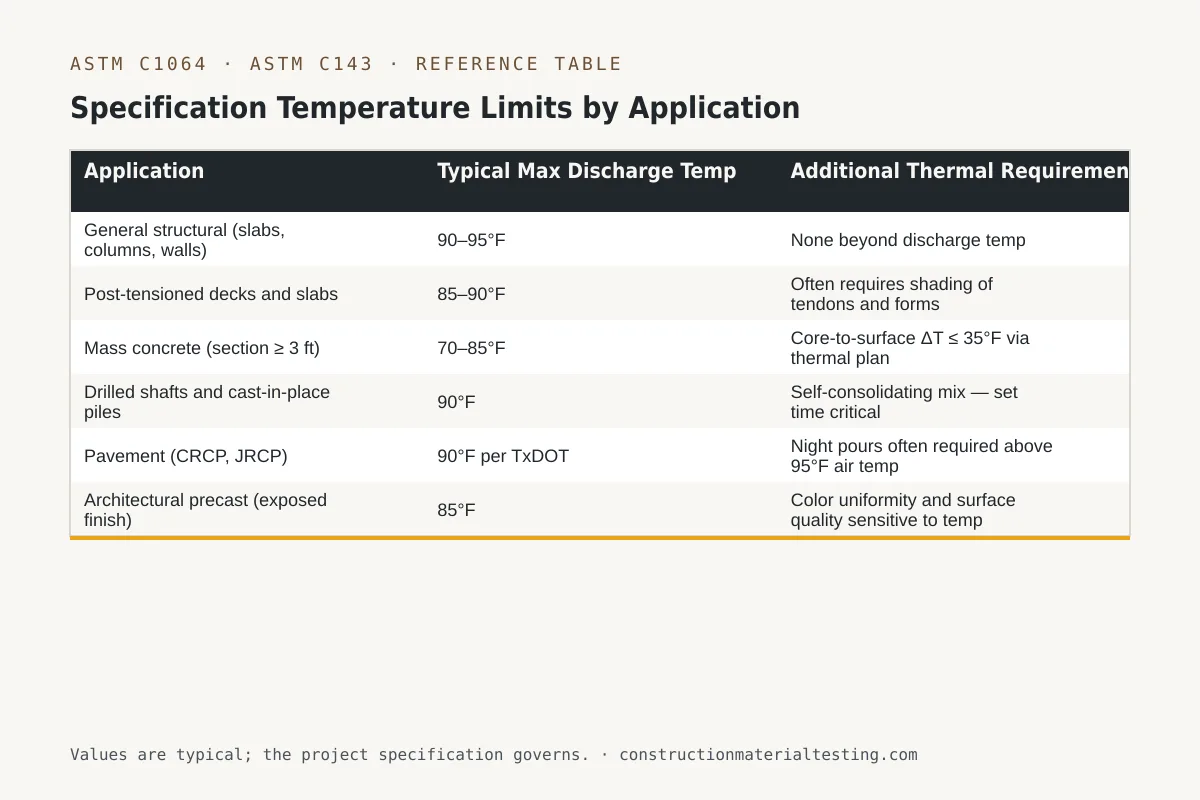
Not all concrete is governed by the same maximum placement temperature. Structural elements with high section thickness — mass concrete footings, pile caps, transfer beams — face a different thermal risk: internal heat of hydration rather than external ambient temperature. These elements often carry not just a maximum placement temperature but also a maximum differential limit between core and surface, typically 35°F, enforced with embedded thermocouples. Meeting the 95°F discharge limit does not guarantee compliance with a mass concrete thermal plan.
The table below summarizes typical project-level temperature limits by concrete application type. These are common practice ranges; the engineer of record's specification governs on any specific project.
| Application | Typical Max Discharge Temp | Additional Thermal Requirement |
|---|---|---|
| General structural (slabs, columns, walls) | 90–95°F | None beyond discharge temp |
| Post-tensioned decks and slabs | 85–90°F | Often requires shading of tendons and forms |
| Mass concrete (section ≥ 3 ft) | 70–85°F | Core-to-surface ΔT ≤ 35°F via thermal plan |
| Drilled shafts and cast-in-place piles | 90°F | Self-consolidating mix — set time critical |
| Pavement (CRCP, JRCP) | 90°F per TxDOT | Night pours often required above 95°F air temp |
| Architectural precast (exposed finish) | 85°F | Color uniformity and surface quality sensitive to temp |
Field Testing Frequency and Documentation During Hot-Weather Pours
Special inspection requirements for concrete under IBC Section 1705 and the applicable ACI 318 sections establish minimum testing frequencies, but hot weather is an explicit trigger for increased frequency in most preconstruction meeting discussions and in sound practice. When a pour begins at 7:00 a.m. with concrete temperature at 82°F and air temperature rising, the concrete arriving at 10:00 a.m. may be a different material in terms of workability and set characteristics even if the batch tickets look identical. Testing only the first truck and the last truck of a three-hour pour misses that evolution.
Our standard hot-weather testing frequency calls for temperature measurement on every load when ambient conditions are within 5°F of the project's maximum discharge limit. When temperatures are comfortably below the limit, we test every five loads or every 50 cubic yards, whichever is more frequent, consistent with the project specification. Every temperature measurement is time-stamped and tied to a truck number and ticket number so that any trend — concrete getting hotter as the day progresses, for example — is visible in the daily report before it becomes a specification violation.
Cylinder fabrication, curing, and transport are amplified concerns in hot weather. ASTM C31 requires that freshly cast cylinders be maintained at 60–80°F for the first 24 hours. On a Texas job site in July, achieving that without an insulated curing box or a temperature-controlled jobsite trailer is essentially impossible if the cylinders are left in a standard plastic carrier on the ground. We carry insulated cylinder carriers and monitor their internal temperature. Cylinders that experience initial curing outside the required range must be flagged in our report; the engineer of record decides how to handle the affected set.
For Houston-area materials testing and Dallas-area materials testing, our regional dispatch hubs can coordinate early-morning pour coverage with technicians on site before first truck arrival, which is the most effective way to manage testing continuity across a long hot-weather pour.
Curing Strategy: Houston Humidity vs. Dallas Wind
Curing in hot weather is not a single protocol. The goal is to maintain moisture and control temperature in the concrete surface zone long enough for adequate hydration to develop — generally considered to require at least seven days of moist curing for standard portland cement mixes, or as specified by the engineer. In hot weather, both moisture retention and temperature management become harder simultaneously, and the dominant challenge differs by region.
In the Houston and Gulf Coast environment, relative humidity frequently exceeds 70% and overnight temperatures remain above 80°F. The concrete surface does not dry as rapidly as in drier climates, but the ambient heat means that concrete temperature remains elevated for longer, slowing the strength gain of properly cured concrete and increasing the risk that temperature-sensitive chemical admixtures behave unpredictably. Wet burlap covered with white polyethylene sheeting is effective here — the burlap holds moisture and the white poly reflects solar radiation, reducing surface temperature by 10–15°F compared with unshaded concrete. Misting systems are also used on large slabs, but misting with warm water offers less benefit than misting with chilled water or fogged water that actually evaporates and cools the surface.
In Dallas, Fort Worth, and the drier inland regions, the combination of low relative humidity and persistent southerly or southwesterly wind makes water loss from the curing medium the primary concern. Wet burlap that is not weighed down at the edges and overlapped generously will dry out in 30–45 minutes without someone actively re-wetting it. White-pigmented curing compound applied immediately after the finishing pass — before any surface skinning — is often the more reliable option in these conditions, provided the compound meets ASTM C309 requirements and the project specification accepts membrane curing. Not all specifications do; some structural elements, particularly formed surfaces that will receive bonded topping or waterproofing, require moist curing rather than membrane curing.
Wind protection is the highest-leverage intervention in North Texas placements. Temporary windbreaks — burlap screens, shade cloth stretched on pipe scaffolding, or foam-board panels on the windward side — can drop the effective evaporation rate below the 0.20 lb/ft²/hr threshold without changing concrete temperature at all. This is worth planning in advance rather than improvising after the first crack appears. A windbreak erected before placement is a prevention measure; one erected after cracking begins is an aesthetic gesture.
Common Hot-Weather Failures and How to Respond
Temperature exceedance at the truck is the most common hot-weather failure mode we document. When a load arrives above the project limit, the correct response is rejection of that load, not negotiation. The batch ticket, the C1064 temperature reading, and the time are recorded; the load is returned to the plant. The contractor then works with the ready-mix supplier to identify the cause — typically, aggregate temperature that was not pre-conditioned, insufficient ice substitution, or plant mixing water that had warmed over the course of the day — and corrective action is implemented before the next load is accepted. If multiple consecutive loads fail temperature, the pour should stop and not resume until the plant can demonstrate it is meeting the limit.
Plastic shrinkage cracking, once it appears, cannot be reversed. The cracks can be routed and sealed if they are wide enough to accept sealant, or left in place if they are hairline and the surface use tolerates them — but neither option restores the uncracked slab. Prevention through the nomograph, windbreaks, and timely fogging is the only effective strategy. If cracking is observed while the concrete is still plastic, immediately fogging the surface, laying wet burlap, and stopping finishing operations until the concrete stiffens can limit further propagation. It cannot close cracks that have already formed.
Cylinder failures attributed to hot weather are usually traceable to one of two causes: initial curing temperature exceedance (cylinders too hot in the first 24 hours) or a genuine reduction in w/cm due to water addition at the truck. Distinguishing between these requires reviewing the batch tickets, the field temperature logs, and the cylinder curing records simultaneously. If the batch ticket shows a compliant mix design and no unauthorized water addition, and the field curing log shows cylinders maintained within the required temperature range, then a strength failure points to the concrete itself — potentially to the mix water temperature at the plant, aggregate absorption variability, or admixture dosing error. Our daily reports are structured to support exactly this kind of forensic review.
Testing Frequency and Action Thresholds Summary
Field teams benefit from having the key thresholds and testing intervals in a single reference. The table below consolidates the primary action levels referenced in ACI 305R, ASTM C1064, and ASTM C143 for hot-weather concrete operations.
| Parameter | Standard | Action Threshold | Field Response |
|---|---|---|---|
| Concrete discharge temperature | ASTM C1064 / ACI 305R | > project limit (typically 90–95°F) | Reject load; notify plant for corrective action |
| Slump | ASTM C143 | Below spec minimum at discharge | Reject load; do not add water |
| Evaporation rate | ACI 305R nomograph | ≥ 0.20 lb/ft²/hr | Implement fogging, windbreaks, or shading before placement |
| Evaporation rate — critical | ACI 305R nomograph | ≥ 0.40 lb/ft²/hr | Halt placement; mandatory protection measures in place first |
| Cylinder initial curing temp | ASTM C31 | Outside 60–80°F in first 24 hr | Flag cylinders in report; engineer determines disposition |
| Core-to-surface ΔT (mass concrete) | Project thermal plan / ACI 305R | > 35°F | Insulate surface; adjust cooling pipe flow if present |
| Water addition at truck | Project specification | Any unauthorized addition | Reject load; document on daily report |
Where This Fits on Your Project
Hot weather concrete management is not a single test — it is a system that connects mix design, delivery scheduling, field testing, protection measures, and documentation into a continuous chain. A gap anywhere in that chain produces a gap in the quality record, and gaps in the quality record become owner liability when a slab cracks or cylinders fail. Our field materials testing services include pre-placement environmental assessment, ASTM C1064 temperature monitoring at every threshold frequency, ASTM C143 slump verification, cylinder fabrication and controlled initial curing, and daily reports that give the engineer and owner a complete picture of each placement.
Whether you are paving a warehouse slab in Katy in June or placing a foundation mat in Frisco in September, the ACI 305 requirements are the same. What changes is which mitigation strategies receive the most emphasis and how early in the morning the pour needs to start. We can help project teams build the hot-weather concrete plan before the first truck rolls, not after the first problem appears. If your project is approaching a hot-weather pour and you need inspection and testing coverage, submit a proposal request and we will scope the testing program based on your mix, your pour volume, and your schedule.
Get our guides in your Google results
Add Construction Materials Testing as a preferred source and Google shows our guides more often when you search for testing topics.