
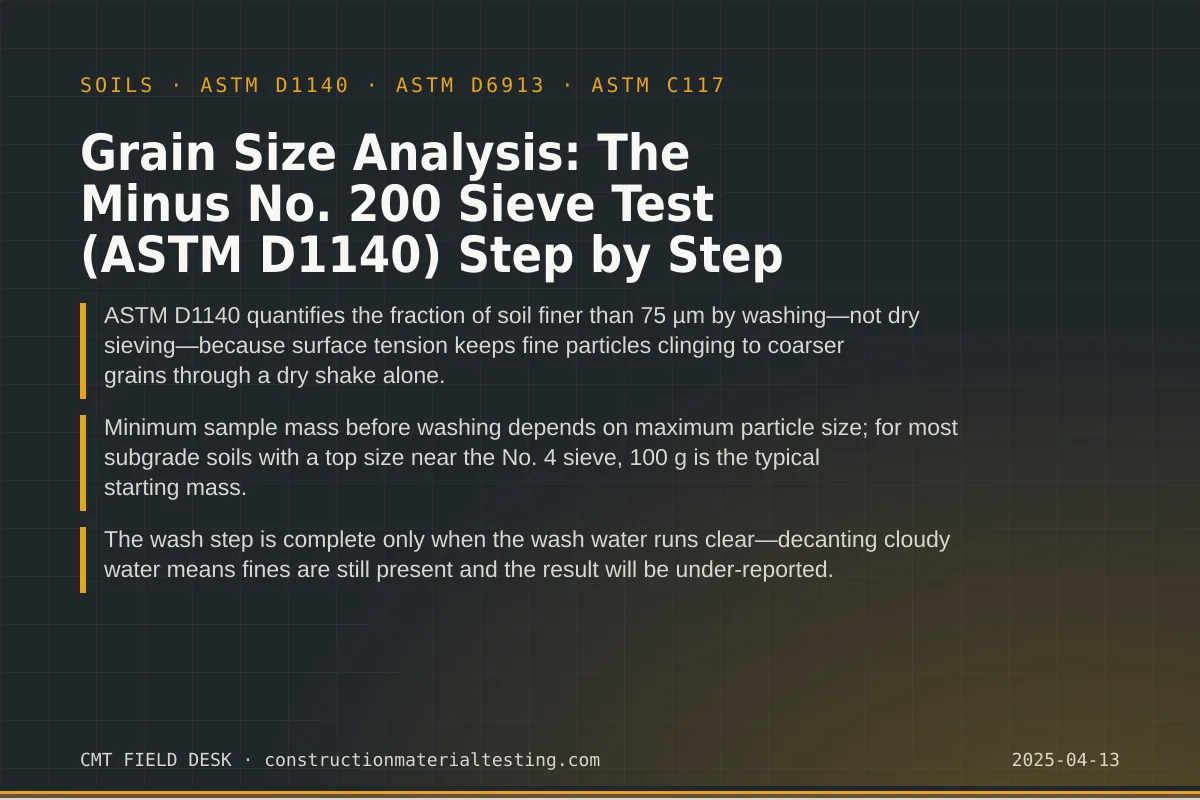
Why Fines Content Controls More Than You Might Expect
The No. 200 sieve has a 75-micrometer opening—smaller than a human hair. Particles that pass through it are silt- and clay-sized, and they behave fundamentally differently from sand or gravel. They hold water by surface adsorption, they swell when wet and shrink when dry, and they block the pore pathways that let excess moisture escape under load. A soil that looks firm in dry weather can become a liability the moment seasonal groundwater or a rain event raises the moisture content near or above the plastic limit.
From a specification standpoint, virtually every select-fill, engineered subgrade, and granular base course requirement carries a ceiling on the percentage passing the No. 200 sieve. TxDOT embankment and subgrade specifications, for example, restrict fines content in select fill, and AASHTO soil classification divides granular materials from fine-grained ones largely at the 35-percent-passing-No.-200 boundary. The minus 200 sieve test is the single measurement that tells you whether a borrow source, a delivered fill load, or a native subgrade can meet those thresholds without treatment.
What many contractors do not realize is that dry sieving alone cannot reliably separate fines from coarser particles. Clay fines bind electrostatically to sand grains and pass through the nest only when water breaks that bond. ASTM D1140 exists precisely because the dry-shake method of ASTM D6913 is not sufficient for this fraction; the wash step is the critical differentiator, not a convenience.
Applicable Standard and When to Use It
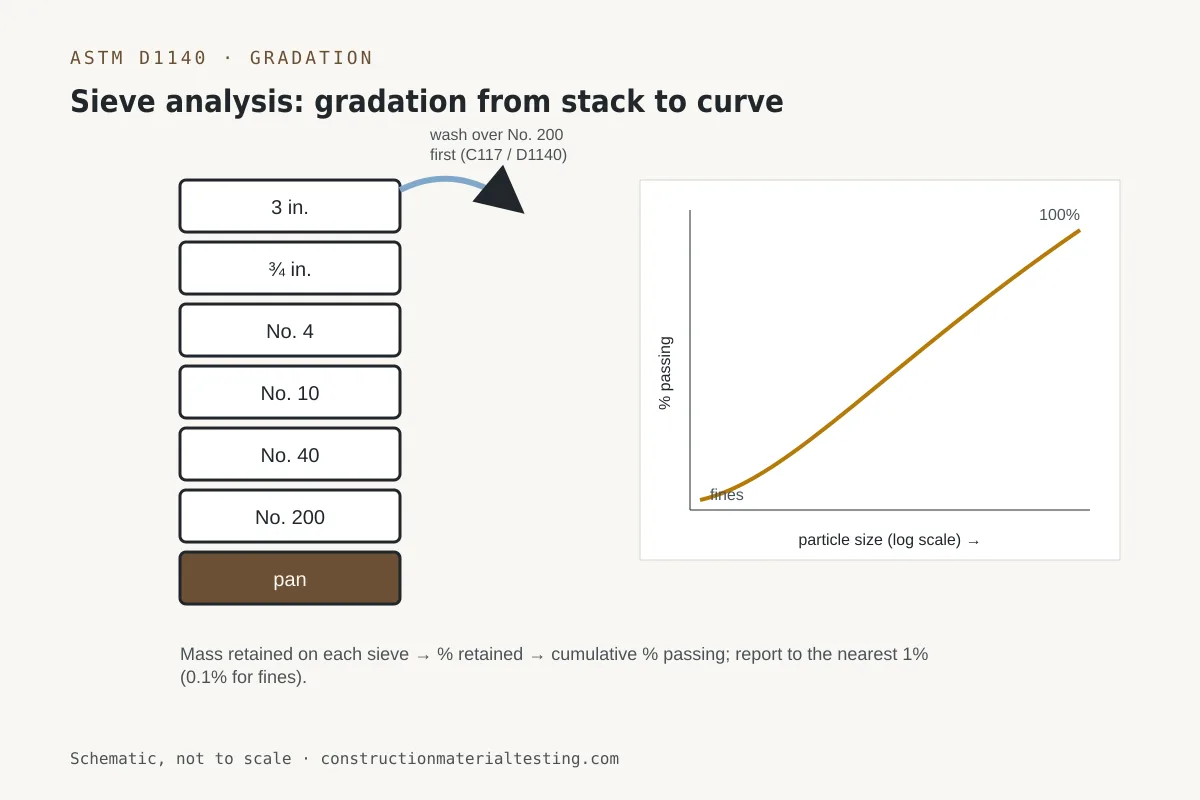
The controlling standard is ASTM D1140, formally titled *Standard Test Methods for Determining the Amount of Material Finer than 75-µm (No. 200) Sieve in Soils by Washing*. It covers two procedures: Procedure A, which uses only the No. 200 sieve; and Procedure B, which uses a protecting sieve (typically No. 40) nested above the No. 200 to reduce puncture risk when coarse material is present. Our laboratory defaults to Procedure B when the sample contains gravel-sized particles.
D1140 is a standalone test, but it is most frequently paired with ASTM D6913 for a full particle-size distribution. When both tests are ordered together, the washed and oven-dried retained material from D1140 becomes the input for the D6913 sieve stack. Running them together is more efficient and eliminates any rounding discrepancy between separately prepared specimens. If only fines content is needed—say, a quick compliance check on incoming fill—D1140 alone delivers that number faster and at lower cost. For aggregate materials rather than soils, the parallel standard is ASTM C117, which uses the same washing principle but has different sample-size requirements tuned to coarse aggregate.
Geotechnical investigations, borrow-source evaluations, pavement subgrade qualification, and stabilization design all trigger a D1140 test. Any time a specification references percent passing the No. 200 sieve for a soil or fine-grained fill, this is the method that produces that number.
- Standalone fines check: order D1140 alone
- Full gradation curve needed: pair D1140 with D6913; retained material transfers directly to the sieve stack
- Aggregate (not soil): use C117 instead
- Result feeds USCS group symbol, AASHTO classification, and fill-acceptance decisions
Equipment and Sample Preparation
The equipment list for the minus 200 sieve test is short: a No. 200 (75-µm) sieve in good condition, a protecting No. 40 sieve for Procedure B, a flat-bottomed wash pan large enough to submerge the sample, a drying oven calibrated to 110 ± 5°C, and a balance readable to 0.1 g (or 0.01 g when sample mass is small). A water source with enough pressure to flush the sieve without driving particles through it rounds out the essentials. We check every No. 200 sieve under a loupe before use—a single puncture or stretched wire can swallow particles that should be retained and inflate the reported fines percentage.
Sample size matters more than many operators appreciate. ASTM D1140 specifies minimum initial dry mass based on the maximum particle size present. For material with a maximum size near the No. 4 sieve, 100 g is a reasonable starting mass; for material containing gravel up to 3/8 inch, the minimum rises to 200 g; for material up to 3/4 inch, 500 g or more may be required. Using too small a sample exaggerates the influence of any weighing error on the final percentage. See the standard's Table 1 for the specific thresholds.
Before weighing, the sample must be dried to a constant mass at 110 ± 5°C. If the sample arrived wet from the field—which is typical for split-spoon or bulk samples shipped in sealed bags—we oven-dry it first, cool it in air (not a desiccator, unless the project specification requires one), then record the initial dry mass to the nearest 0.1 g. This mass is the denominator in the final calculation, so any error here propagates directly to the reported percentage.
The Washing Procedure: Where the Test Actually Happens
Place the dried, weighed sample in the wash pan. Add enough potable water to cover the material, then agitate the slurry by hand—stirring, swirling, or kneading—to break any aggregated clay and detach fines from coarser grains. Pour the slurry over the sieve nest (No. 40 above No. 200) while holding it slightly tilted so wash water can drain freely. A low-pressure stream of water from a hose or squeeze bottle helps flush particles through. Do not use such high pressure that you drive particles through the mesh; you are washing fines off, not forcing material past openings they would not otherwise pass.
Return the retained coarse particles from the sieves to the wash pan, add fresh water, and repeat. The cycle continues until the decanted wash water runs clear—meaning no visible cloudiness or color from suspended fines. In practice, most silty soils require three to five wash cycles; highly plastic clays with strong interparticle bonds can require more. Rushing this step and calling it done while the water still carries a haze is the most common source of under-reported fines content we see when re-testing contractor-submitted samples.
Once the wash water is clear, consolidate all retained material—from the pan and from both sieves—back into the pan. Do not discard the material held on the No. 40 sieve; it is part of the retained fraction. Place the pan in the oven at 110 ± 5°C and dry to constant mass, which typically means at least 12 hours for most soil samples. Remove, allow to cool, and weigh to the nearest 0.1 g. Record this as the mass of washed, dried retained material.
Calculation, Reporting, and the Minus 200 Sieve Test Result
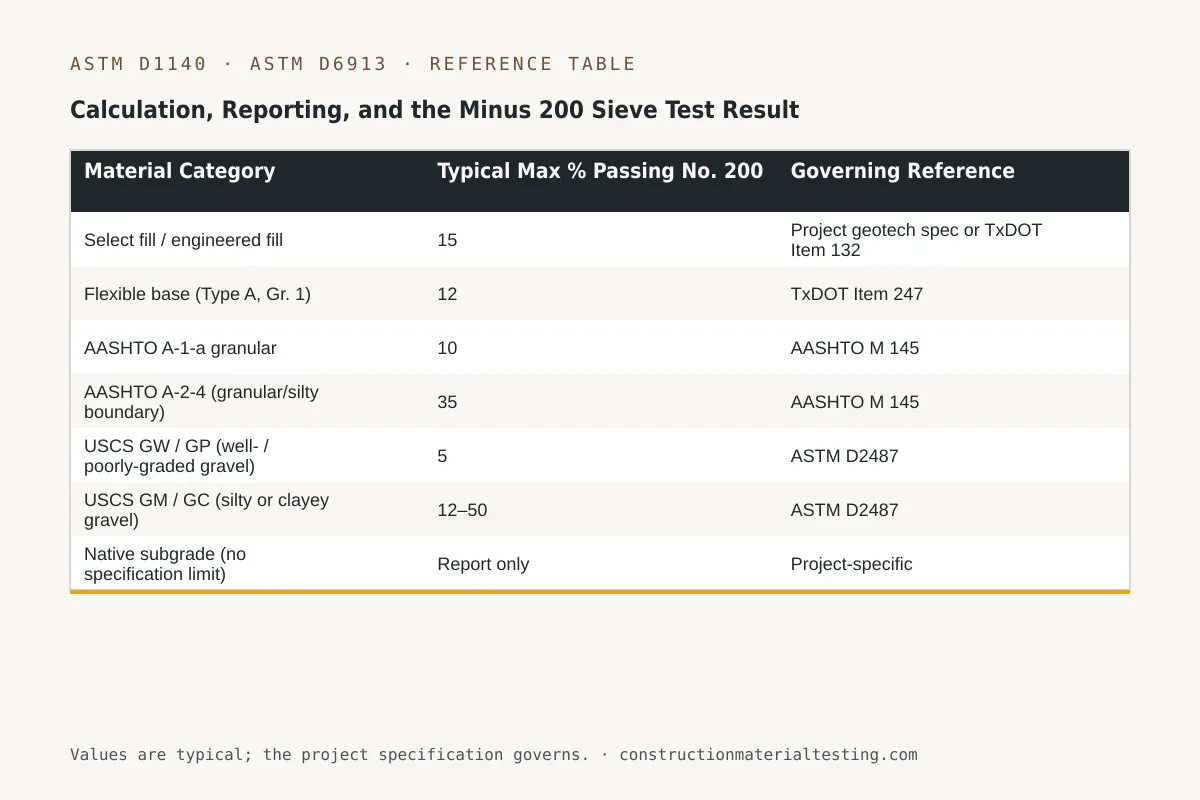
The arithmetic is straightforward. Subtract the washed, dried retained mass from the initial dry mass to get the mass of material finer than the No. 200 sieve. Divide that difference by the initial dry mass and multiply by 100 to express it as a percentage. Written out: Percent finer than No. 200 = [(Initial dry mass − Washed dry retained mass) ÷ Initial dry mass] × 100. Round to the nearest whole number unless the specification requires a decimal.
The table below shows representative fines limits from common specification categories. These are not universal—always confirm against the project-specific geotechnical report or contract documents—but they illustrate the range of thresholds the D1140 result must clear.
| Material Category | Typical Max % Passing No. 200 | Governing Reference |
|---|---|---|
| Select fill / engineered fill | 15 | Project geotech spec or TxDOT Item 132 |
| Flexible base (Type A, Gr. 1) | 12 | TxDOT Item 247 |
| AASHTO A-1-a granular | 10 | AASHTO M 145 |
| AASHTO A-2-4 (granular/silty boundary) | 35 | AASHTO M 145 |
| USCS GW / GP (well- / poorly-graded gravel) | 5 | ASTM D2487 |
| USCS GM / GC (silty or clayey gravel) | 12–50 | ASTM D2487 |
| Native subgrade (no specification limit) | Report only | Project-specific |
How the Result Feeds Soil Classification and Fill Acceptance
Percent passing the No. 200 sieve is a branching point in both USCS (ASTM D2487) and AASHTO classification. In USCS, soils with more than 50 percent finer than No. 200 are fine-grained (M or C groups) and require Atterberg limits to subdivide further. Soils with fewer than 50 percent fines are coarse-grained, but even within that group the percentage determines whether you have a clean gravel, a silty gravel, or a clayey gravel. Without a reliable D1140 result, every classification step downstream is guesswork. Our full ASTM D6913 gradation analysis uses the washed retained mass as its starting point precisely so the classification hangs together without internal contradictions.
Fill acceptance on most commercial and civil projects works in one of two ways: the specification either caps fines content at a fixed ceiling (accept or reject the load) or requires that the fines not be plastic—meaning a passing D1140 result must be accompanied by a non-plastic Atterberg limits result. If a load tests at 18 percent passing No. 200 against a 15-percent ceiling, the options are rejection, blending with cleaner material, or chemical stabilization with lime or cement. Each of those decisions is expensive relative to the cost of the test that identified the problem at the stockpile rather than after placement and compaction.
Our ASTM D1140 test method page documents the exact procedure we follow, including how retained material is transferred to the D6913 sieve stack when a combined gradation is ordered. That transfer step is where the two tests connect mechanically, and getting it right ensures the gradation curve and the standalone fines percentage are internally consistent rather than slightly different numbers from different specimens.
Where This Fits on Your Project
The minus 200 sieve test is rarely the only test ordered on a project, but it is often the test that drives the first go/no-go decision on a borrow source or delivered fill. Running it early—before material is placed, not after—keeps a problem from becoming an expensive remediation. Whether you need a standalone fines check on a single borrow pit sample, a combined D1140 and D6913 gradation for classification, or a broader testing program covering compaction, Atterberg limits, and subgrade evaluation, our dispatched technicians and laboratory staff can sequence the work to match your schedule and specification deadlines.
We operate laboratory facilities in Sugar Land with 27 regional dispatch hubs, so samples collected at your site reach the bench quickly. If you are working through a geotechnical engineer who needs results integrated into a classification report, or a contractor who needs fill acceptance documentation for the owner, we can coordinate the reporting format accordingly. Use our proposal request page to describe the material, specification, and turnaround need, and we will respond with a testing plan.
Get our guides in your Google results
Add Construction Materials Testing as a preferred source and Google shows our guides more often when you search for testing topics.