
Why Scope the Investigation Before the Drill Rig Arrives
A geotechnical site investigation begins on paper, not in the ground. Before we mobilize a drill rig, we need the site plan, proposed column loads or slab area, any grading intent, and whatever existing boring data exists for adjacent parcels. That background review shapes every decision that follows: how many borings to drill, how deep to take them, which in-situ tests to run, and what samples to send to the laboratory. Skipping this step almost always produces either too little data—leaving the structural engineer to guess—or unnecessary borings that inflate costs without improving design confidence.
Regulatory and contractual context matters here too. IBC Section 1705 establishes when special inspection and testing are required, and many jurisdictions require a geotechnical report before a foundation permit is issued. The ASCE Geo-Institute publishes guidance on investigation scope that practicing engineers treat as a baseline. Our role is to execute the field and laboratory work to a standard the engineer of record can rely on—which means documenting every decision we make in the field, not just the final numbers.
Planning Boring Depth and Spacing
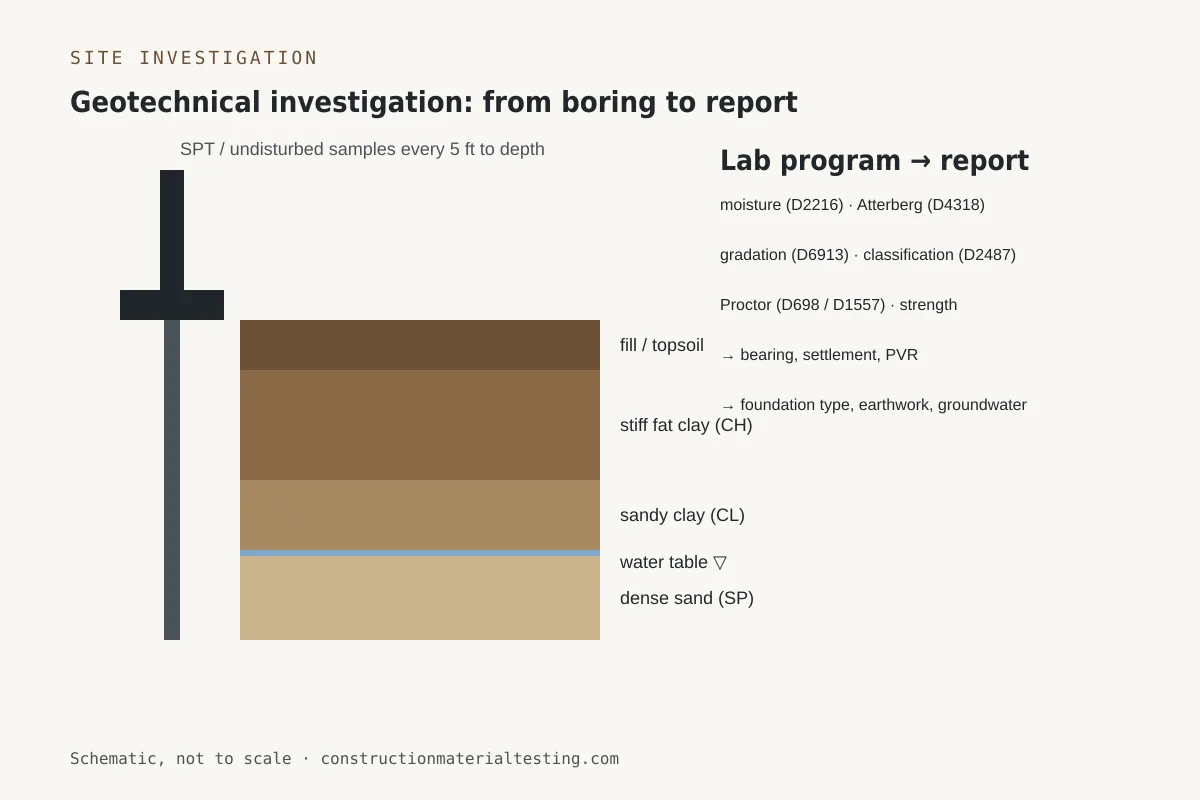
There is no single universal spacing rule, but there is a logic to it. For a lightly loaded one-story building on a uniform site, four corner borings plus one interior boring may be sufficient. For a multi-story structure, tank farm, or site with known fill, we tighten the grid. The goal is to characterize every soil stratum that will influence settlement or bearing failure—which means the boring depth must extend well below the zone of stress influence beneath the deepest, most heavily loaded foundation element.
A common engineering convention for spread footings is to carry borings to a depth equal to at least twice the width of the largest anticipated footing, and for mat foundations to at least 1.5 times the mat width—but those are starting points. If we encounter soft clay, organic material, or loose sand at depth, we push deeper until we reach competent material or the drill indicates we are well into it. For sites where deep foundations are possible, borings typically reach the anticipated pile tip elevation plus an additional ten feet or more to confirm bearing layer continuity.
Shallow groundwater, caliche layers common to the Texas Gulf Coast region, and old fill complicate depth planning. When we hit something unexpected—say, a layer of shell hash at 15 feet that wasn't on the geologic map—we log it, adjust the boring depth on the spot, and note it in the field log. That real-time judgment is what separates a useful investigation from a mechanical exercise.
SPT Procedure and Undisturbed Sampling in the Field
The Standard Penetration Test (SPT) is the workhorse of most geotechnical site investigations. We drive a standard split-barrel sampler into the soil using a 140-pound hammer falling 30 inches. The sampler is driven 18 inches total; we count blows for each of three successive 6-inch increments and record the blow count for the last 12 inches as the N-value. That number—often corrected for hammer energy and overburden—feeds directly into correlations for bearing capacity, liquefaction potential, and relative density in sands.
Every split-barrel run recovers a disturbed sample. We log the material, note color, odor, and any unusual inclusions, bag the sample, and label it with boring number, depth interval, and blow count. In cohesive soils where we need strength and consolidation data, we switch to thin-walled Shelby tube sampling. The tube is pushed—not driven—into the soil to minimize disturbance, then sealed with wax or end caps and transported upright to protect the structure of the sample. That care matters: a remolded clay sample will give you unreliable shear strength and consolidation parameters.
We also run other in-situ tests when the project warrants them. Pressuremeter or dilatometer testing gives modulus data that SPT correlations cannot. Hand vane shear tests on recovered cohesive samples give immediate undrained shear strength checks in the field before the sample is sent to the lab. All of this is documented on the boring log in real time—depth, sample type, recovery, blow counts, field descriptions using USCS soil classification criteria—so the geotechnical engineer reviewing the data sees exactly what we saw.
Groundwater Observation: One Reading Is Not Enough
Groundwater is not a static number, and treating it as one causes real problems downstream. When we advance a boring by rotary methods, drilling fluid and cuttings disturb the borehole, which temporarily masks the true water level. The standard practice is to record the depth at which water is first encountered during drilling, then measure the stabilized water level at the end of drilling, and—where time and site access allow—return the following day to measure again. That 24-hour reading, with the borehole open and the drilling disturbance dissipated, is generally the most reliable single observation.
In areas with artesian pressure, perched water tables in fill, or tidal influence, even a 24-hour reading may not capture the seasonal high. We note these conditions in the boring log and flag them for the geotechnical engineer. Seasonal high groundwater is the number that governs slab-on-grade design, basement waterproofing, and the design of any below-grade structure, so underreporting it has consequences that last the life of the building. Our geotechnical services include piezometer installation when a project demands longer-term water level monitoring.
The Laboratory Program That Turns Samples into Design Data
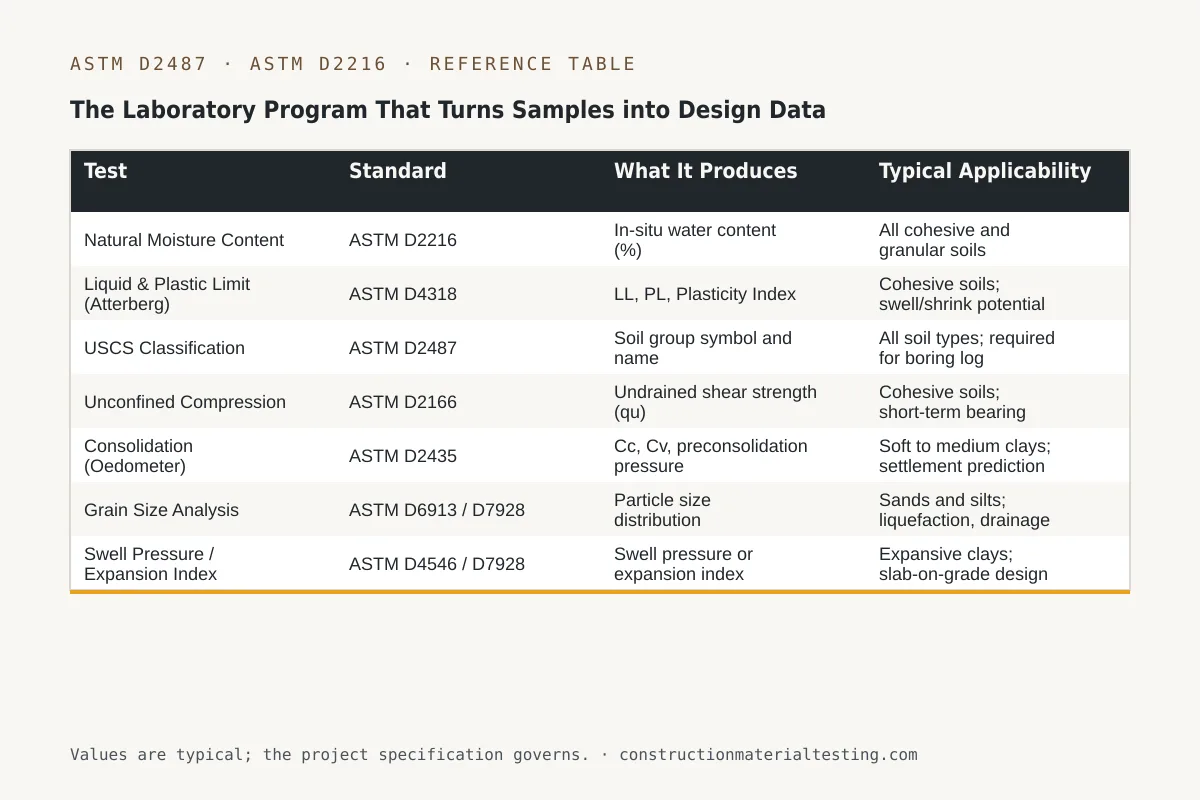
Field logs describe what the soil looks like; laboratory testing tells you what it will do under load. The minimum program for most projects includes natural moisture content per ASTM D2216, Atterberg limits per ASTM D4318 on cohesive layers, and formal USCS classification per ASTM D2487 for every distinct stratum. Beyond that baseline, the scope depends on what the field work found.
Soft clays need consolidation testing to estimate long-term settlement under load. Loose sands need grain-size analysis to evaluate liquefaction susceptibility. Expansive clays—common in portions of the Texas Gulf Coast region—need swell-pressure testing so the foundation engineer can design against heave. Unconfined compression tests on Shelby tube samples give undrained shear strength for short-term bearing capacity calculations. We select the test program in coordination with the geotechnical engineer so that every test ordered answers a specific design question rather than padding the report.
Sample condition on arrival matters as much as the field sampling technique. We store Shelby tubes upright, at controlled temperature, and test them as soon as practical. A tube that has been horizontal in a hot truck for a week yields compromised data no matter how carefully it was pushed in the field.
| Test | Standard | What It Produces | Typical Applicability |
|---|---|---|---|
| Natural Moisture Content | ASTM D2216 | In-situ water content (%) | All cohesive and granular soils |
| Liquid & Plastic Limit (Atterberg) | ASTM D4318 | LL, PL, Plasticity Index | Cohesive soils; swell/shrink potential |
| USCS Classification | ASTM D2487 | Soil group symbol and name | All soil types; required for boring log |
| Unconfined Compression | ASTM D2166 | Undrained shear strength (qu) | Cohesive soils; short-term bearing |
| Consolidation (Oedometer) | ASTM D2435 | Cc, Cv, preconsolidation pressure | Soft to medium clays; settlement prediction |
| Grain Size Analysis | ASTM D6913 / D7928 | Particle size distribution | Sands and silts; liquefaction, drainage |
| Swell Pressure / Expansion Index | ASTM D4546 / D7928 | Swell pressure or expansion index | Expansive clays; slab-on-grade design |
What the Geotechnical Report Actually Delivers
A finished geotechnical report is not a data dump. It integrates the boring logs, laboratory results, and the geotechnical engineer's interpretations into actionable recommendations. The core deliverables are a site description and subsurface profile, boring logs with field and laboratory data, groundwater information, and engineering recommendations keyed to the proposed construction. Those recommendations typically cover allowable bearing pressure for shallow foundations at specific depths, estimated total and differential settlement, pile or drilled shaft parameters if deep foundations are needed, lateral earth pressure coefficients for retaining structures, and pavement subgrade information when applicable.
The bearing capacity recommendations in the report are not standalone numbers—they are tied to specific foundation dimensions, depths, and load conditions. When the structural engineer changes the footing size or the building layout shifts significantly during design development, the geotechnical engineer should be consulted to confirm the original recommendations still apply. We see problems on projects where the report's numbers are used out of context, applied to foundations that differ materially from what the investigation assumed.
Settlement estimates deserve particular attention. Total settlement tells you the absolute movement; differential settlement—the difference in movement between two adjacent foundation elements—governs structural distress. A building that settles two inches uniformly is a different problem from one that settles half an inch at one column and two inches at the next. The report should address both, and if it doesn't, the engineer of record should ask before foundation drawings are finalized.
How Geotechnical Site Investigation Results Drive Foundation Type
The subsurface data funnel toward one of several foundation strategies. Competent bearing soil at shallow depth with low plasticity and modest groundwater allows conventional spread footings or a lightly reinforced slab—straightforward, cost-effective, and appropriate when the investigation confirms the conditions. Soft or highly plastic clays close to the surface push designers toward a stiffened slab system, post-tensioned mat, or deep foundations that bypass the problem layer. Loose saturated sands in seismically active areas require liquefaction analysis and may necessitate ground improvement before any foundation system can function as designed.
In the Houston metropolitan area and surrounding Gulf Coast counties, highly plastic Beaumont and Gulf Coast clays dominate many sites. These soils expand when wetted and shrink during drought, and a geotechnical investigation that doesn't quantify swell pressure leaves the foundation engineer guessing at a critical input. Pier-and-beam systems or drilled piers extending into deeper, more stable strata are common responses, but the required pier length varies site to site—which is exactly why boring depth matters so much at the planning stage.
The geotechnical report also informs decisions the structural engineer doesn't always think of first: whether to specify moisture barrier systems beneath slabs, whether site drainage improvements are needed to stabilize seasonal moisture variation, and whether imported fill should be specified or the on-site material can be reused. These are not afterthoughts; they are part of the investigation's value, and they are worth discussing with the geotechnical engineer before the report is finalized.
Where This Fits on Your Project
A geotechnical site investigation should be scoped and executed before the structural engineer finalizes foundation design—ideally during schematic design when there is still flexibility to respond to what the data shows. Waiting until a foundation permit is imminent compresses review time, limits the ability to iterate on foundation strategy, and occasionally produces a report that answers yesterday's layout rather than today's.
Our field and laboratory teams handle the full sequence: pre-investigation review, drill rig coordination, SPT and Shelby tube sampling, groundwater monitoring, and the laboratory program needed to support the geotechnical engineer's report. If you are ready to scope an investigation or need help defining boring depth and spacing for an upcoming project, submit a proposal request and we will follow up with questions about your site and schedule.
Get our guides in your Google results
Add Construction Materials Testing as a preferred source and Google shows our guides more often when you search for testing topics.