

Start with Licensing and the Engineer of Record
A geotechnical engineering firm earns your trust first by having a licensed Professional Engineer who will seal the report and defend its conclusions in writing. This is not a formality—the PE of record is the person a structural engineer will call when the bearing capacity recommendation conflicts with the architect's footing depth, and the person whose license is on the line if the report misclassifies a compressible stratum. Ask directly: who is the PE of record on this project, what is their license number and state, and will they visit the site during drilling? A firm that routes that question to a salesperson is showing you something.
Beyond the PE, look at who actually runs the field program. ACI- and NICET-certified field technicians are trained to recognize when a boring log needs a note about refusal, color change, or odor—details that shape the lab testing plan. If the firm subcontracts all its drilling to a third party it has never worked with before, ask how field observations are communicated and who makes real-time decisions about boring depth adjustments.
Drilling Capability, Laboratory Scope, and What a Geotechnical Engineering Firm Should Be Able to Run In-House
The most useful geotechnical firms control their own data from hole to report. That means owned or tightly contracted drilling rigs, trained drillers, and a laboratory that can run soil classification under ASTM D2487, moisture-density relationships under ASTM D698, Atterberg limits, consolidation, and shear strength without shipping samples to a stranger. Every hand-off between the driller, the lab, and the reporting engineer is a place where a sample gets mislabeled, a chain-of-custody gap opens, or a turnaround commitment slips. When you ask about laboratory scope, you want specifics: which tests are run in-house, which are sent out, and to whom.
For projects on the Texas Gulf Coast, the Houston-area clay profile is its own discipline. The fat clays in this region—high-plasticity CH materials by the Unified Soil Classification System described in ASTM D2487—behave differently from the sandy fills you encounter twenty miles inland. A firm that has primarily worked in Central Texas or outside the state may underestimate swell potential or misread the significance of a perched water table. Ask for boring logs from recent nearby projects. The logs will tell you whether the firm's drillers and engineers recognize the stratigraphy you are likely to encounter.
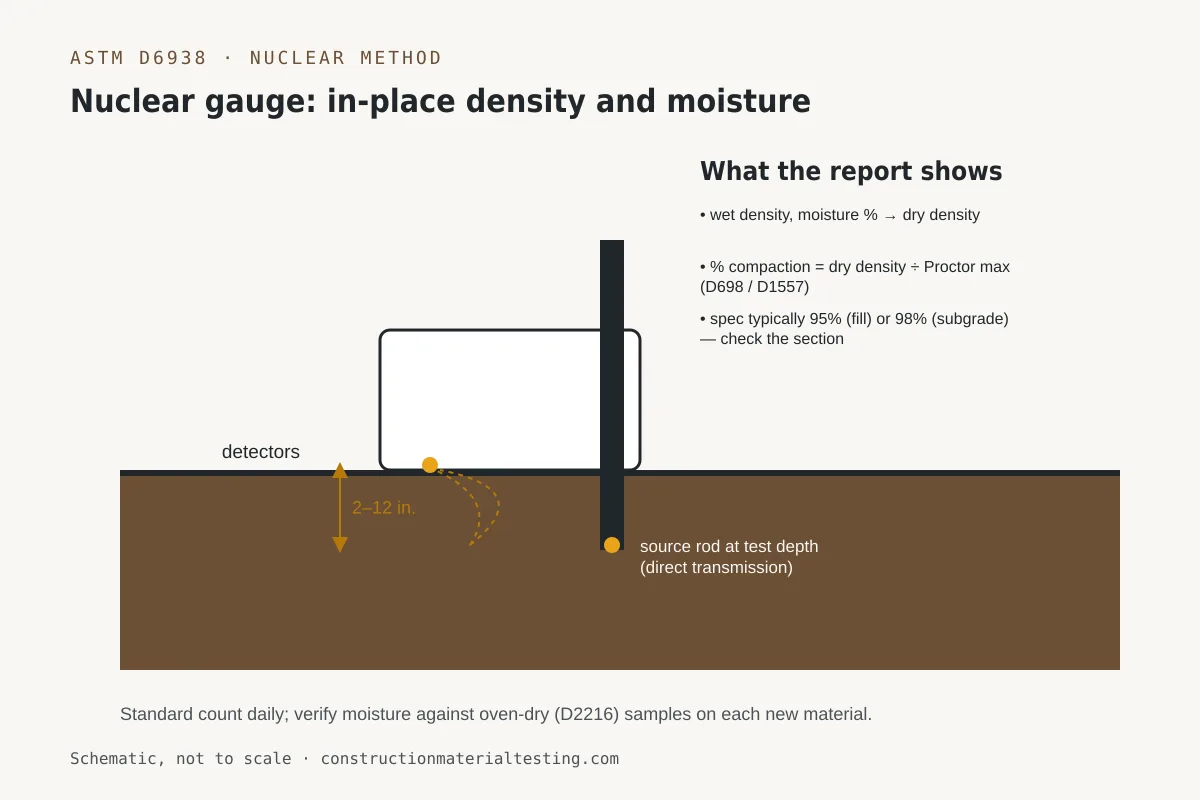
In-place density verification during earthwork—commonly performed by nuclear gauge per ASTM D6938—is a separate service from the geotechnical report itself, but the two need to be consistent. The compaction specification in the geotech report should reference the same Standard Proctor curve that the field technician uses during construction. If the geotechnical firm and the testing firm are different entities, verify that they will coordinate on that document before earthwork begins.
Report Quality, Coverage, and Red Flags to Watch For
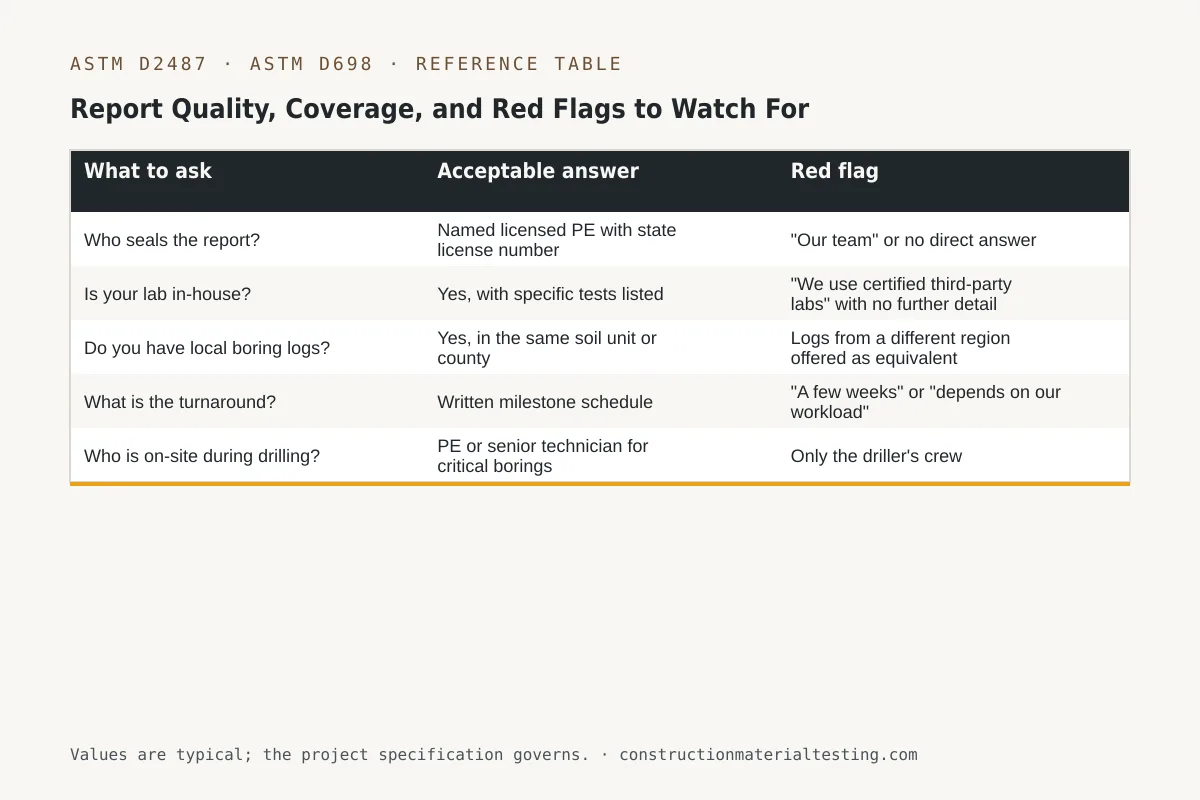
A geotechnical report is only as useful as its site-specific content. Before you hire, ask the firm for a redacted sample report from a project with a similar building type and soil setting. Look for a scaled boring location plan, actual blow counts and sample depths on the boring logs, lab test results tabulated and tied to specific samples, and explicit foundation recommendations with allowable bearing values and minimum embedment depths. A report that gives you a range ('2,000 to 3,000 psf depending on conditions') without explaining which conditions drive each end of that range forces the structural engineer to guess. The ASCE Geo-Institute maintains practice guidelines that describe what a competent report should contain; reviewing those before your proposal conversations will sharpen your questions.
Coverage geography matters on any project that has multiple structures, a large footprint, or phased construction. Ask whether the firm can mobilize to your site within a reasonable window, whether they have experience with local permitting offices and building departments, and what their actual backlog looks like at the time of proposal. A firm based two states away that promises fast mobilization is a different risk than a local firm with a documented dispatch process. Our service areas page reflects where we maintain active field presence, which is the right question to ask any firm you are evaluating.
The clearest red flags: a proposal delivered without a defined scope of borings; a fee so low it cannot cover the lab tests a project of your type requires; no mention of a PE of record; and a turnaround promise with no written milestone dates. Geotechnical work done in a hurry to meet a price point tends to produce reports that developers hand to structural engineers who then order additional borings anyway—which costs more and loses more time than a thorough first effort would have.
| What to ask | Acceptable answer | Red flag |
|---|---|---|
| Who seals the report? | Named licensed PE with state license number | "Our team" or no direct answer |
| Is your lab in-house? | Yes, with specific tests listed | "We use certified third-party labs" with no further detail |
| Do you have local boring logs? | Yes, in the same soil unit or county | Logs from a different region offered as equivalent |
| What is the turnaround? | Written milestone schedule | "A few weeks" or "depends on our workload" |
| Who is on-site during drilling? | PE or senior technician for critical borings | Only the driller's crew |
Where This Fits on Your Project
Geotechnical work belongs at the front of your project schedule, before foundation design is locked and before earthwork is bid. The report's bearing capacity values, recommended foundation type, and compaction specifications feed directly into structural drawings and bid documents. Starting that work late compresses every downstream schedule. Our geotechnical services team works alongside the field inspection program so that the lab data used to build the report and the field density testing used to verify earthwork are on the same documented quality system. If you are putting together a scope of services and want to understand what a thorough subsurface investigation for your site type should include, use our proposal request form to start that conversation.
Get our guides in your Google results
Add Construction Materials Testing as a preferred source and Google shows our guides more often when you search for testing topics.