
Why Density Is the Starting Point for Everything Else
Every fresh concrete calculation that matters on a pour — volume delivered, air content, cement factor — runs through one number: the measured density, commonly called unit weight. When a ready-mix truck rolls up and the driver hands you a batch ticket claiming a certain design yield, the only way to verify it is to weigh a known volume of the fresh concrete yourself. That is exactly what ASTM C138 gives you: a repeatable, equipment-light procedure that takes about ten minutes and can save you thousands of dollars if the numbers don't match.
The procedure produces three reportable values — density (unit weight in lb/ft³ or kg/m³), yield (ft³ or m³ per batch), and gravimetric air content (percent). Each one serves a distinct purpose, and experienced field technicians check all three rather than stopping at density. A mix can have a plausible-looking density and still be yielding short, because density alone tells you nothing about how many cubic yards actually came off the truck.
For owners and engineers tracking concrete quality under materials testing programs, the C138 result also feeds directly into questions about whether the structural mix meets the minimum cementitious material requirements in the contract documents. If the yield is inflated, the cement content per cubic yard is diluted — a problem that doesn't show up until you're looking at low compressive strength results weeks later.
Equipment and Setup Before the Truck Arrives
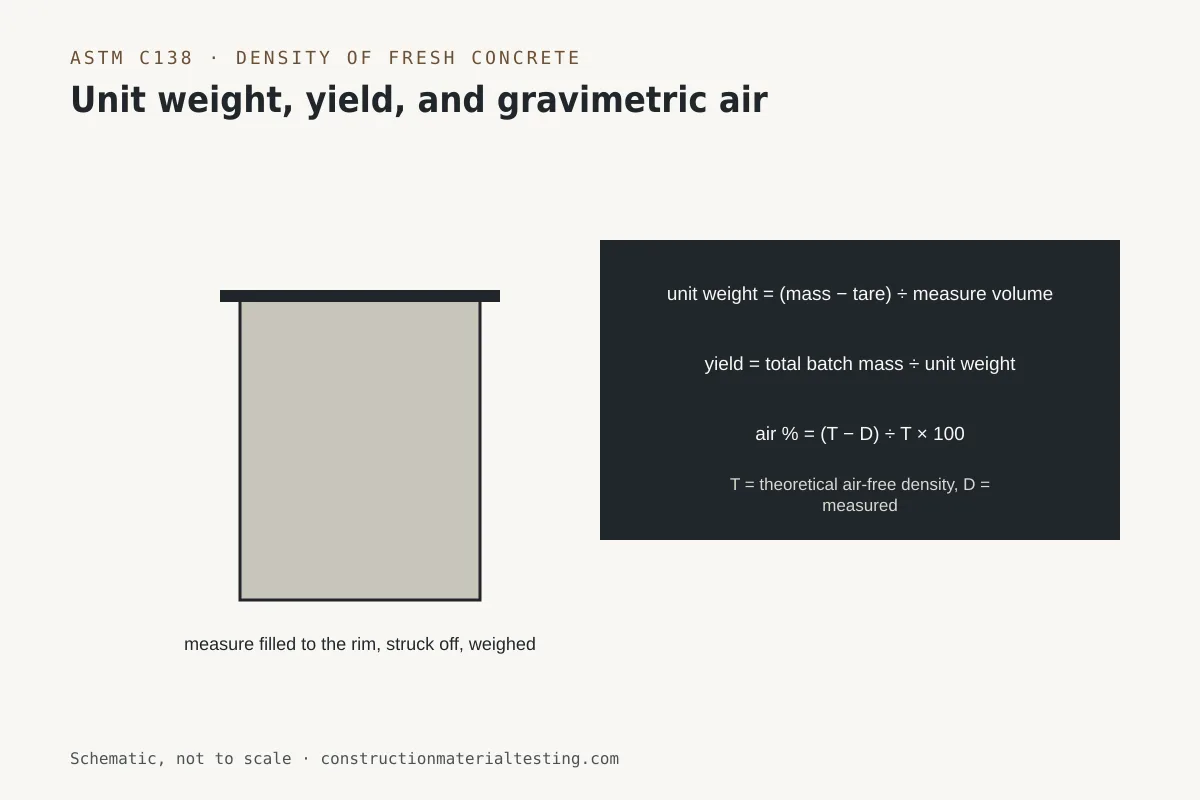
ASTM C138 requires a rigid, watertight measure of known volume. Standard sizes are 0.1 ft³ for aggregate up to 1 inch nominal maximum size and 0.5 ft³ for coarser mixes, though a 0.25 ft³ measure works for intermediate gradations. The measure must be calibrated — meaning you have a recorded volume and tare weight verified against a calibrated scale. Calibration is done by the water-fill method, weighing the measure empty and then full of water at a known temperature, and the result is recorded in your field logbook. A measure with a dented rim or a warped base introduces systematic error, so inspect the equipment before you drive to the site.
Your scale needs to be readable to 0.1 lb (0.05 kg) and have a capacity adequate for the filled measure. A 0.5 ft³ measure filled with 145-lb/ft³ concrete weighs roughly 72 lb plus the tare — plan accordingly. Bring a tamping rod (5/8-inch diameter, bullet-nosed, 24 inches long) for mixes with slump high enough to rod, and an internal vibrator of appropriate diameter for stiffer mixes. The standard is specific: use rodding for slump greater than 3 inches and vibration for slump of 3 inches or less, with an exception allowing rodding at any slump when the nominal maximum aggregate size is 1½ inches or greater and the mix would be damaged by vibration.
Get the measure level on a solid surface away from traffic vibration. If you're working off a tailgate or a scaffold deck, the scale reading will drift. We carry a small rubber mat to damp vibration — not required by the standard but it eliminates a common source of scatter in field readings.
Running the Concrete Unit Weight Test Step by Step
Obtain the fresh concrete sample per ASTM C172 — that means composite samples from the middle portion of the load, not from the first or last discharge. Fill the measure in layers (three layers for rodding, two for vibration), consolidating each layer fully before adding the next. For rodded samples, distribute 25 rod penetrations uniformly across each layer, penetrating about 1 inch into the layer below. After the final layer, strike off flush with a flat plate or the strike-off bar that comes with the measure kit; do not use a trowel at an angle, which can trap air under the screed.
Wipe the outside of the measure clean, then place it on the scale and record the total mass. Subtract the tare to get the mass of concrete. Divide by the known volume of the measure — that quotient is your density in lb/ft³ (or kg/m³ if you're working SI). The ASTM C138 standard publishes the full formula set, but the field arithmetic is straightforward enough to do on a $10 calculator. Record ambient temperature, concrete temperature, slump, and time of sampling alongside the density result — you'll need them if the number gets questioned.
Do not shortcut the consolidation step. Under-consolidated measures consistently read low density, which produces an artificially high calculated yield and can mask a genuine short load by making it look like the batch over-yielded. We've seen technicians rod too lightly on sticky mixes and then report a yield discrepancy that dissolved once the procedure was repeated correctly. Consolidation effort is the single greatest source of operator error in this test.
Calculating Yield, Relative Yield, and Gravimetric Air
Once you have the measured density, the math branches three ways. Yield is the total volume produced by one batch: divide the total mass of materials in the batch (from the batch ticket — cement, aggregate, water, admixtures) by the measured density. That gives you cubic feet or cubic meters per batch. Compare it to the design volume per batch to see whether the plant hit its target. Relative yield is the ratio of measured yield to design yield; values above 1.00 mean extra volume was delivered, values below 1.00 mean you were shorted.
Gravimetric air content is the third calculation, and it doesn't require a pressure meter. You need the theoretical air-free density of the mix, which you calculate from the specific gravities and proportions of each ingredient — information that should be on the approved mix design. Subtract the measured density from the theoretical density, divide by the theoretical density, and multiply by 100. The result is percent air by volume. This method is the reference procedure for mixes where the pressure meter is unreliable, such as those containing lightweight aggregate or certain pumped lightweight fill mixes. For comparison against a pressure air meter reading from ASTM C231, a difference of more than about 1 percentage point warrants investigation — either the mix proportions are off, or one of the instruments has a problem.
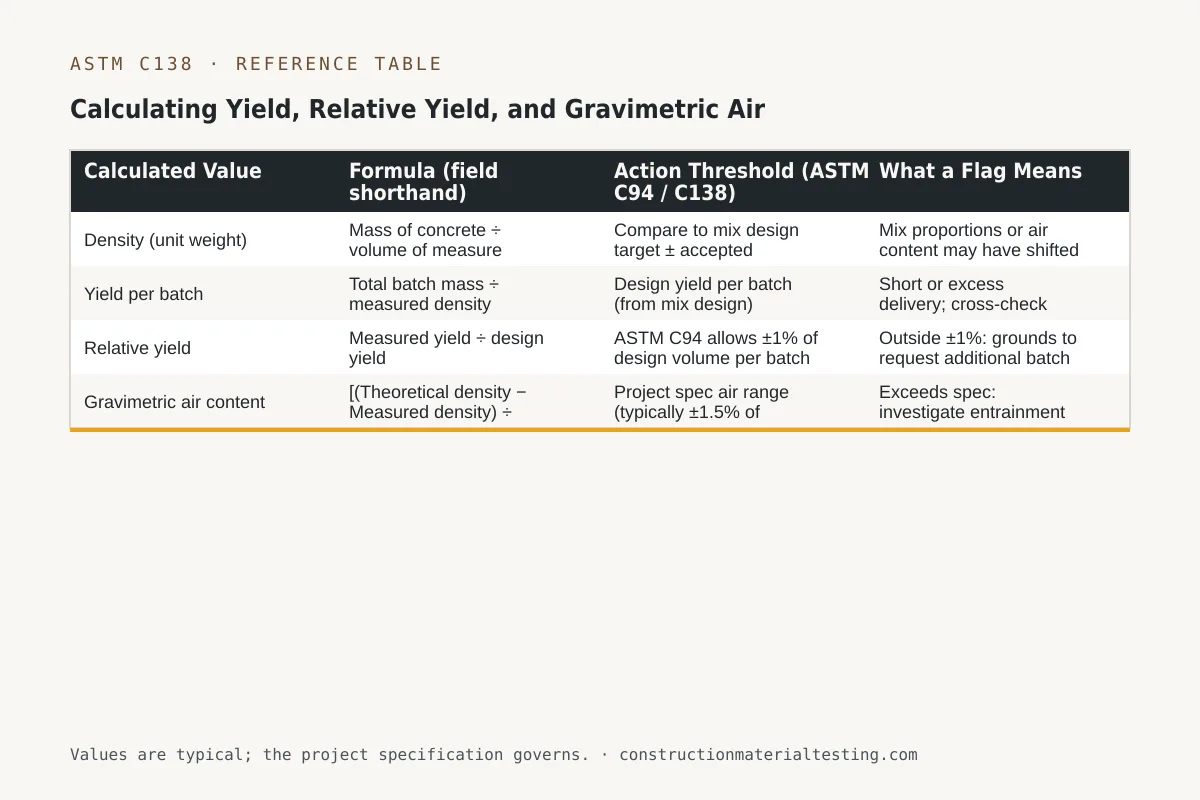
The table below shows what these three outputs tell you and what action thresholds look like in practice. The yield tolerance column references ASTM C94, which governs ready-mixed concrete delivery and is the document your dispute process will point to.
| Calculated Value | Formula (field shorthand) | Action Threshold (ASTM C94 / C138) | What a Flag Means |
|---|---|---|---|
| Density (unit weight) | Mass of concrete ÷ volume of measure | Compare to mix design target ± accepted variation | Mix proportions or air content may have shifted |
| Yield per batch | Total batch mass ÷ measured density | Design yield per batch (from mix design) | Short or excess delivery; cross-check batch ticket |
| Relative yield | Measured yield ÷ design yield | ASTM C94 allows ±1% of design volume per batch | Outside ±1%: grounds to request additional batch or reject load |
| Gravimetric air content | [(Theoretical density − Measured density) ÷ Theoretical density] × 100 | Project spec air range (typically ±1.5% of target) | Exceeds spec: investigate entrainment before placement |
Resolving Short-Load Disputes with the Supplier
When relative yield runs below 1.00 by more than the tolerance in ASTM C94, you have documented grounds to contact the plant. The key is documentation: a signed field log showing the measure's calibrated volume, tare weight, scale reading, batch ticket number, truck number, load number, time of sampling, and the technician's ACI certification number. Without that chain of records, a dispute becomes a he-said/she-said conversation. With it, you're presenting data collected under a documented procedure, and most suppliers take that seriously.
The typical resolution path is that the plant runs the batch ticket through their yield calculation and compares it to yours. Discrepancies often trace to one of three sources: an error in the plant's batch water (corrected water–cement ratios), aggregate moisture corrections that weren't applied properly, or an actual weighing malfunction at the batching plant. In rare cases, the field measure itself was out of calibration — which is why we re-verify our equipment whenever a dispute arises. If both parties used calibrated equipment and followed the standard, the numbers should converge within the C94 tolerance. When they don't, the next step is typically a witnessed re-test on the next load from that plant.
Contractors sometimes ask whether they can use individual cylinder weights as a proxy for the C138 bucket test in a yield dispute. The answer is no — cylinders are consolidated differently, the molds are smaller, and they aren't calibrated measures. The C138 measure test is the contractually defensible method, and it's the one worth doing correctly every time the yield question matters.
Common Field Errors That Corrupt the Data
Overfilling and scraping down at an angle traps a meniscus of air under the strike-off plate and consistently lowers the density reading. Strike-off should be done with a sawing motion using a flat plate held perpendicular to the rim. Concrete that bleeds significantly before you weigh the measure will also read low — sample, fill, and weigh without delay. The standard calls for completing the test within a specific window after sampling, and that window is shorter than many technicians realize on a hot Texas summer day when concrete temperature is climbing.
Forgetting to re-tare the scale after placing the measure — or using a scale that hasn't been zeroed at field temperature — is another common source of error. Digital scales with temperature-compensated load cells are less prone to this, but we still verify zero at the start of each test. A 0.5-lb error on a 0.1 ft³ measure translates to a density error of 5 lb/ft³, which is large enough to flip a yield calculation from acceptable to short.
Finally, using the wrong consolidation method for the slump class — rodding a 1-inch slump mix, for example — produces a poorly consolidated sample regardless of how many rod strokes you make. If you're unsure whether a sticky mix can be rodded adequately, use vibration and note it on the field log. The standard permits this judgment call with documentation.
Where This Test Fits on Your Project
Concrete unit weight testing under ASTM C138 is typically required at the same frequency as compressive strength sampling — at minimum once per 50 cubic yards or once per day of placement under most special inspection programs, though project specifications and the authority having jurisdiction may set higher frequencies. For post-tensioned slabs, structural columns, and other elements where ACI 318 imposes strict limits on mix proportions, the density and yield records become part of the permanent inspection file.
If your project is in the scoping or pre-bid phase, or if you've already started placing concrete and yield discrepancies are showing up, our field teams dispatch from regional hubs across Texas and the Gulf Coast region. We operate under a documented quality system that covers calibration, technician qualification, and data reporting. Request a proposal and we'll outline what a C138 testing program looks like for your specific mix design, placement schedule, and specification requirements.
Get our guides in your Google results
Add Construction Materials Testing as a preferred source and Google shows our guides more often when you search for testing topics.