
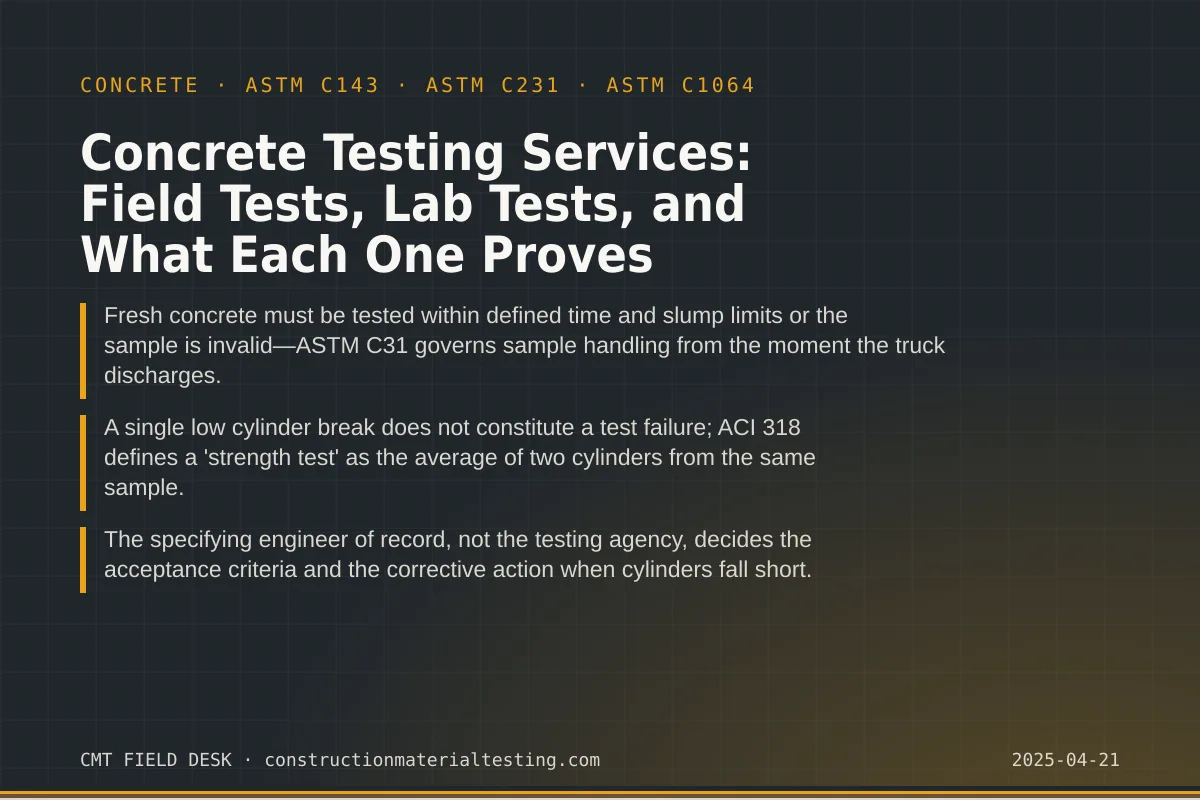
What Concrete Testing Services Actually Cover
Concrete testing services span two distinct phases: tests performed on fresh concrete at the point of placement, and tests performed on hardened cylinders in a controlled laboratory environment. Both phases are required for a complete picture of how a mix is behaving. Fresh tests tell you what is happening in the truck and the chute right now; hardened tests tell you what that same concrete will do in the structure for the next fifty years. Running one without the other leaves a gap in the quality record that no amount of paperwork can close.
Most of the confusion we see in the field comes from treating these two phases as interchangeable or, worse, skipping the fresh tests because the batch plant already provided a mix design. The mix design is a starting point. What actually gets placed depends on water added at the site, haul time, ambient temperature, and a dozen other variables. Fresh testing catches those deviations before the concrete is in the wall. Lab testing confirms that what was placed reached its specified strength. You need both. For a broader look at why this matters structurally, our overview of concrete testing for construction covers the owner's perspective alongside the technical one.
The Fresh-Concrete Test Set
When a ready-mix truck arrives, the technician's first job is sampling. ASTM C172 controls where in the load the sample comes from—typically not the first or last ten percent of the discharge—and requires the composite sample to be obtained within a two-minute window. Everything that follows depends on that sample being taken correctly. A contaminated or time-delayed sample produces numbers that do not represent the concrete in the forms, and no test result should be reported from such a sample.
Temperature is measured first because it takes the least time and affects every other result. ASTM C1064 requires the reading to be taken within five minutes of sampling. Hot weather limits under ACI 305 and cold weather limits under ACI 306 both reference maximum and minimum placement temperatures; if the reading is out of tolerance, the load is flagged immediately. Slump follows. The ASTM C143 procedure takes about five minutes and gives a direct measure of workability. The cone is rodded in three layers, struck off, lifted in a smooth continuous motion over approximately five seconds, and the drop measured to the nearest quarter inch. A slump outside the specified range is a hold point—water should not be added at the truck to correct it.
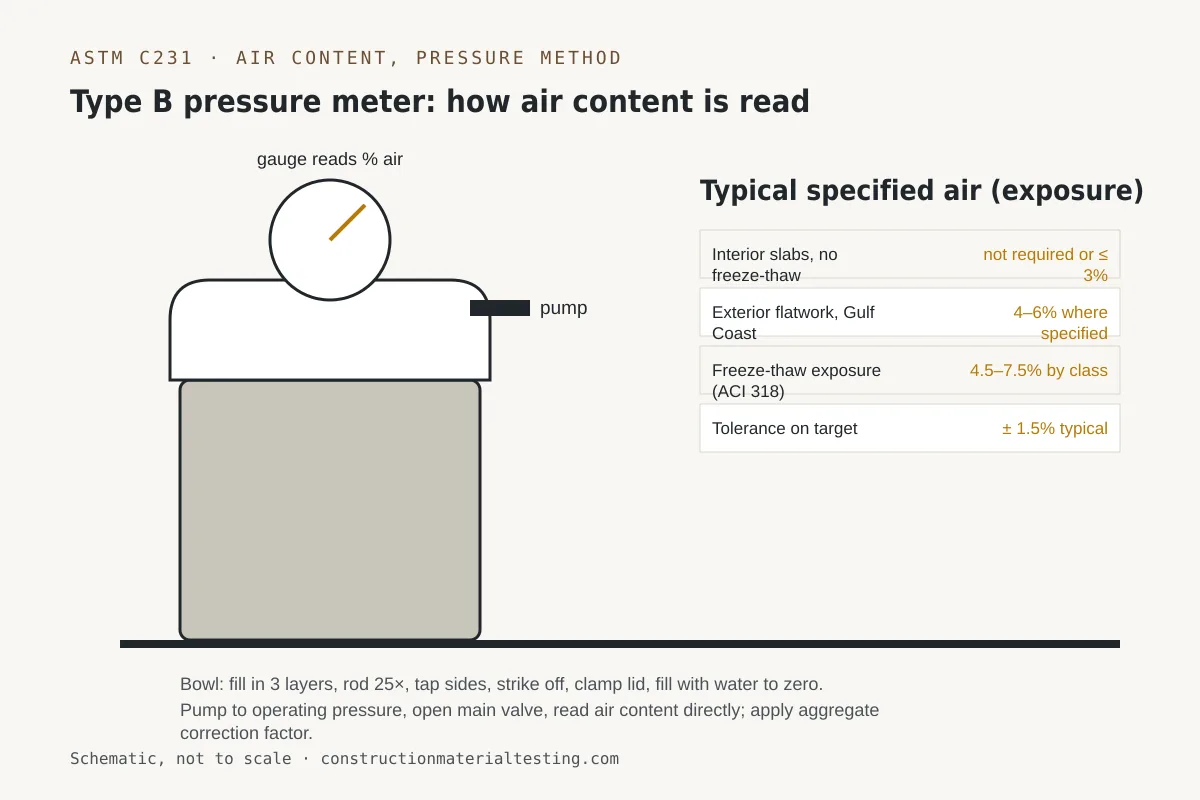
Air content rounds out the fresh-test set. ASTM C231 uses a pressure meter to determine the air void content of the fresh mix. In freeze-thaw environments, entrained air is the primary defense against surface scaling, and a reading outside the specified range of typically 4–7 percent is a significant finding. In Texas, freeze-thaw durability is less often the driver, but air content still affects workability and finishing characteristics, so the test is routinely performed regardless of climate exposure class. Together, temperature, slump, and air content define whether the fresh concrete is in spec—and whether the cylinders cast from it represent acceptable material.
Making and Curing Field Cylinders—Where Mistakes Happen
The compressive strength result you get 28 days from now is only as good as the cylinder cast in the field. ASTM C31 covers the full procedure: mold size (typically 4×8 or 6×12 inches), rodding or vibration requirements by slump range, strike-off, and the curing conditions required for the first 24 hours. That initial cure period is where most field errors occur. Cylinders left in direct sun on a flatbed in August, or left unprotected on a concrete slab that drops to 45°F overnight, will not represent the potential strength of the mix. ASTM C31 requires initial curing between 60°F and 80°F. A temperature-monitoring log for the first 24 hours is not optional on projects where cylinder strength is the acceptance criterion.
After the initial cure period, cylinders are transported to the laboratory for standard curing in a water bath or moist room maintained at 73°F ± 3°F. That standard curing condition is defined in ASTM C31 and is what ASTM C39 assumes when a strength result is reported. Field-cured cylinders—left near the structure to approximate actual curing conditions—serve a different purpose: they help determine when forms can be stripped or post-tensioning stressed, not whether the concrete meets the specified f'c. Confusing the two is a common source of disputes at the 28-day mark. For the full standard curing and testing protocol, see the ASTM C31 standard at ASTM.org.
Compressive Strength Testing and Acceptance Criteria
At the laboratory, cylinders are capped—usually with sulfur mortar or neoprene pad caps in a retainer—then placed in a compression machine and loaded at a controlled rate until failure. ASTM C39 governs the procedure. The result is the maximum load divided by the cross-sectional area, expressed in psi. A typical reporting set includes breaks at 7 days and 28 days, though some specifications add 3-day or 56-day breaks depending on the mix design and structural application.
ACI 318, the primary structural concrete design standard, defines acceptance of concrete strength in terms of a strength test, which is the average of all cylinders cast from a single sample and tested at the same age. A single cylinder does not constitute a strength test. Acceptance is satisfied when the average of two cylinders from each sample either meets or exceeds f'c, and no individual strength test result falls below f'c by more than 500 psi when f'c is 5,000 psi or less. When f'c exceeds 5,000 psi, no strength test result may fall below f'c by more than 10 percent. These are the thresholds against which the laboratory report is evaluated—not the individual cylinder number alone.
The 7-day break serves as an early indicator, not an acceptance criterion. Most mixes reach roughly 65–75 percent of 28-day strength at seven days, so a 7-day result that is proportionally low is worth flagging but does not trigger corrective action by itself. It does tell the project team to watch the 28-day result closely and ensure no premature loading occurs. Our materials testing services include the full lab processing chain from receipt through break reporting, with results available in the project portal.
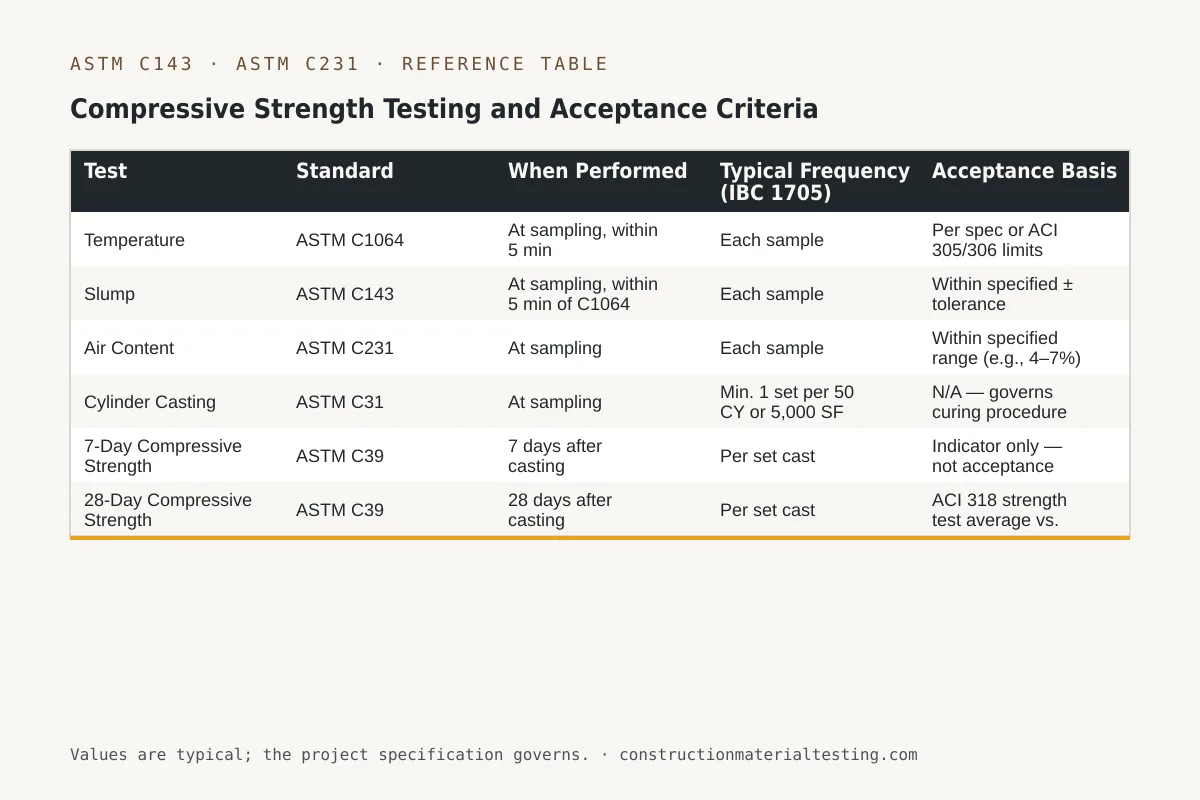
| Test | Standard | When Performed | Typical Frequency (IBC 1705) | Acceptance Basis |
|---|---|---|---|---|
| Temperature | ASTM C1064 | At sampling, within 5 min | Each sample | Per spec or ACI 305/306 limits |
| Slump | ASTM C143 | At sampling, within 5 min of C1064 | Each sample | Within specified ± tolerance |
| Air Content | ASTM C231 | At sampling | Each sample | Within specified range (e.g., 4–7%) |
| Cylinder Casting | ASTM C31 | At sampling | Min. 1 set per 50 CY or 5,000 SF slab, or once per day of placement | N/A — governs curing procedure |
| 7-Day Compressive Strength | ASTM C39 | 7 days after casting | Per set cast | Indicator only — not acceptance |
| 28-Day Compressive Strength | ASTM C39 | 28 days after casting | Per set cast | ACI 318 strength test average vs. f'c |
Who Orders Concrete Testing Services, and Who Sets the Frequency
On projects subject to special inspection under IBC Chapter 17, the owner or owner's representative engages the special inspection agency. The contractor does not hire the inspector for work they are inspecting—that independence is a code requirement, not a preference. The statement of special inspections, prepared by the design professional of record, defines which elements require inspection and testing, and at what frequency. IBC 1705.3 specifically addresses concrete and cross-references ACI 318; the combination establishes the minimum testing program. Individual specifications may be more stringent.
On smaller projects outside the special inspection trigger thresholds, the owner or general contractor typically engages a testing lab directly. In either case, the specifying engineer sets the mix design requirements—f'c, maximum water-cement ratio, slump range, air content range, maximum aggregate size—and those parameters become the acceptance criteria the lab reports against. The testing agency does not set acceptance criteria; it reports results and flags nonconformances. What happens next is the engineer's call. For detail on how our slump testing procedure and air content testing procedure integrate into a special inspection program, those method pages outline the field steps and documentation requirements.
What Happens When a Cylinder Breaks Low
A low 28-day break triggers a defined sequence, not a demolition order. The first step is to verify the result is valid: check the field record for proper initial curing temperature, check the chain of custody for transport damage, and confirm the laboratory capping and break procedure was performed correctly. A cylinder that was frozen in the field or cracked during transport produces a result that does not represent in-place concrete. If any of those conditions apply, the result may be qualified before any structural evaluation begins.
If the result is valid and falls below the ACI 318 acceptance threshold, the engineer of record is notified. The most common next step is drilling cores from the in-place concrete at locations of concern. ACI 318 provides guidance on core evaluation: a set of three cores from a given area is considered adequate if no individual core is below 75 percent of f'c and the average of three cores is at least 85 percent of f'c. Cores tested in a saturated surface-dry condition represent in-place conditions more accurately than standard-cured cylinders, so core results are often higher than a low cylinder break would suggest—particularly when field curing was substandard.
If cores also fall short, the structural engineer evaluates whether the as-built strength is sufficient for the actual loads, whether load restrictions or remediation are required, or whether removal and replacement is warranted. The American Concrete Institute publishes detailed guidance on investigating low-strength test results; that process is technical, project-specific, and cannot be resolved by re-testing cylinders from the same pour.
Where Concrete Testing Services Fit on Your Project
The time to coordinate concrete testing is before the first truck arrives—not the morning of the pour. The testing program should be established during preconstruction: the mix designs reviewed and approved, the sampling and cylinder-break schedule confirmed against the project specification, the special inspection plan issued, and the laboratory notified of anticipated pour dates and volumes. Scrambling to find a technician on pour day, or discovering after placement that the required frequency was not met, creates documentation gaps that slow down permit close-out and can trigger rejection of structural elements by the authority having jurisdiction.
Our field technicians dispatch from hub locations across the region and carry the equipment to run the full fresh-concrete test set—temperature, slump, air content, and cylinder casting—on every sample. Laboratory staff process and break cylinders under documented procedures, and results are uploaded to a project portal accessible to the engineer, owner, and contractor. Whether your project requires standard materials testing or a full special inspection program under IBC 1705, we can build the testing scope around your schedule and specification. Request a proposal to get a testing scope and fee estimate before your first placement date.
Get our guides in your Google results
Add Construction Materials Testing as a preferred source and Google shows our guides more often when you search for testing topics.