
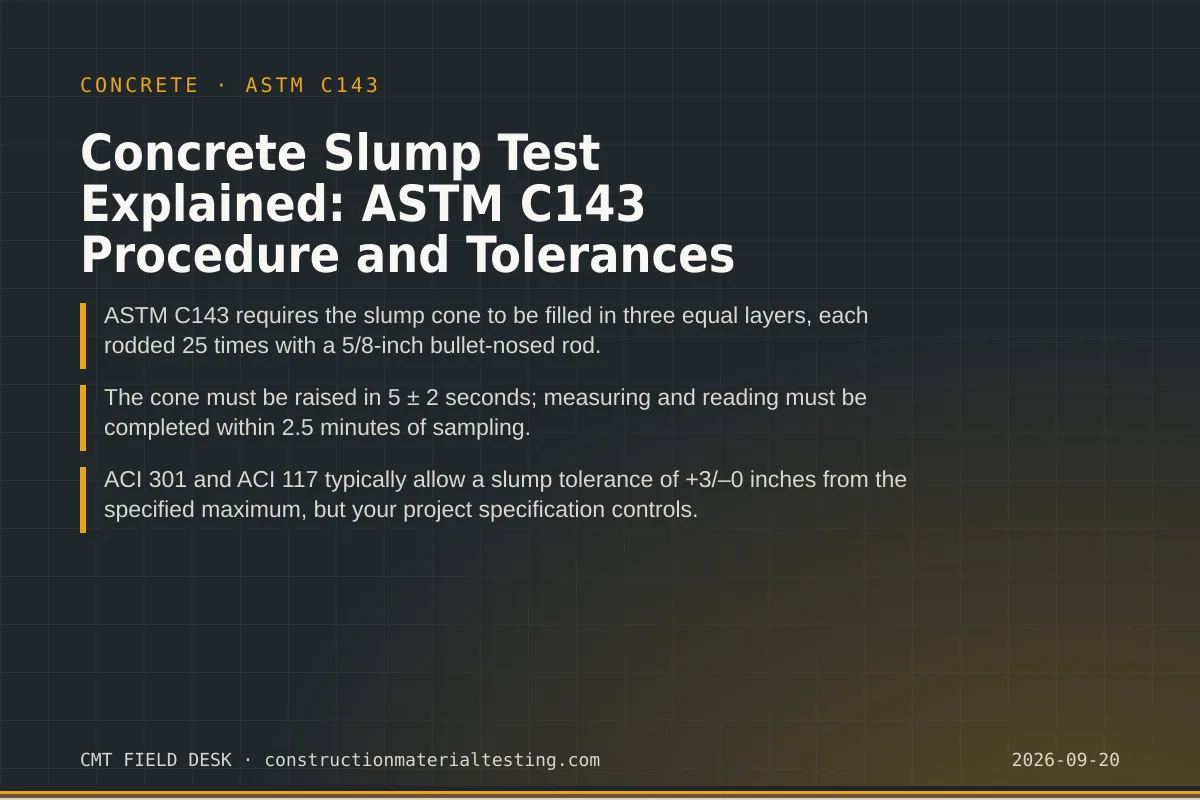
Why the Concrete Slump Test Matters on Every Pour
Concrete arrives at the jobsite as a perishable material. Once the drum stops turning, chemistry is already consuming workability. The concrete slump test gives us a fast, repeatable snapshot of that workability before any concrete goes into formwork. If the slump is outside the specified range, we know immediately — before a single cubic yard is placed — that something has changed in the mix.
Slump is sensitive to water content, cement paste volume, admixture dosage, concrete temperature, and haul time. A result that deviates from the design value is therefore a signal worth investigating, not just a number to record and move on. Our technicians treat every out-of-tolerance reading as a conversation starter with the batch plant, not a formality.
Slump alone does not determine whether concrete is acceptable. It is one piece of a composite field record that includes air content and unit weight testing, cylinder fabrication, and temperature measurement. Read in isolation, slump can mislead; read alongside the full ASTM C172 composite sample, it tells the real story of the load.
Sampling Before You Test: ASTM C172 Comes First
Before a slump cone touches concrete, the sample must be obtained correctly. ASTM C172 governs composite sampling from a truck mixer. We collect samples from the middle portion of the load — not the first or last tenth of the discharge — by repeatedly passing a bucket or sample container through the discharge stream. The full composite sample is assembled from at least two portions taken within a five-minute window.
Sampling location matters: the test must begin within five minutes of obtaining the composite sample, and the entire suite of fresh concrete tests — slump, air, unit weight, temperature, and cylinder fabrication — must be completed within the time frame the governing standard requires. Delaying even a few minutes on a hot Texas afternoon can cause a legitimate slump to read low and trigger a rejection that was actually a procedural error. We set up equipment before the truck arrives so nothing slows us down once the sample hits the wheelbarrow.
ASTM C143 Procedure Step by Step
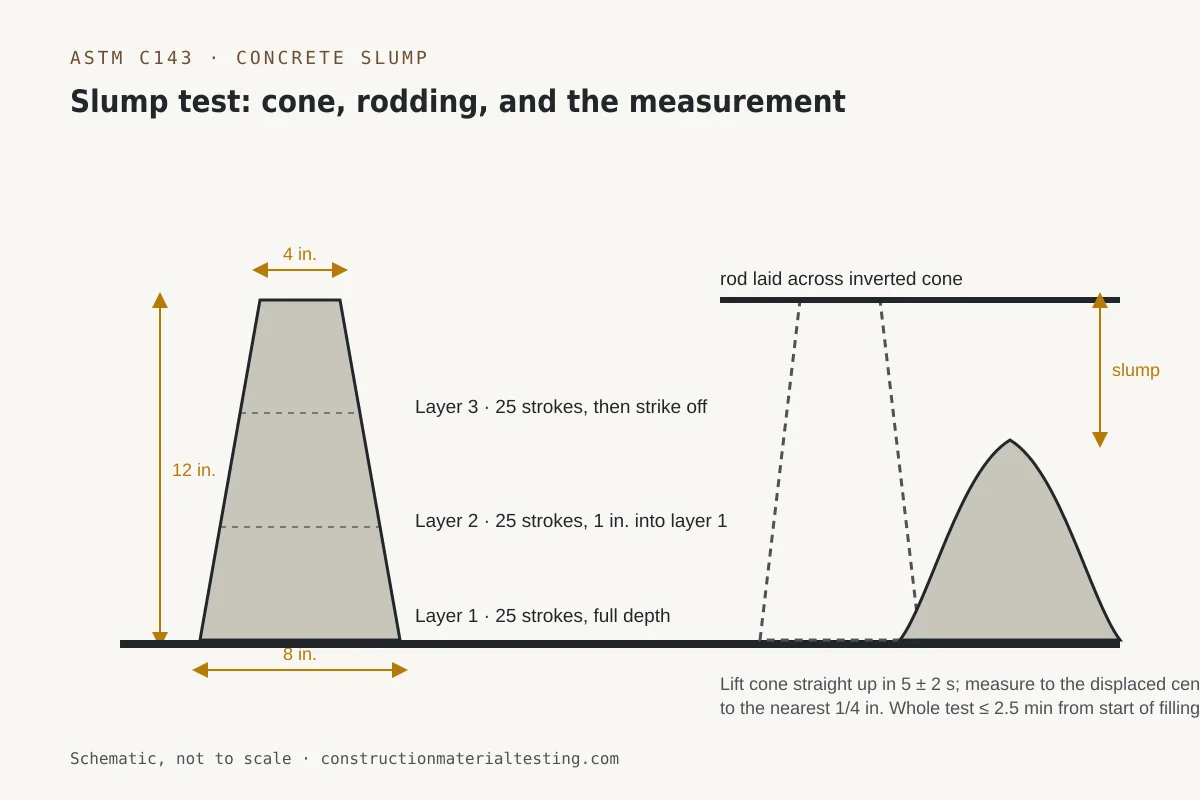
The ASTM C143 standard procedure starts with a clean, damp slump cone — 4 inches in diameter at the top, 8 inches at the base, 12 inches tall — placed on a flat, rigid, non-absorptive surface. The operator stands on the foot plates to hold the cone steady throughout filling. The interior is dampened but not left with puddles.
The cone is filled in three equal layers, each approximately four inches deep. Each layer is rodded 25 times with a 5/8-inch diameter bullet-nosed rod, distributing strokes evenly across the layer. For the bottom layer, rod the full depth. For the second and third layers, rod only just into the top of the preceding layer — about one inch of penetration. After rodding the third layer, strike off flush with a screeding motion.
Lift the cone straight up in 5 ± 2 seconds with a smooth, controlled motion — no lateral or twisting movement. Set the cone beside the concrete. Lay the rod horizontally across the inverted cone and measure the vertical distance from the underside of the rod to the displaced center of the concrete mass. That measurement, to the nearest quarter-inch, is the slump. The entire test from the start of filling to the final measurement must be completed within 2.5 minutes of sampling.
Reading the Result: What Each Slump Profile Tells You
A true slump — the mass settles symmetrically and the top drops evenly — is the only valid result under ASTM C143. A shear slump, where one side shears off and slides, must be discarded. Perform a fresh test immediately; if the replacement test also shears, the mix likely lacks cohesion, which is worth reporting to the engineer of record even if the number is otherwise in range.
A zero slump (concrete stays rigid when the cone lifts) may indicate a very stiff mix designed for slip-forming or precast, or it may mean the concrete has begun to stiffen in the drum due to heat or extended haul. Context matters: compare the batch ticket time, mixing revolutions, and temperature reading before drawing conclusions. A slump above the maximum is the more common field problem — extra water at the truck, a pump mix arriving too wet, or an admixture overdose.
Slump Tolerances Under ACI 301 and ACI 117
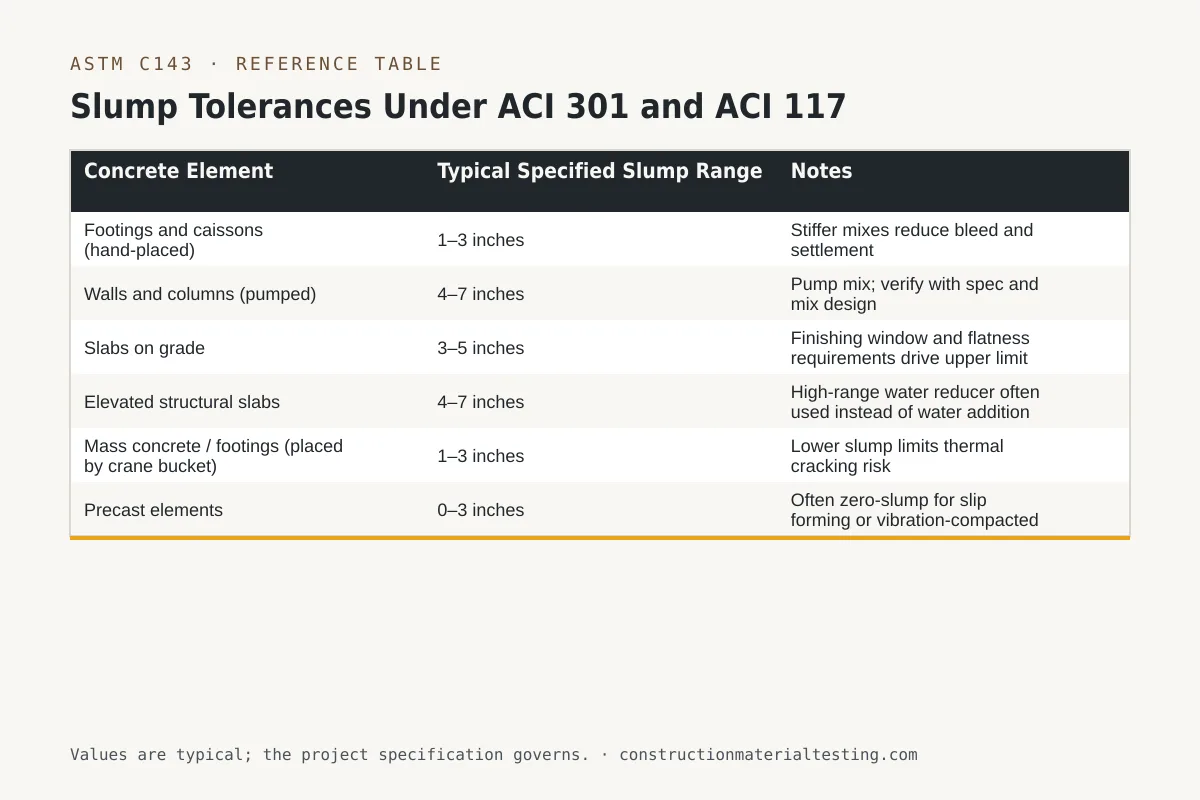
Project specifications typically invoke ACI 301 (Specifications for Structural Concrete) and ACI 117 (Specification for Tolerances for Concrete Construction and Materials) for acceptance criteria. Both documents address slump tolerances in language that allows a positive deviation from the specified maximum while permitting the mix to be stiffer. The specific tolerance values in your specification — often +3/–0 inches from the specified maximum, or a defined range such as 4 ± 1 inch — govern over any general rule. Always read the project spec before deciding whether a load is acceptable.
When the measured slump exceeds the specified maximum by more than the allowed tolerance, the load is subject to rejection. Adding water at the truck to bring a stiff load into tolerance is prohibited by ACI 301 and by most project specifications unless the mix is still within the maximum allowable water-cement ratio, the drum is retumbled for the required revolutions, and the engineer of record approves in writing. In practice, on most commercial and DOT work, water addition at the site is not permitted at all. Our technicians document the measured slump, compare it to the batch ticket's target, and notify the contractor and the inspecting engineer — we do not add water ourselves and we do not authorize it.
| Concrete Element | Typical Specified Slump Range | Notes |
|---|---|---|
| Footings and caissons (hand-placed) | 1–3 inches | Stiffer mixes reduce bleed and settlement |
| Walls and columns (pumped) | 4–7 inches | Pump mix; verify with spec and mix design |
| Slabs on grade | 3–5 inches | Finishing window and flatness requirements drive upper limit |
| Elevated structural slabs | 4–7 inches | High-range water reducer often used instead of water addition |
| Mass concrete / footings (placed by crane bucket) | 1–3 inches | Lower slump limits thermal cracking risk |
| Precast elements | 0–3 inches | Often zero-slump for slip forming or vibration-compacted mixes |
When to Reject the Load
Rejection is a defined act with defined consequences. When slump exceeds the allowable tolerance, the standard process is to notify the superintendent, document the load number and batch ticket, and request that the load be returned to the plant or held pending engineer review. Do not allow the load to be placed while a dispute about adding water is ongoing — concrete placed in violation of the spec is subject to removal at the contractor's expense under most general conditions language.
A low slump reading is less commonly a cause for outright rejection, but it warrants a second test if the deviation from target is significant. A stiff mix placed and consolidated properly will usually meet strength requirements; the concern is whether it can be consolidated without honeycombing in congested rebar or narrow forms. Bring the engineer into that conversation immediately. Our field technicians are trained to communicate test results to the responsible party in real time, not after the pour is finished.
Rejection authority under a third-party special inspection program ultimately rests with the engineer of record or the owner's representative. Our role is to measure, document, and report — accurately and promptly. What we will never do is sign off on a result we did not witness or back-date a test time to make a borderline reading appear compliant.
How Slump Connects to Cylinder Strength Results
Slump and compressive strength are related but not interchangeable. Within a well-designed mix, higher water content increases slump but decreases strength by raising the water-cement ratio. That relationship is why adding water at the truck is so problematic: one inch of additional slump from free water addition can meaningfully reduce 28-day cylinder breaks. When we see a pattern of high slumps followed by marginal cylinder results, water addition is one of the first variables we examine.
Cylinders fabricated from the same ASTM C172 composite sample as the slump test create a traceable record. Our laboratory cures, caps, and breaks those cylinders following ASTM C31 procedures, and the break report references the original field ticket — including the slump, air content, temperature, and load number. That chain of documentation is what makes the data useful for forensic analysis if a low break triggers a core investigation later. Learn more about what concrete testing covers on a construction project before your next pour.
Common Field Mistakes That Invalidate the Test
The most frequent procedural errors we see in the field are testing on an uneven or absorptive surface, failing to hold the cone down firmly during filling, rodding fewer than 25 times per layer, and taking longer than 2.5 minutes from sampling to measurement. Any of these can shift the result by half an inch or more — enough to incorrectly pass or fail a load. We also see technicians measuring to the top of the highest point of the slumped concrete rather than the center of the displaced mass, which overstates slump on a shear failure.
Equipment condition matters too. A dented or out-of-round cone, a bent rod, or a wet surface that has not been properly dampened (just damp, not slick with water) all introduce variability. Our technicians inspect and clean the cone before each use, and cones are replaced when deformation is visible. These details are not procedural pedantry — they are the difference between a result that means something and a number that provides false confidence to the engineer reviewing the field report.
Where This Fits on Your Project
The concrete slump test is a mandatory fresh concrete test for virtually all structural concrete under IBC special inspection requirements and is required by most DOT and public agency specifications at a defined frequency per day or per volume placed. Our concrete and materials testing services include slump, air, unit weight, temperature, and cylinder fabrication as a coordinated field package, dispatched from our Sugar Land headquarters or from the nearest of our 27 regional hubs.
If your project is moving toward a concrete pour and you need ACI- and NICET-certified technicians on-site with calibrated equipment and a documented quality system behind the laboratory, request a proposal and our field desk will respond with coverage details, frequency recommendations based on your spec, and turnaround for cylinder break reports. Read more about the ASTM C143 standard and our testing capabilities before your preconstruction meeting.
Get our guides in your Google results
Add Construction Materials Testing as a preferred source and Google shows our guides more often when you search for testing topics.