
What ACI 306 Actually Requires in the Field
Most contractors know that cold weather concrete means something changes on the jobsite, but the specific triggers in ACI 306R are worth pinning down. The American Concrete Institute defines cold weather conditions as a period when the mean daily air temperature drops below 40 °F (4 °C) for more than three consecutive days. Once those conditions exist, the document's protection requirements apply — and they do not switch off the moment a warm front rolls through. ACI 306R guidance from the American Concrete Institute covers fresh concrete temperature at placement, protection duration, and the minimum in-place strength concrete must reach before protection can be removed.
The protection period is not a single fixed number. It depends on the type of structure (massive vs. thin), the exposure category, and whether the concrete will be loaded or subjected to freezing after protection ends. ACI 306R provides minimum in-place strengths that must be achieved before protection is removed — commonly 500 psi before concrete can be exposed to freezing, and progressively higher thresholds before shoring or formwork can be stripped. These are the numbers your testing program needs to confirm, and confirming them requires the right specimens tested under the right conditions.
Temperature at placement is the first data point in any cold weather testing plan. ASTM C1064 puts the maximum allowable concrete temperature for cold weather work in context: the fresh concrete temperature must stay warm enough to protect against early freezing but not so warm that it accelerates setting unpredictably. We measure temperature at the point of discharge, using a calibrated thermometer seated in the concrete mass — not held at the surface — and we record that reading as part of the batch ticket data. You can review the full procedure in our ASTM C1064 temperature of freshly mixed concrete test method page.
Field-Cured Cylinders: How ASTM C31 Changes in Cold Weather
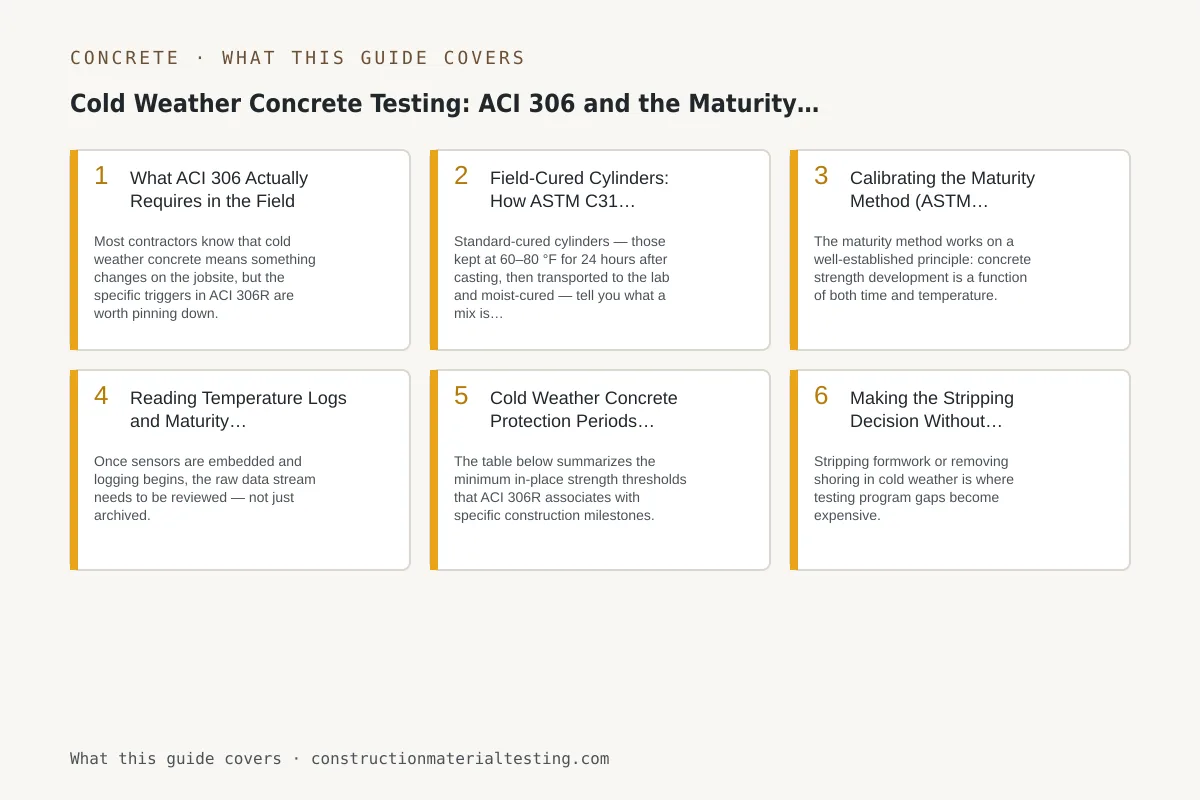
Standard-cured cylinders — those kept at 60–80 °F for 24 hours after casting, then transported to the lab and moist-cured — tell you what a mix is capable of under ideal conditions. They do not tell you what the concrete in your slab achieved while it sat under blankets in 28 °F weather. That is what field-cured cylinders are for, and ASTM C31 procedures for making and curing concrete test specimens draws a clear line between the two.
For field-cured cylinders, we leave the specimens at the pour location, covered and insulated alongside the concrete element, from initial curing through the end of the specified protection period. The cylinders experience the same ambient swings, the same insulation R-value, and the same wind exposure as the slab or wall. When protection is removed from the structure, the field-cured cylinders come off protection at the same time. They are then transported to the lab and tested at ages specified in the project documents — often 7, 14, and 28 days, or at specific milestone events tied to construction sequencing.
Handling matters more in cold weather than it does in summer pours. Cylinders must not freeze before initial set, and they must not be allowed to warm significantly faster than the surrounding structure. We use insulated boxes with supplemental heat sources sized to track the temperature envelope predicted for the concrete element — not to accelerate the cylinders. A field-cured cylinder that was accidentally warmed in a contractor's trailer is no longer representative, and breaks from that set cannot be used to justify stripping decisions.
The number of field-cured sets needed depends on the inspection plan. For special inspection programs under IBC 1705.3, the frequency of cylinder sets is typically specified in the Statement of Special Inspection. We coordinate with the engineer of record before the pour to confirm how many sets will be required, what ages apply, and whether field-cured sets supplement or partially replace the standard-cured sets for that pour.
Calibrating the Maturity Method (ASTM C1074) for Your Mix
The maturity method works on a well-established principle: concrete strength development is a function of both time and temperature. By integrating temperature over time, you get an index — either the Nurse-Saul maturity index (degree-hours) or the equivalent age at a reference temperature — that correlates to strength for a given mix design. ASTM C1074 defines how that calibration is built and how sensors are used in the field.
Calibration requires making at least 30 cylinders from the mix design to be used in the field, curing them at three or more different temperatures while logging temperature continuously, then breaking sets at five or more ages per temperature regime. The resulting strength-maturity pairs are plotted and fit to a curve — typically a logarithmic or hyperbolic function. That curve is the calibration. It is only valid for the specific combination of cementitious materials, water-to-cementitious-materials ratio, and admixture package used in those lab cylinders. If the mix changes — if fly ash proportion shifts or a different cement source is used — recalibration is required.
One common error we see is projects that adopt a calibration curve from a previous job or from the ready-mix producer's historical data without verifying it against field-cured breaks from the current mix and placement conditions. ACI 306R and ASTM C1074 together make clear that the maturity approach is a tool for tracking in-place strength development, not a substitute for independent verification. We recommend running parallel field-cured cylinder programs for the first few pours on any cold weather project, using those break results to validate that the maturity curve is predicting within the confidence range established during calibration.
Reading Temperature Logs and Maturity Indices During the Protection Period
Once sensors are embedded and logging begins, the raw data stream needs to be reviewed — not just archived. A temperature drop in the first 12 hours after placement, before concrete reaches initial set, is far more damaging than the same drop at 72 hours when the matrix has stiffened. We check early logs against the predicted temperature envelope developed from heat-of-hydration calculations and the insulation plan. When measured temperatures fall below that envelope, we notify the contractor so protection can be adjusted before freezing damage occurs.
The maturity index is read directly from the sensor's accumulated data. Most modern wireless sensors calculate the index continuously and push readings to a web dashboard or app. The technician reviews index values against the calibration curve to estimate in-place strength at any point during curing. This real-time visibility is the practical advantage of the maturity method: rather than waiting for a 7-day break to decide whether to strip formwork, the team can see the index climbing toward the target threshold and plan accordingly.
Documentation is as important as the measurement itself. Temperature logs, maturity index reports, and the calibration curve all become part of the project file. For projects subject to special inspection under IBC, the inspector of record typically includes maturity logs in the inspection reports submitted to the building official. We export logs in formats compatible with standard project management and inspection software, and we retain the raw data as part of our quality system records.
Cold Weather Concrete Protection Periods and Strength Thresholds
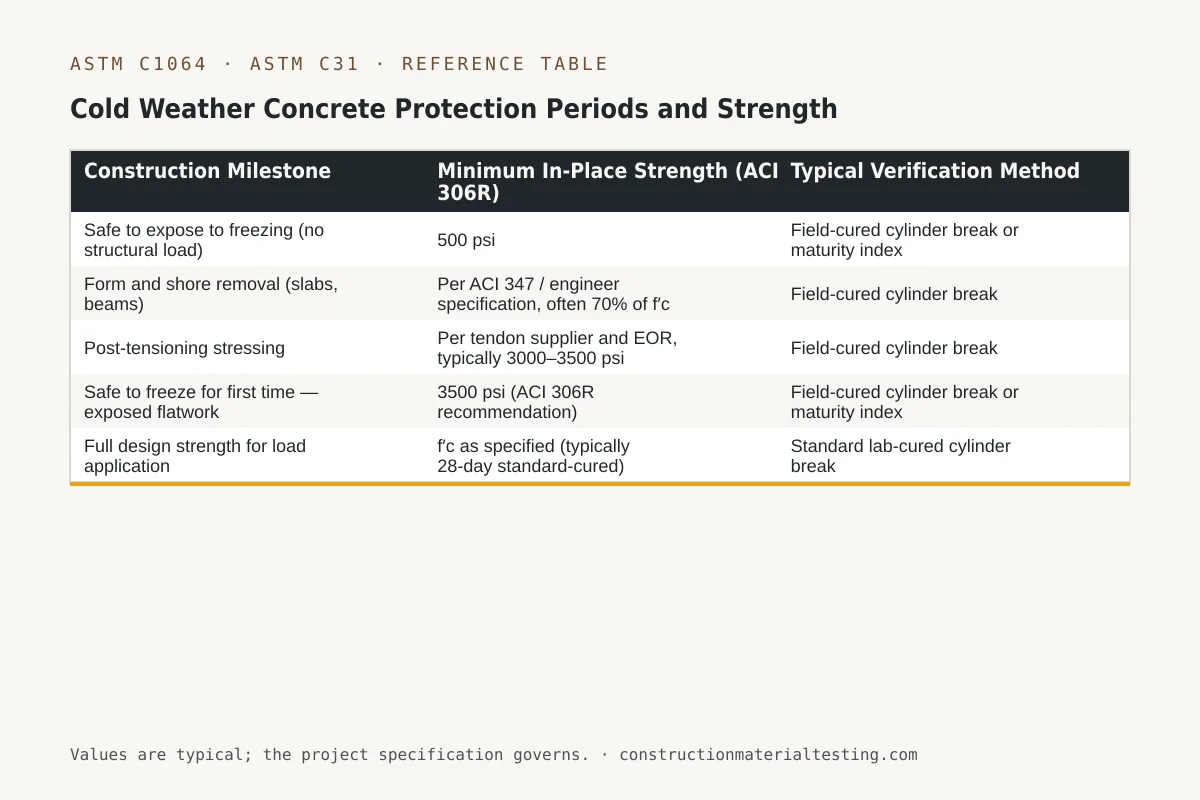
The table below summarizes the minimum in-place strength thresholds that ACI 306R associates with specific construction milestones. These are not project specifications — your structural engineer's drawings and the concrete mix submittal govern — but they represent the baseline guidance that most specifications reference or exceed. Confirming these thresholds is the direct purpose of your field-cured cylinder program and maturity tracking.
One point worth emphasizing: the protection period does not end at a calendar age. It ends when the concrete achieves the required in-place strength and has been protected long enough that subsequent exposure to freezing will not cause damage. For concrete that will remain exposed to freeze-thaw cycles in service, ACI 306R requires a higher strength — often 3500 psi or greater — before the concrete can safely freeze for the first time. A 28-day standard-cured break that shows 5000 psi tells you nothing about what was in the slab at day 7 when the blankets came off.
| Construction Milestone | Minimum In-Place Strength (ACI 306R) | Typical Verification Method |
|---|---|---|
| Safe to expose to freezing (no structural load) | 500 psi | Field-cured cylinder break or maturity index |
| Form and shore removal (slabs, beams) | Per ACI 347 / engineer specification, often 70% of f′c | Field-cured cylinder break |
| Post-tensioning stressing | Per tendon supplier and EOR, typically 3000–3500 psi | Field-cured cylinder break |
| Safe to freeze for first time — exposed flatwork | 3500 psi (ACI 306R recommendation) | Field-cured cylinder break or maturity index |
| Full design strength for load application | f′c as specified (typically 28-day standard-cured) | Standard lab-cured cylinder break |
Making the Stripping Decision Without Guessing
Stripping formwork or removing shoring in cold weather is where testing program gaps become expensive. We have seen projects where the schedule pressure to strip was real, the 28-day lab breaks from a previous pour looked strong, and the team assumed the current pour was in similar shape. It was not. A cold snap during the first 48 hours had slowed strength gain significantly, and the field-cured cylinders — had they been tested — would have shown it. The maturity index from an embedded sensor, cross-checked against a validated calibration curve, gives you the same early warning without waiting for a break.
The practical sequence for a stripping decision looks like this: first, confirm that the maturity index has reached the value corresponding to the required threshold on the calibration curve; second, confirm that at least one set of field-cured cylinders has been broken and that the breaks support the maturity estimate; third, verify with the engineer of record that both data streams are acceptable for release of the element. If the maturity and cylinder data agree and both exceed the threshold, the engineer can release forming with confidence. If they diverge — maturity index suggests adequate strength but cylinder breaks are low — hold and investigate before proceeding.
Regional climate context matters for planning. Projects in northern dispatching regions run longer protection periods almost by default. Our materials testing services in Chicago and materials testing services in Denver operate under cold weather protocols for an extended portion of the year, and calibration curves in those markets are often validated against local cement sources and mix designs common to those regions. If you are working across multiple climates in a single construction season, confirm that the mix design and its calibration curve are appropriate for each location's conditions.
Where This Fits on Your Project
Cold weather concrete testing is not a single test — it is a coordinated program that starts before the first truck rolls and runs until every protection-period milestone has been documented and signed off. The components are ASTM C1064 temperature measurements at discharge, ASTM C31 field-cured cylinder sets placed and cured in parallel with the structure, embedded maturity sensors calibrated under ASTM C1074 for the specific mix, and continuous temperature logging reviewed by qualified personnel who understand the ACI 306R thresholds they are working toward. Our construction materials testing services are staffed by ACI- and NICET-certified technicians who can build and execute that program from pour plan through final documentation.
If you have a cold weather pour coming up — or a project specification that requires a maturity method submission — reach out through our proposal request and we will scope the testing program to match your schedule, your mix design, and the protection period requirements your engineer has specified. Getting the scope right before the concrete arrives is far less costly than sorting out a stripping hold or a disputed test result after the fact.
Get our guides in your Google results
Add Construction Materials Testing as a preferred source and Google shows our guides more often when you search for testing topics.