
What Actually Goes Wrong When You Hire the Wrong Concrete Testing Company
The failure mode nobody talks about is not the dramatic structural collapse — it is the quiet accumulation of bad data that nobody catches until a building department flags a missing break or an engineer of record refuses to sign off on a structural element. A concrete testing company that cuts corners does not usually announce it. The problems show up in the paperwork: cylinders made without a slump test, air content skipped on an air-entrained mix, or break results filed two weeks after the 28-day window.
We have seen projects stall because a prior testing firm missed a scheduled pour entirely — the inspector was not dispatched, no cylinders were made, and the concrete was placed without any documentation. Under IBC special inspection requirements, that placement may need to be cored, tested in place, or in the worst case removed. The cost of that retrofit testing or remediation dwarfs whatever was saved by hiring a cheaper firm in the first place.
The other common failure is cylinder damage in transit or improper initial curing. ASTM C31 is explicit: cylinders must be stored in a temperature range of 60°F to 80°F during the first 24 hours after fabrication and protected from vibration and shock. A technician who leaves cylinders in an un-temperature-controlled truck bed overnight, or stacks them without cushioning, introduces variability that looks like a mix problem when the real problem was handling. Understanding how field specimens are made and cured under ASTM C31 is the starting point for evaluating any firm's field practices.
Technician Certifications: The Credential Floor, Not the Ceiling
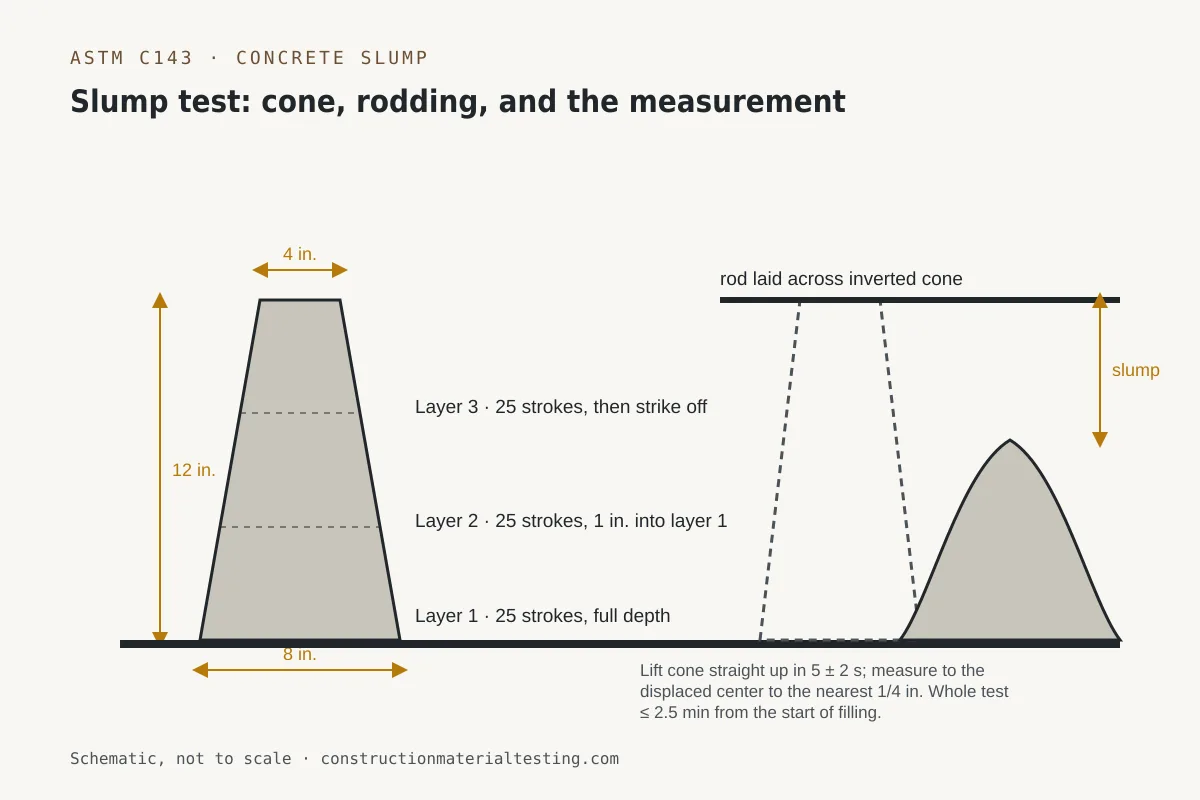
The minimum credential for a technician making and curing field specimens is ACI Field Testing Technician Grade I. This certification covers the five freshly mixed concrete tests that feed directly into structural documentation: slump per ASTM C143, air content per ASTM C231, unit weight, temperature, and cylinder fabrication per ASTM C31. A technician who cannot produce a current wallet card for that certification should not be making cylinders on a project where IBC special inspection applies.
For laboratory compression testing, look for NICET certification or equivalent documented training tied to ASTM C39 compressive strength testing of cylindrical specimens. The machine used for breaking must be calibrated on a schedule traceable to a recognized standard, and that calibration record should be available on request — not buried in a drawer. If a firm cannot produce calibration documentation within a day of being asked, treat that as a disqualifier.
Certifications have expiration dates. ACI Field Testing Technician Grade I recertifies on a cycle, and a lapsed card is a lapsed card regardless of how many years the technician has been in the field. Ask any firm you are considering to confirm certification status for the specific technicians who will work your project, not just the person who answers the phone.
Curing Practice in the Field: Where Strength Data Goes Wrong
Most compressive strength disputes we see trace back to something that happened in the first 24 hours after the cylinders were made, not to a problem with the mix. ASTM C31 establishes that initial curing — the period before specimens are transported to the laboratory — must maintain the cylinders within a specified temperature range and protect them from movement that could disturb the setting concrete. On hot Texas jobsites, that means an insulated curing box with monitoring, not the shadow side of a concrete barrier.
After transport to the laboratory, standard curing in a moist room or water tank must maintain 73°F ± 3°F continuously until the break date. A lab that cannot demonstrate it monitors and records tank temperature is not in a position to defend its break results if a dispute arises. The American Concrete Institute's published guidance on concrete testing and inspection reinforces why these controls matter: strength gain in concrete is highly sensitive to curing temperature, especially in the first several days.
When a 28-day break comes back low, the first question the engineer of record will ask is: were the cylinders properly cured? If the answer is uncertain, the data loses its evidentiary value and you are left arguing over cores. Proper curing documentation is not overhead — it is the thing that makes the test result defensible.
Report Turnaround and Format: What the Data Needs to Show
A test result delivered after the next structural pour is already placed cannot prevent anything. Turnaround expectations should be established before the contract is signed, not assumed. For 7-day breaks on a fast-moving deck pour, 24 to 48 hours after the break date is a reasonable expectation for a laboratory with local dispatch. For 28-day breaks, the report needs to reach the engineer of record and the special inspection firm quickly enough to act on a low result before the affected element is buried under subsequent work.
Report format matters as much as turnaround speed. At a minimum, each report should identify the project name and address, the placement location (grid line, elevation, structural element), the batch ticket or truck number, the time of sampling, concrete temperature and ambient temperature at time of testing, slump, air content where specified, and the individual break values at each test age. A report that shows only a compressive strength number with a project name is not adequate documentation for a special inspection program under IBC Section 1705.
Ask prospective firms for a sample report before you hire them. If the sample report is missing fields that your building department or engineer of record will require, you will be chasing supplemental documentation on every submittal — which creates exactly the kind of project delay that testing is supposed to prevent. Our overview of what concrete testing accomplishes on a construction project outlines what complete documentation looks like.
Dispatch Coverage and Scheduling: The Logistics Problem That Kills Pours
A testing firm headquartered two hours from your jobsite that promises coverage sounds fine in a proposal and falls apart on a 6 a.m. pour with a tight ready-mix window. Dispatch coverage — meaning a certified technician who can be on your site within a defined response window — is a logistical question, not a marketing claim. Ask specifically: where is the nearest dispatch hub to this site, how many technicians are available in that area, and what is the backup when the primary technician has a conflict?
Missed pours are not just an inconvenience. On a project with a special inspection program, a placement that occurs without the required observation and testing documentation is a non-conforming placement. Resolving that after the fact requires written justification, potentially additional testing, and the signature of the engineer of record — none of which is free or fast. Our materials testing services are supported by 27 regional dispatch hubs precisely to keep that scenario from happening on projects across Texas and the surrounding region.
Scheduling communication matters too. A testing firm that goes silent between dispatches — that does not confirm the technician is en route, does not flag a scheduling conflict before pour day, and does not call if a technician is running late — will eventually cost you a pour. Establish communication expectations in writing as part of the service agreement.
The Selection Checklist: What to Evaluate Before You Sign a Contract
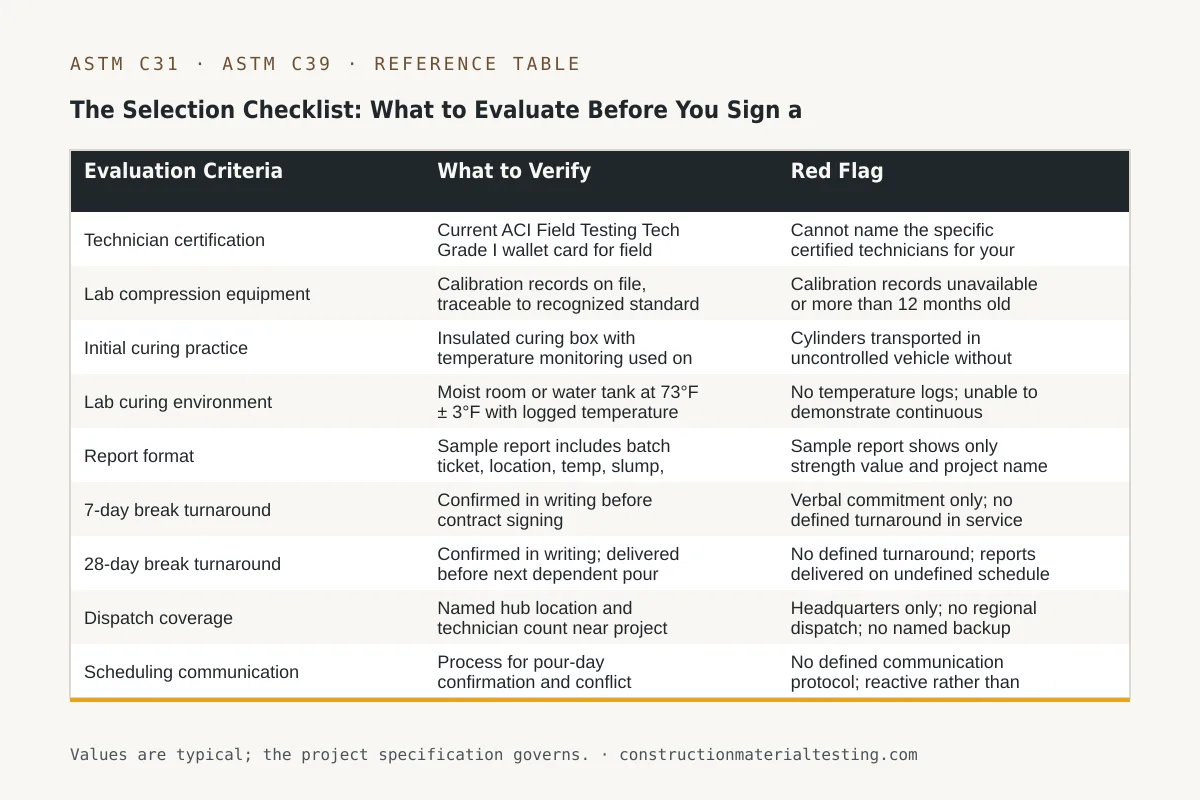
When you put a concrete testing company through a structured evaluation, the differences between firms become clear quickly. The table below captures the key criteria, what to verify, and what a red flag looks like. This is not an exhaustive due-diligence list, but these are the items most directly tied to project risk. For a deeper look at the individual test methods that your project will likely require, review the procedures for slump testing per ASTM C143 and air content testing per ASTM C231 — both are performed on fresh concrete at the point of discharge and feed directly into the acceptance record.
Price is obviously a factor, but evaluate it last. A firm whose quote is significantly below competitors is almost always reflecting a difference in something else on this list — technician certification level, lab equipment calibration status, or dispatch capacity. The ASTM C31 standard itself describes the field procedures technicians must follow; any firm that cannot walk you through those procedures during a pre-qualification conversation is telling you something.
| Evaluation Criteria | What to Verify | Red Flag |
|---|---|---|
| Technician certification | Current ACI Field Testing Tech Grade I wallet card for field staff | Cannot name the specific certified technicians for your project |
| Lab compression equipment | Calibration records on file, traceable to recognized standard | Calibration records unavailable or more than 12 months old |
| Initial curing practice | Insulated curing box with temperature monitoring used on site | Cylinders transported in uncontrolled vehicle without documentation |
| Lab curing environment | Moist room or water tank at 73°F ± 3°F with logged temperature records | No temperature logs; unable to demonstrate continuous monitoring |
| Report format | Sample report includes batch ticket, location, temp, slump, air, individual break values | Sample report shows only strength value and project name |
| 7-day break turnaround | Confirmed in writing before contract signing | Verbal commitment only; no defined turnaround in service agreement |
| 28-day break turnaround | Confirmed in writing; delivered before next dependent pour | No defined turnaround; reports delivered on undefined schedule |
| Dispatch coverage | Named hub location and technician count near project site | Headquarters only; no regional dispatch; no named backup technician |
| Scheduling communication | Process for pour-day confirmation and conflict notification defined | No defined communication protocol; reactive rather than proactive |
Where This Fits on Your Project
Concrete testing sits at the intersection of quality control and legal documentation. The cylinders you make, the slump and air results you record, and the break data you file are the evidentiary record that a structure was built to specification. A firm that handles this work well is nearly invisible — things happen on schedule, reports arrive, the engineer of record has what they need. A firm that handles it poorly surfaces at the worst possible times: a disputed break at 28 days, a missed pour flagged during a building department inspection, a project closeout held up by incomplete documentation.
Selecting a concrete testing company before the project starts — not in response to a crisis — is the only way to negotiate appropriate service terms, verify credentials, and establish dispatch and communication protocols. If you are bidding a project, staffing a special inspection program, or trying to replace a testing firm mid-project, we can put together a scope and coverage plan specific to your site. Submit a proposal request and a member of our field desk will follow up with coverage details and a sample report for your review.
Get our guides in your Google results
Add Construction Materials Testing as a preferred source and Google shows our guides more often when you search for testing topics.