
What the Speedy Moisture Tester Actually Does
The speedy moisture tester is a sealed pressure vessel with a Bourdon-tube gauge. When you load a weighed soil sample and a measured charge of calcium carbide reagent, the carbide reacts with free water in the sample to produce acetylene gas. The pressure that builds inside the vessel is proportional to the amount of water released, and the gauge face is calibrated to read that pressure directly as a percent moisture. The entire reaction typically stabilizes within three to five minutes, which is why compaction crews have carried these testers on fill jobs for decades.
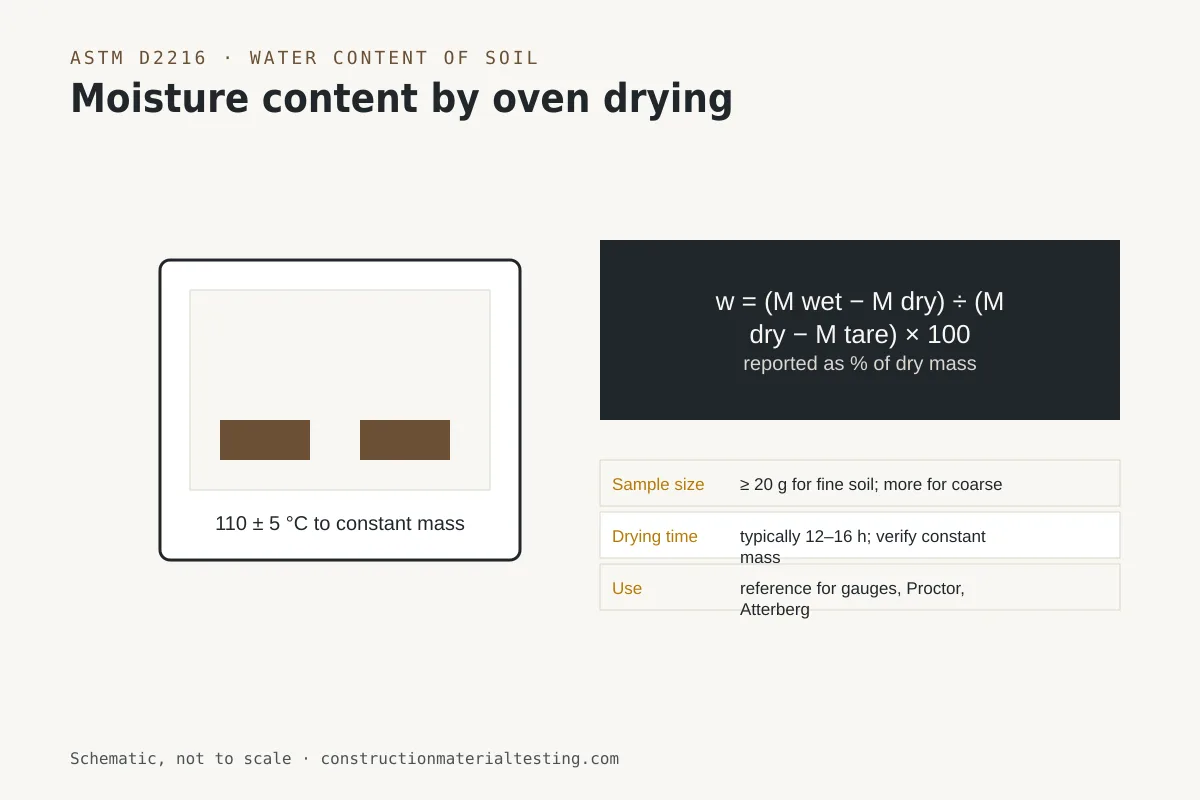
The governing standard is ASTM D4944, Standard Test Method for Field Determination of Water (Moisture) Content of Soil by the Calcium Carbide Gas Pressure Tester. It is important to understand from the outset that D4944 is a field screening method, not a replacement for the gravimetric oven-dry procedure in ASTM D2216. The two methods complement each other: the speedy tester gives you a result in minutes on the fill before the roller makes another pass; the oven-dry method gives you the verified number that goes into the permanent record.
Equipment and Reagent Check Before You Start
Before loading any sample, inspect the vessel body, the cap O-ring or gasket, and the gauge. A cracked or deformed gasket will bleed pressure and give a low moisture reading. Wipe the inside of the vessel and cap with a dry cloth—any moisture residue from a previous test will add to your reading. Zero the gauge by opening the valve if your instrument has one, or confirm the needle rests at zero with the cap loose.
Calcium carbide reagent degrades when exposed to moisture or air. Open the reagent container only as long as needed, reseal it immediately, and store it in a cool, dry place away from ignition sources. If the granules look dusty, powdery, or have clumped, the reagent has partially hydrolyzed and your readings will run low. We carry a fresh supply to the field and note the lot number in our test records so we can trace any anomalous results. The balance you use to weigh the sample should be checked with a reference weight at the start of each shift—field balances take abuse and drift.
Step-by-Step Field Procedure Under ASTM D4944
Collect a representative sample from the material being tested—either from the fill surface as placed or from the borrow area, depending on what your specifications require. Break up any lumps and remove particles larger than the maximum size your tester is rated for, typically material retained on the No. 4 sieve for standard 26-gram instruments. Place the cap of the vessel on your balance, tare it, and weigh the sample directly into the cap to the mass indicated on the instrument's scale. Most testers in current field use require either 20 g or 26 g; using the wrong mass means the gauge calibration is wrong for your reading.
Add the specified charge of calcium carbide reagent—usually two scoops with the scoop provided, but follow the manufacturer's specification for your instrument. Place the reagent in the body of the vessel while keeping the soil sample in the cap, so the two do not contact until you seal the tester. Bring the cap and body together firmly and latch or thread the closure. A proper seal is critical; if the cap can be rotated after latching, the O-ring is not seated.
With the vessel sealed, hold it horizontally and shake it vigorously for the full duration specified by the manufacturer—typically 10 to 15 seconds of hard shaking, then inversion and shaking again to ensure all sample contacts the reagent. Set the tester on a level surface and allow the gauge to stabilize. Do not read the gauge while still shaking, and do not tap the gauge. After roughly three to five minutes, the needle should stop moving. Record the gauge reading to the nearest graduation.
Reading the Gauge and Converting to Oven-Dry Basis
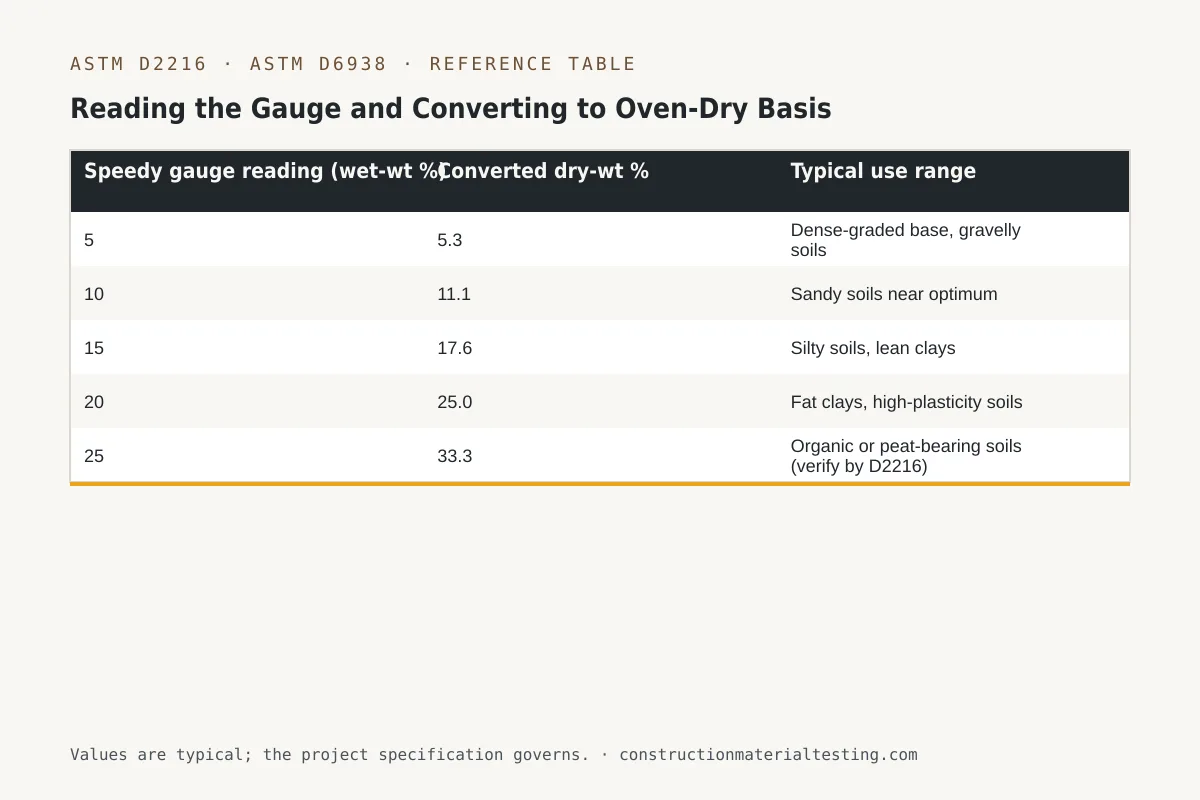
The gauge on a speedy moisture tester reads moisture content on a wet-weight basis, meaning the water mass is expressed as a percentage of the total sample mass including the water. Proctor compaction standards derived from ASTM D698 and field density acceptance criteria are almost always stated on a dry-weight basis, where the water mass is divided by the dry soil mass. These two conventions give different numbers for the same soil, and confusing them is one of the most common field errors we see.
The conversion is straightforward. If your speedy gauge reads W_w (wet-weight basis), the dry-weight moisture content W_d is: W_d = W_w / (1 − W_w/100). For example, a gauge reading of 15 on the wet-weight scale converts to approximately 17.6 on the dry-weight scale. Some tester manufacturers provide a dual-scale gauge or a conversion chart; if yours does not, tape a small laminated conversion table inside your field kit. Always record both the raw gauge reading and the converted value so the calculation can be checked.
Cross-check your readings periodically against oven-dry determinations from the same location. If the speedy readings run consistently high or low relative to the oven values, recalibrate by adjusting your sample mass slightly—some practitioners use a corrected sample mass derived from an empirical correlation established at the start of a project. Document any such correction in your test report. For permanent record-keeping, ASTM D2216 oven-dry testing is the reference method and should be used whenever the speedy result is being used to make an acceptance or rejection decision on a questionable lift.
| Speedy gauge reading (wet-wt %) | Converted dry-wt % | Typical use range |
|---|---|---|
| 5 | 5.3 | Dense-graded base, gravelly soils |
| 10 | 11.1 | Sandy soils near optimum |
| 15 | 17.6 | Silty soils, lean clays |
| 20 | 25.0 | Fat clays, high-plasticity soils |
| 25 | 33.3 | Organic or peat-bearing soils (verify by D2216) |
Limitations: When the Speedy Moisture Tester Can Mislead You
The calcium carbide reaction liberates water that is chemically free—pore water and adsorbed surface water that releases quickly. High-plasticity clays and expansive soils hold significant amounts of water in their crystal lattice and double-diffuse layer that the reagent cannot access fully within the reaction window. As a result, speedy readings on fat clays (CH classification) routinely underestimate true moisture content compared to oven-dry values. The error is not constant, which makes a fixed correction factor unreliable. For embankments, liner systems, or subgrade work where the material is predominantly CH or MH, we treat every speedy result as preliminary and confirm with D2216.
Soils with significant organic content present a different problem. Organic matter can react with calcium carbide or interfere with the pressure response, producing erratic readings. Peat, decomposed organics, and soils with visible organic debris should not be tested by this method at all; the result is not defensible. Similarly, soils containing gypsum or other water-bearing minerals may release crystallization water that inflates the reading.
Temperature affects the reaction rate and the gas volume at a given pressure. ASTM D4944 specifies that testing should be conducted within an acceptable temperature range, and readings taken on very cold mornings or inside a shaded structure on a hot afternoon may differ from a reading taken in direct sun. Note ambient temperature in your field log whenever conditions are outside a moderate range. When these limitations matter on your project, nuclear density gauge testing per ASTM D6938 provides simultaneous in-place moisture and density without the chemical reaction dependency, though it carries its own calibration and regulatory requirements.
Safety Handling Calcium Carbide in the Field
Calcium carbide is a reactive solid classified as a Division 4.3 dangerous-when-wet material under DOT and OSHA hazard communication rules. When it contacts water—including the moisture in your palms—it generates acetylene, a highly flammable gas with a wide explosive range. Never handle the reagent with wet gloves, and keep the reaction vessel away from open flame, welding operations, or running equipment exhaust during and immediately after testing. Outdoors in open air the acetylene disperses rapidly, but inside a confined space such as a pipe trench or enclosed structure, gas can accumulate.
Wear chemical splash goggles and nitrile gloves when loading the reagent. If you need to vent the vessel after a test—some instruments have a relief valve—point the vent away from your face and any ignition source. Dispose of the spent reagent charge by spreading it in a thin layer on dry ground in open air, away from combustibles, and allowing the residual gas to dissipate before collecting it as solid waste. Store reagent containers in a locked, dry, ventilated compartment in your field vehicle, not in the passenger cab.
Where This Fits on Your Project
The speedy moisture tester earns its place on compaction-controlled earthwork when you need a rapid check—before the roller runs, during marginal weather, or at the beginning of a shift to confirm borrow material is workable. It does not replace the oven-dry reference method for formal acceptance testing, and it has real limitations with clays and organics that the field crew must understand before they trust the number. Used correctly and paired with a documented verification protocol against D2216, it gives a crew the real-time feedback that keeps a fill moving without gambling on the final density results.
If your project involves compaction testing, subgrade verification, or earthwork quality control and you want a team that documents corrections, understands the limitations, and carries both field and laboratory capability, submit a proposal request and we will scope the appropriate testing program for your site conditions and specification requirements.
Get our guides in your Google results
Add Construction Materials Testing as a preferred source and Google shows our guides more often when you search for testing topics.