
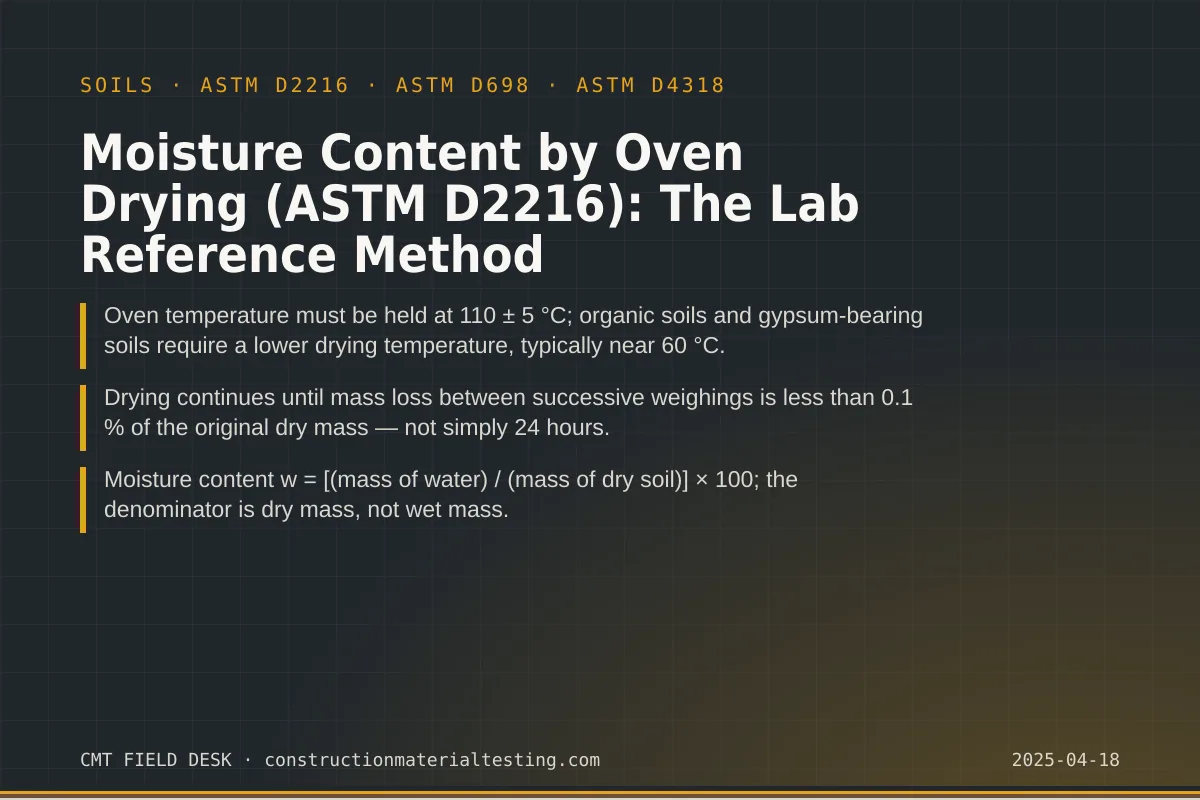
Why the Moisture Content Oven Drying Method Is the Reference Standard
ASTM D2216 determines moisture content by measuring mass before and after driving off pore water in a controlled oven — no inference, no calibration curve, no probe drift. That directness is why every other field and laboratory moisture method is validated against it. A nuclear density gauge measures gamma attenuation and hydrogen scattering; a speedy moisture meter measures gas pressure from a calcium carbide reaction. Both correlate back to D2216 oven-dry values to mean anything on a project. When field readings and oven results disagree, the oven-dry value governs.
The standard is published by ASTM International and applies to soils and rock that do not contain significant quantities of materials that oxidize, decompose, or otherwise change mass at 110 °C — so it covers the vast majority of mineral soils encountered in earthwork, foundation, and pavement subgrade work. ASTM D2216 is the controlling document, and our laboratory procedure for D2216 follows it without modification.
Protocol: Temperature, Drying Time, and Mass to Constant
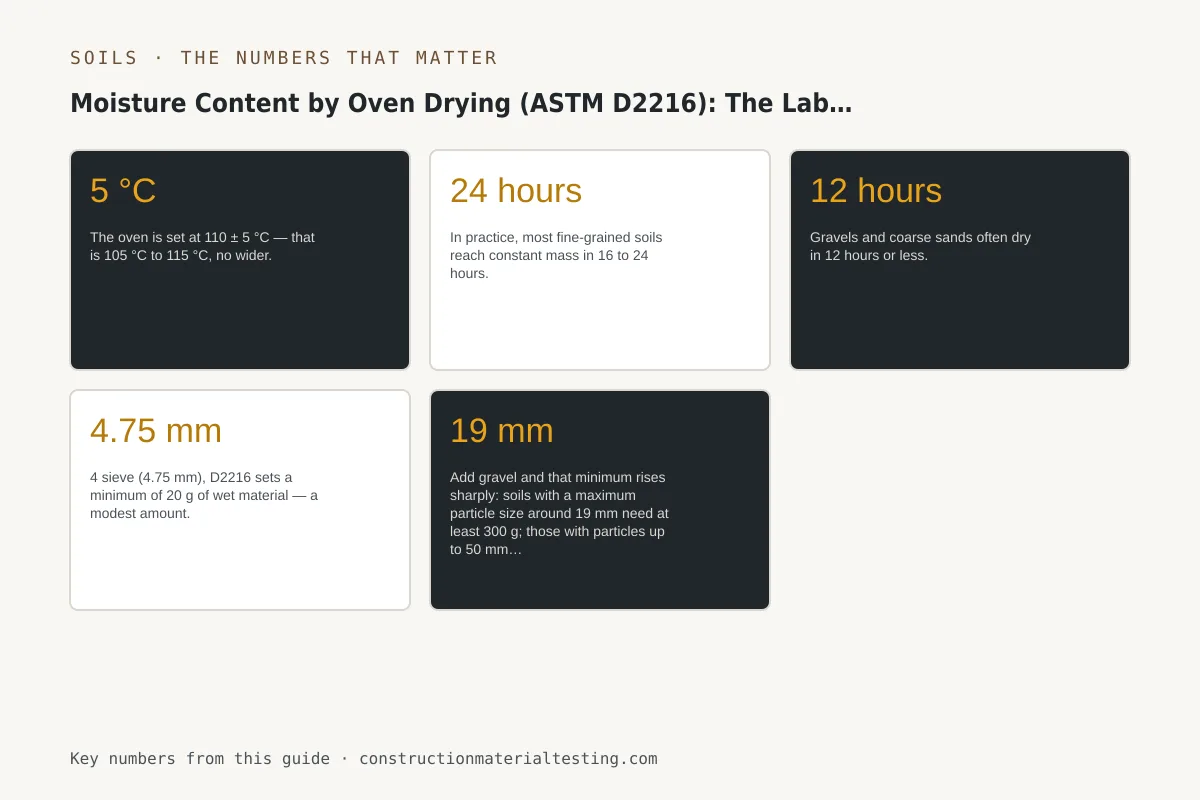
The oven is set at 110 ± 5 °C — that is 105 °C to 115 °C, no wider. Below that band, free water may not fully leave clay-sized particles within a practical drying period. Above it, you begin to drive off structural water from some minerals and start oxidizing organic matter, both of which inflate the calculated moisture content and produce a number that does not represent field pore water. We verify oven temperature with a calibrated thermometer at the start of each day's run.
The specimen dries until it reaches constant mass, defined in D2216 as a condition where successive weighings taken at least one hour apart differ by no more than 0.1 % of the specimen's dry mass. In practice, most fine-grained soils reach constant mass in 16 to 24 hours. Gravels and coarse sands often dry in 12 hours or less. We do not assume a fixed drying time — we weigh. Once the specimen is pulled from the oven, it goes directly to the balance or into a desiccator if there will be a delay; any time a warm clay sits exposed to lab air it begins reabsorbing humidity, which understates the true moisture content.
Special materials require adjusted temperatures. Organic soils — peat, muck, organic clays — and soils with significant gypsum content should be dried at approximately 60 °C because the 110 °C protocol destroys chemically bound water and organic compounds that are not free pore water. The technician identifies these soils during specimen preparation, not after, and logs the drying temperature on the data sheet. Omitting that note has caused real problems when later lab work — such as Atterberg limits per ASTM D4318 — is run on a material whose recorded moisture content came from the wrong temperature.
- Oven set point: 110 ± 5 °C, confirmed with calibrated thermometer
- Constant mass criterion: successive 1-hour weighings within 0.1 % of dry mass
- Organic soils and gypsum soils: dry at approximately 60 °C, note on data sheet
- Balance resolution: 0.01 g for specimens under 200 g; coarser-resolution balances acceptable for large specimens per the standard's guidance
- Containers: metal moisture cans with tight-fitting lids; lids are closed during transport to the balance
Calculation, Sample Size, and How the Number Is Used
Moisture content w is expressed as a percentage of dry mass: w (%) = [(M_w − M_d) / (M_d − M_c)] × 100, where M_w is the mass of the container plus wet soil, M_d is the mass of the container plus dry soil, and M_c is the mass of the empty container. The denominator is always dry soil mass, not wet soil mass — a point that confuses field personnel who encounter moisture content expressed as a fraction of wet mass in some agricultural or food-science contexts. Using wet mass in the denominator produces a systematically lower number and is not what any geotechnical specification is referencing.
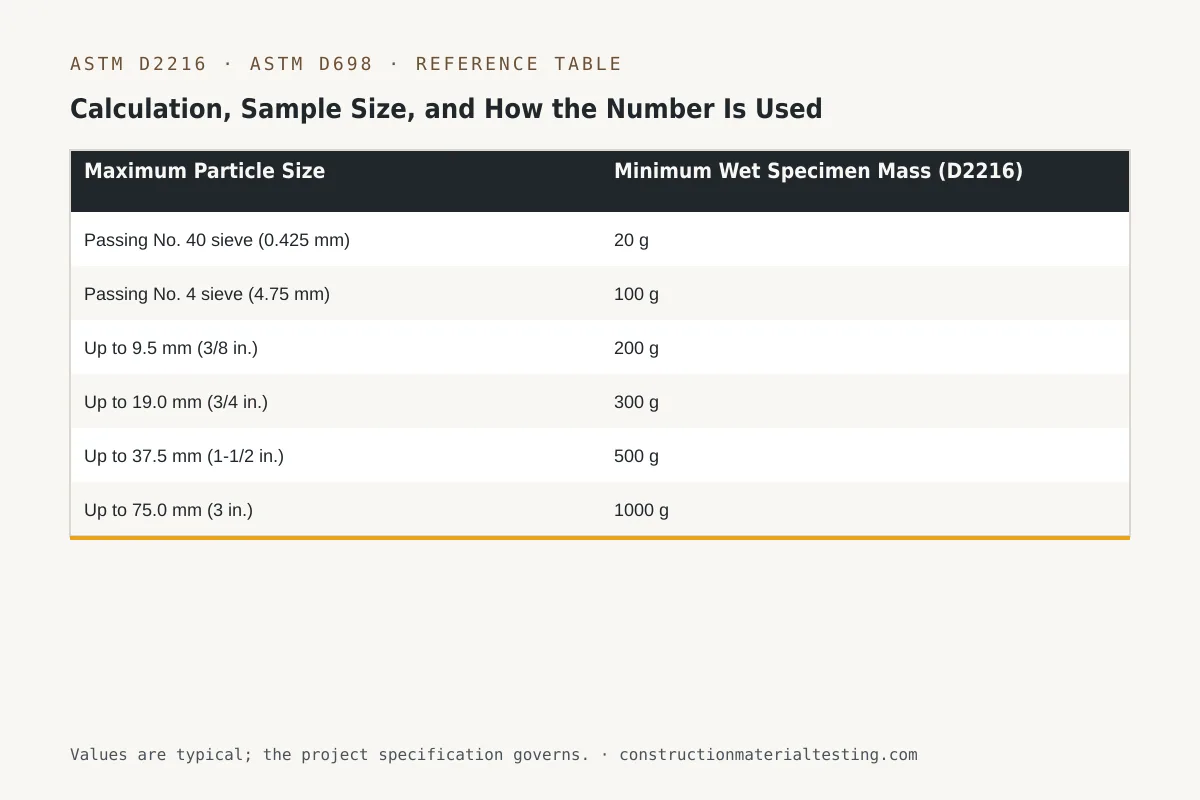
Minimum specimen mass is set by maximum particle size. For soils with particles passing the No. 4 sieve (4.75 mm), D2216 sets a minimum of 20 g of wet material — a modest amount. Add gravel and that minimum rises sharply: soils with a maximum particle size around 19 mm need at least 300 g; those with particles up to 50 mm need 1,000 g or more. The logic is statistical: a small specimen of gravelly material may contain one or two large clasts whose individual moisture content is not representative of the matrix. We size the specimen at the point of sampling, before any material is discarded.
The practical reach of a single D2216 result is wide. Standard Proctor compaction testing per ASTM D698 plots dry density against moisture content across five or more points; each point requires an accurate moisture content, and each of those moisture contents is determined by D2216. Atterberg limits — liquid limit, plastic limit, plasticity index — require knowing the moisture content at specific consistency states, again via D2216. When a nuclear gauge reads 12.4 % moisture on a fill lift and the oven-dry sample from the same location reads 10.1 %, the compaction curve was built on oven-dry data, so the oven-dry value is the one that tells you where you stand relative to optimum.
| Maximum Particle Size | Minimum Wet Specimen Mass (D2216) |
|---|---|
| Passing No. 40 sieve (0.425 mm) | 20 g |
| Passing No. 4 sieve (4.75 mm) | 100 g |
| Up to 9.5 mm (3/8 in.) | 200 g |
| Up to 19.0 mm (3/4 in.) | 300 g |
| Up to 37.5 mm (1-1/2 in.) | 500 g |
| Up to 75.0 mm (3 in.) | 1000 g |
Where This Fits on Your Project
D2216 runs quietly in the background of almost every geotechnical and earthwork testing program — it is the denominator in Proctor curves, the backbone of Atterberg work, and the check on any field moisture device your inspector carries. If your project involves fill compaction, subgrade evaluation, foundation investigation, or any testing under ASTM D4318 or ASTM D698, oven-dry moisture content is already part of the program whether it appears as a line item or not. We run D2216 out of our Sugar Land laboratory under a documented quality system with dispatch support from 27 regional hubs. If you are putting together a soil testing scope or need to add oven-dry verification to an existing field nuclear gauge program, submit a proposal request and we will match the right testing protocol to your schedule and specification requirements.
Get our guides in your Google results
Add Construction Materials Testing as a preferred source and Google shows our guides more often when you search for testing topics.