
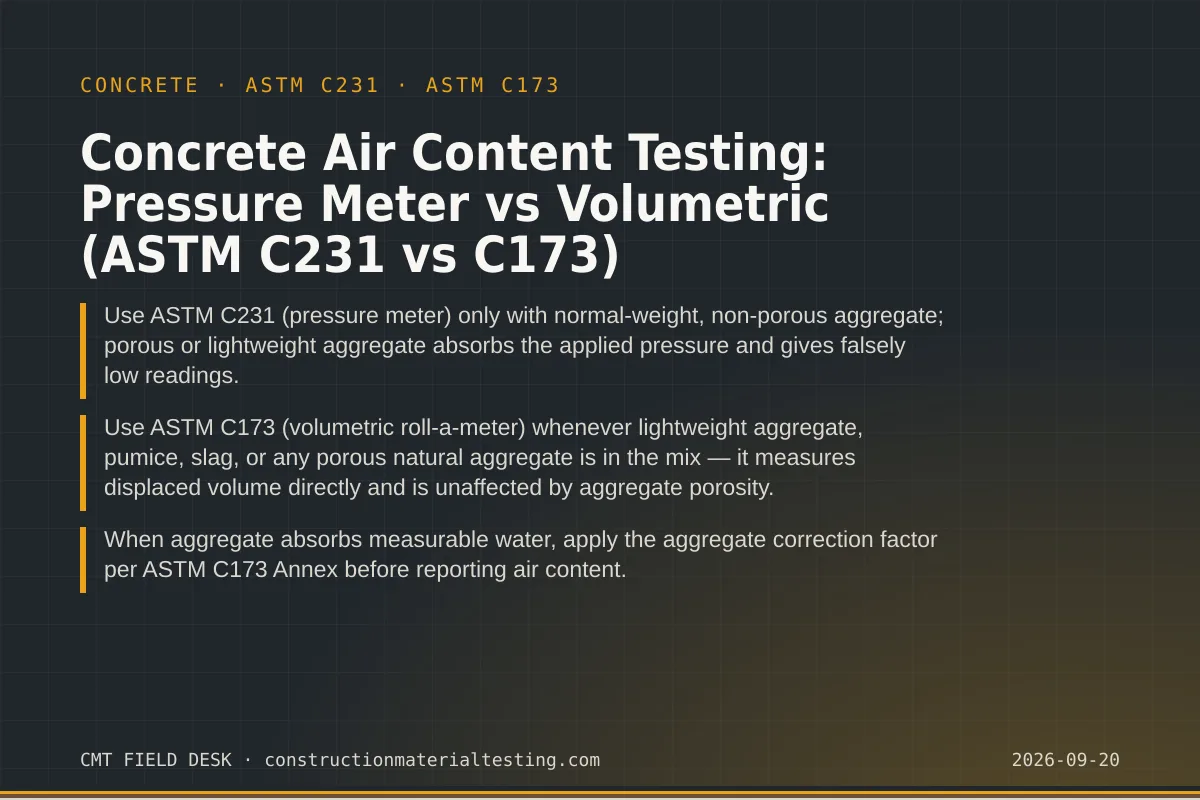
Why the Test Method Choice Matters
Air content is one of the few fresh-concrete properties that cannot be recovered after placement. Too little entrained air leaves the paste vulnerable to freeze-thaw scaling; too much air bleeds strength from the mix at a rate of roughly four to five percent per additional percentage point of air. Getting an accurate concrete air content test reading at the truck — not a guessed or method-mismatched value — is therefore a project-critical decision.
The two dominant field methods, ASTM C231 and ASTM C173, measure air by completely different physical principles. C231 applies a known pressure to the concrete surface and calculates air from the resulting volume change using Boyle's law. C173 adds isopropyl alcohol to the concrete, expels all air bubbles, and reads displaced volume directly on a graduated stem. Because the physics differ so fundamentally, so do the conditions under which each method is valid.
ASTM C231 — The Pressure Meter Method
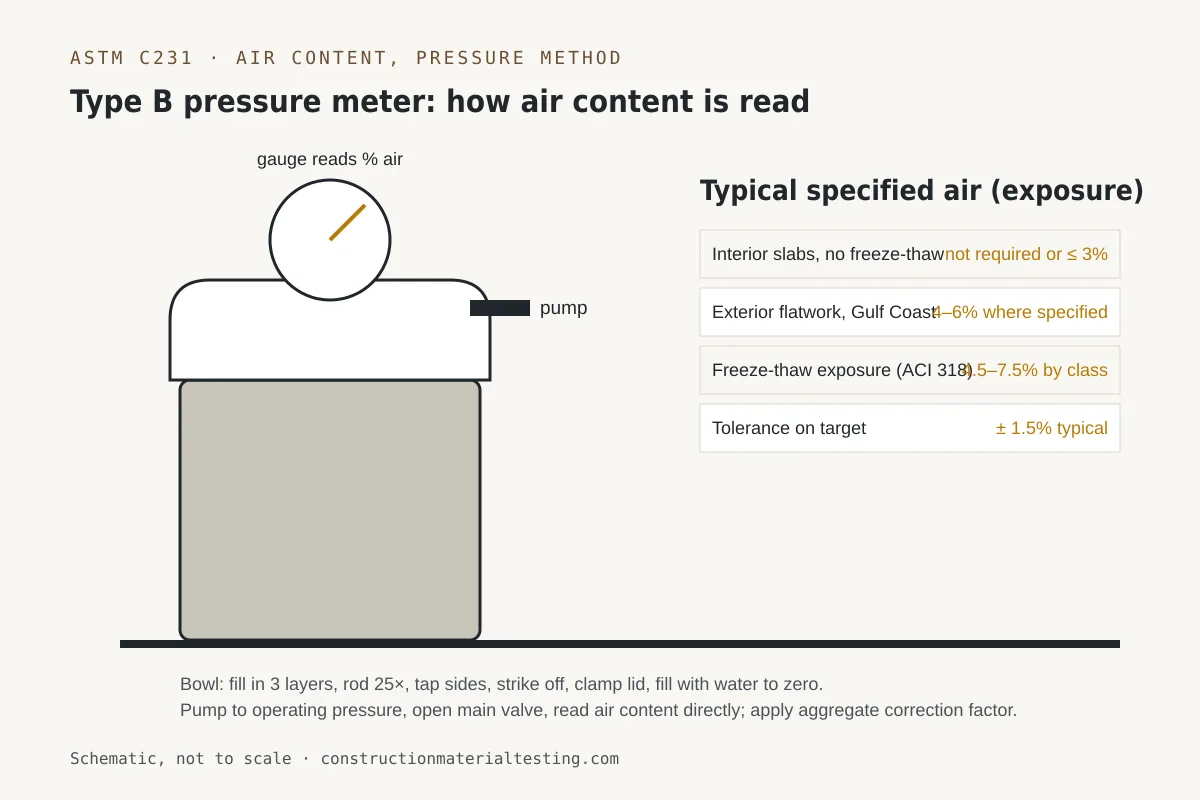
The Type B pressure meter is the faster of the two methods and the one most technicians reach for on ordinary ready-mix pours. You fill the bowl in three equal layers, rod or vibrate each layer, strike off the surface, clamp the lid, charge the air chamber to a calibrated initial pressure, open the petcock between the chamber and the concrete, and read the gauge after the needle stabilizes. The whole operation takes about six minutes once the sample is consolidated.
The critical limitation is built into the physics: Boyle's law assumes that only the entrained air voids compress under pressure. If the aggregate particles themselves contain internal pores or absorb water, they also compress or release gas under pressure, and the gauge overcounts or undercounts accordingly. This is why ASTM C231 explicitly restricts the method to concrete made with normal-weight, non-porous aggregate — typically crushed limestone, river gravel, or granite quarried from dense formations. Volcanic aggregates, some manufactured lightweight aggregates, and many natural aggregates from porous geologic sources fall outside that boundary.
Calibration of the pressure meter follows the procedure in the standard: the bowl is calibrated for volume and the gauge is calibrated at the working pressure using the small air jar supplied with the instrument. We calibrate at the start of each day's testing and whenever the meter takes a hard impact. A gauge that reads even 0.2 % off baseline will push borderline results the wrong direction.
ASTM C173 — The Volumetric Method and When to Use It
The roll-a-meter produces a direct volumetric measurement rather than an inferred one. You fill the bowl in layers, consolidate, add water to a reference mark on the neck, add a measured charge of isopropyl alcohol (which breaks surface tension and releases entrapped air from aggregate pores), cap the meter, and roll it aggressively for about a minute to work the alcohol through the mix. You then read the graduated stem and apply any correction for residual foam.
Because the alcohol physically displaces air from every pore — both paste voids and aggregate internal pores — the method measures only the air that was originally in the paste, not air absorbed and re-released from aggregate. That makes ASTM C173 the required method for lightweight concrete, concrete containing expanded shale, clay, or slate aggregate, concrete with pumice or scoria aggregate, and any mix where aggregate porosity is uncertain. The test takes longer — typically fifteen to twenty minutes — and the rolling step is physically demanding, but there is no substitute when aggregate type demands it.
One practical note: isopropyl alcohol concentration matters. The standard requires 70 % isopropyl or higher. Field bottles that have been left open or contaminated with water underperform and can suppress bubble release, giving a low reading. We check concentration with a simple hydrometer before each project start when conditions are borderline.
Aggregate Correction Factor in ASTM C173
Even with the volumetric method, some aggregates — particularly those with fine internal porosity — hold water in their pores that the alcohol does not fully displace during the rolling period. ASTM C173 addresses this through an aggregate correction factor (AG), determined by running a separate trial on a mortar fraction of the mix without the coarse aggregate. The correction is subtracted from the raw stem reading to give true air content.
Determining the AG factor adds roughly thirty minutes to the initial setup for a new mix design, but once it is established for a given aggregate source and gradation, it can be applied to subsequent tests from that source. We typically determine the AG factor at the start of a project when the aggregate source is unfamiliar or when the material's absorption value from the mix design sieve analysis exceeds about two percent. Skipping the correction on an absorbent aggregate can inflate reported air by a full percentage point or more — enough to make a passing result a failing one, or vice versa.
Concrete Air Content Test: Specification Ranges by Exposure Class
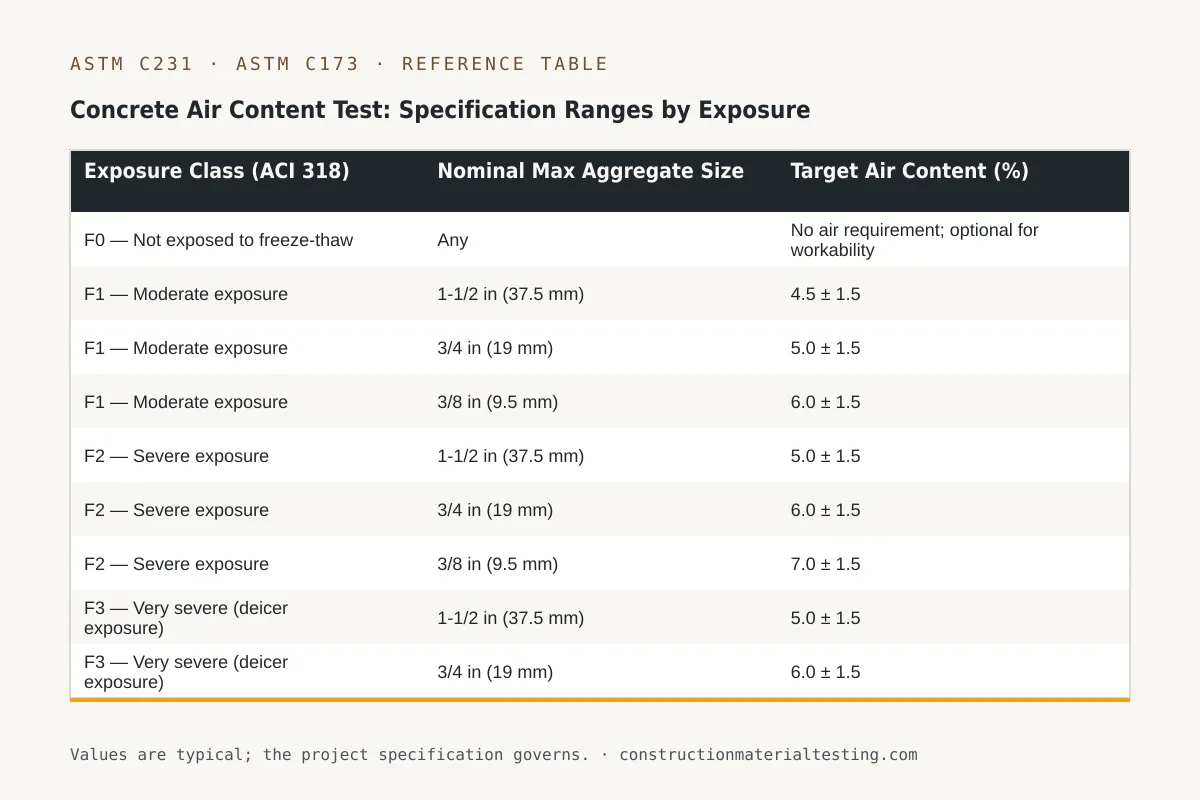
ACI 318 and ACI 201.2R tie required air content to both freeze-thaw exposure severity and nominal maximum aggregate size (NMAS). Larger aggregate means less paste volume per cubic yard, so a smaller percentage of air can provide adequate bubble spacing in the paste fraction. Smaller aggregate mixes require higher total air percentages to achieve the same spacing factor.
The table below summarizes typical target air ranges from ACI guidance. Always verify against the project specification, which may tighten these ranges or reference a different edition of ACI 318. The International Building Code Section 1705 requires special inspection of concrete air content when the structural engineer of record specifies it or when exposure conditions warrant — confirm inspection frequency in the project's statement of special inspections.
| Exposure Class (ACI 318) | Nominal Max Aggregate Size | Target Air Content (%) |
|---|---|---|
| F0 — Not exposed to freeze-thaw | Any | No air requirement; optional for workability |
| F1 — Moderate exposure | 1-1/2 in (37.5 mm) | 4.5 ± 1.5 |
| F1 — Moderate exposure | 3/4 in (19 mm) | 5.0 ± 1.5 |
| F1 — Moderate exposure | 3/8 in (9.5 mm) | 6.0 ± 1.5 |
| F2 — Severe exposure | 1-1/2 in (37.5 mm) | 5.0 ± 1.5 |
| F2 — Severe exposure | 3/4 in (19 mm) | 6.0 ± 1.5 |
| F2 — Severe exposure | 3/8 in (9.5 mm) | 7.0 ± 1.5 |
| F3 — Very severe (deicer exposure) | 1-1/2 in (37.5 mm) | 5.0 ± 1.5 |
| F3 — Very severe (deicer exposure) | 3/4 in (19 mm) | 6.0 ± 1.5 |
| F3 — Very severe (deicer exposure) | 3/8 in (9.5 mm) | 7.0 ± 1.5 |
How Air Content Relates to Other Fresh-Concrete Tests
Air content never stands alone as a quality indicator. We run it alongside unit weight per ASTM C138, which provides an independent cross-check: if air goes up, unit weight goes down proportionally. A sudden drop in unit weight that does not match an increase in reported air content signals either a water addition or a batch error that neither instrument will catch on its own. Running both tests on the same sample takes less than ten additional minutes and produces a consistency check that strengthens any rejection decision.
Slump and temperature readings also factor in. High slump from excess water dilutes the air-entraining admixture concentration per unit volume, sometimes dropping air content below spec even when the admixture dose looks correct on the batch ticket. Elevated concrete temperature accelerates air loss after discharge; on hot-weather pours we time the air test to occur within the first few minutes of sampling, before evaporative and thermal loss skew the reading. Our technicians record sample time and truck discharge time on every test report for this reason.
Field Execution: Sampling, Timing, and Common Errors
Both ASTM C231 and C173 require the concrete sample to be obtained in accordance with ASTM C172 — composite samples from the middle portion of the load, not the first or last discharge. This alone disqualifies samples grabbed from the chute the moment the truck arrives. The elapsed time from final sampling to start of the air test should not exceed five minutes, and the test itself must be completed before the concrete is more than fifteen minutes old from the time of first water contact (or as the specification states).
Common errors we see in the field include: not sealing the pressure meter lid fully before charging, resulting in pressure bleed-off and a low reading; failing to agitate the roll-a-meter vigorously enough so that alcohol does not fully contact aggregate surfaces; and reading the volumetric stem before foam fully settles, which inflates the result. ACI-certified Field Testing Technicians are trained on all of these failure points — certification exists precisely because the tests look simple but produce bad data when performed carelessly. Our materials testing services include ACI-certified technician dispatch for concrete placements of any scale.
Choosing Between Methods: A Decision Summary
In practice, the choice between ASTM C231 and C173 is usually determined before the pour begins, once the mix design and aggregate source are reviewed. If there is any doubt about aggregate porosity, C173 is the conservative and defensible choice. Switching methods mid-project because results are inconvenient is not acceptable; the method should be defined in the project's inspection and testing plan before concrete placement starts.
For the overwhelming majority of structural concrete poured with dense natural aggregate — slabs, walls, columns, footings — C231 is appropriate, faster, and easier to perform consistently in busy field conditions. For lightweight structural concrete, insulating concrete fills, or any mix where the aggregate source documentation lists absorption values above roughly two percent, C173 should be specified. Confirm with the mix design engineer when the aggregate is borderline. Our ASTM C231 test method page and ASTM C173 test method page include equipment specs and calibration intervals for reference.
- Dense natural aggregate (limestone, granite, river gravel) with absorption < 2 %: use ASTM C231
- Lightweight aggregate (expanded shale, clay, slate, pumice): use ASTM C173
- Aggregate absorption > 2 % or unknown source: use ASTM C173 with AG correction factor
- Slag or recycled concrete aggregate: verify porosity; default to ASTM C173 until characterized
- Normal-weight mix but on-site concrete temperature > 90 °F: use ASTM C231 but test immediately after sampling
Where This Fits on Your Project
Whether you are coordinating a tilt-wall pour, a post-tensioned parking deck, or a foundation mat in a freeze-thaw climate, the concrete air content test is a required hold point that needs a qualified technician, calibrated equipment, and a pre-agreed method. Our dispatch network covers the Houston metro and 27 regional hubs across Texas and the Gulf Coast region, with ACI- and NICET-certified technicians available for scheduled and emergency placements.
If you are putting together a testing and inspection plan for an upcoming concrete scope, request a proposal and include your mix design documents and aggregate sources. We will specify the correct test method, calibration schedule, and reporting frequency before the first truck rolls.
Get our guides in your Google results
Add Construction Materials Testing as a preferred source and Google shows our guides more often when you search for testing topics.