

What Construction Materials Testing Services Actually Cover
Construction materials testing services sit at the intersection of quality assurance and structural accountability. On any given day, our technicians are casting concrete cylinders on a slab pour at 5 a.m., running nuclear density gauge readings behind a compactor on a road base, and pulling soil samples for laboratory classification — often on three different sites before noon. That range of activity is not incidental; it reflects what the work actually demands when a project is moving at full pace.
The term 'CMT' gets used loosely in the industry, but the scope is precise when a contract defines it correctly. At its core, a CMT firm provides two interlocked services: field testing and inspection performed during active construction, and laboratory testing performed on samples collected in the field or submitted by the contractor. Neither function is optional when structural elements are involved. Field data without lab verification leaves gaps; lab data without proper field sampling is built on a compromised foundation.
What separates a competent CMT engagement from a checkbox exercise is continuity. The technician who watches a truck discharge concrete and casts the cylinders is part of the same quality chain as the laboratory technician who breaks those cylinders 28 days later. When that chain has gaps — samples cast improperly, curing conditions not maintained, results reported to the wrong party — the data loses its value precisely when someone needs it most, such as during a structural dispute or a permit closeout inspection.
Owners who understand the scope of materials testing services before the project begins make better decisions about budget, scheduling, and risk transfer. Owners who learn what CMT covers only after a failed cylinder set or a compaction rejection are managing a problem rather than preventing one.
The Field Side: What Happens on the Jobsite
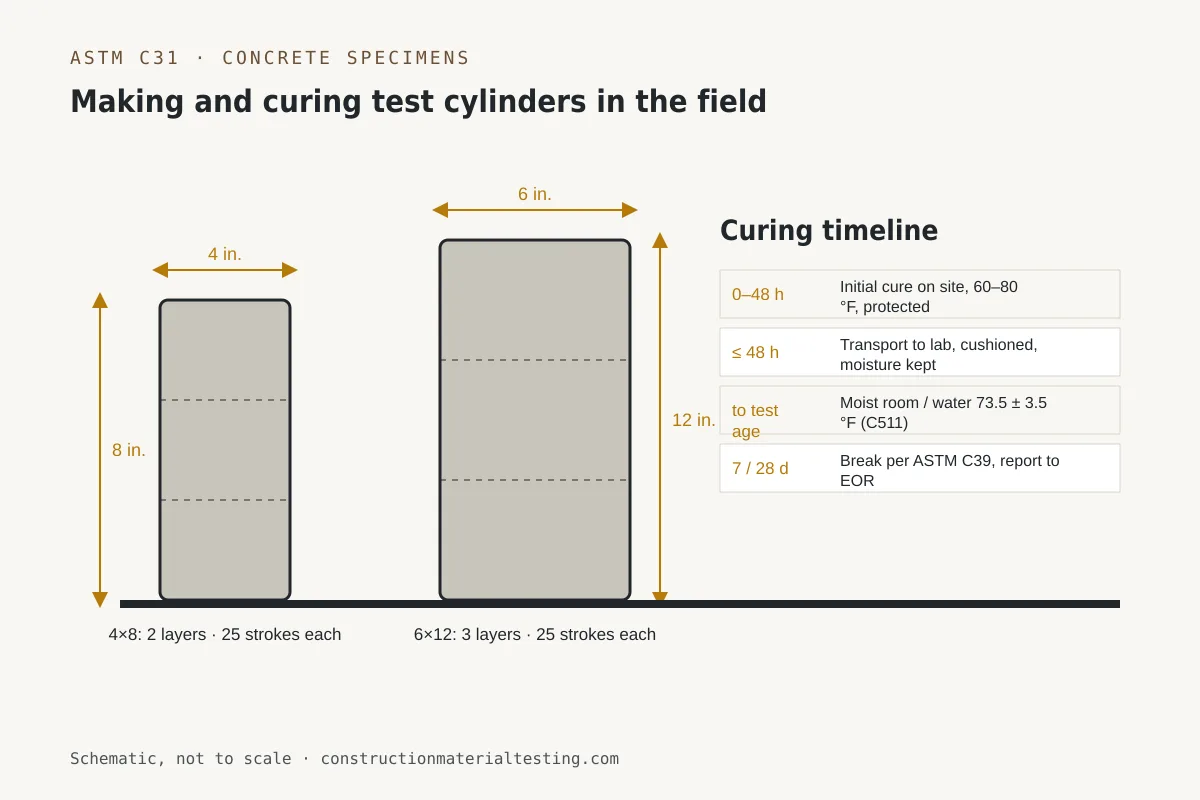
Field work in CMT is time-critical and sequenced around contractor operations. For concrete, the technician must be present during placement — not after. The fresh concrete tests (slump, air content, unit weight, and temperature) must be completed within five minutes of obtaining the composite sample, and cylinder casting must follow within 15 minutes of sampling per ASTM C31. A technician who arrives late misses the window for a valid sample entirely. That is why scheduling coordination between the project superintendent and the CMT firm matters before the first truck rolls.
Soil and earthwork testing operates on a different rhythm but carries similar urgency. A compactor finishes a lift, and the nuclear density gauge technician moves in to take readings before the next lift covers the surface. If the lift fails to meet the specified compaction percentage, the contractor needs that information while the equipment is still on site — not the following morning. Readings taken with a nuclear gauge per ASTM D6938 in-place density and moisture testing give the technician dry density and moisture content simultaneously, and both are compared to the lab-established maximum dry density from a standard or modified Proctor test to compute percent compaction.
Structural steel, masonry, and post-installed anchor inspections fall under the special inspection umbrella, which overlaps with CMT but operates under a distinct IBC Chapter 17 framework. On projects subject to special inspections, the inspector documents compliance with approved drawings and specifications, and that documentation goes to the building official — not just the contractor. The distinction between a CMT technician collecting data for the owner's QA program and a special inspector creating a record for the authority having jurisdiction is important, and scopes of work should define which function is being performed.
Our field technicians hold ACI Field Testing Technician certification for concrete work and NICET credentials for soils and asphalt — NICET certification requirements establish the competency baseline that most specifications cite when they require 'certified technicians.' That matters because a certification is not just a credential; it represents demonstrated proficiency in the specific procedures that govern the tests a technician performs.
The Laboratory Side: Where Samples Become Data
Every sample collected in the field has a laboratory destination. Concrete cylinders go into a standard curing room maintained at 73°F ± 3°F (23°C ± 1.7°C) per ASTM C31 until their scheduled break date. Soil samples go through classification, Proctor compaction testing, Atterberg limits, and gradation analysis depending on what the specification requires. Aggregate samples are split and run through a nested sieve stack per ASTM C136 sieve analysis procedure to verify that the particle size distribution meets the mix design gradation requirements before material is incorporated into concrete or asphalt.
Laboratory turnaround times are governed partly by physics — a 28-day cylinder break simply cannot happen before day 28 — and partly by workflow. Seven-day breaks are typically reported within 24 hours of testing, and 28-day results follow the same timeline after their break date. Our laboratory under its documented quality system maintains a chain-of-custody protocol from sample receipt through result delivery, which is the mechanism that connects a field sample to a traceable test report.
One area where laboratory work protects owners that is often underappreciated is mix design verification. Before a contractor places a single yard of concrete, the mix design should be reviewed and, where the specification requires it, trial batches should be run to establish that the proposed proportions will achieve the required compressive strength. Similarly, asphalt mix designs — whether evaluated under Marshall or Superpave protocols — establish the target gradation, binder content, and void properties that field tests are later measured against. A mix design on file is the baseline that makes field test results meaningful.
Testing Frequencies: What Specifications Actually Require
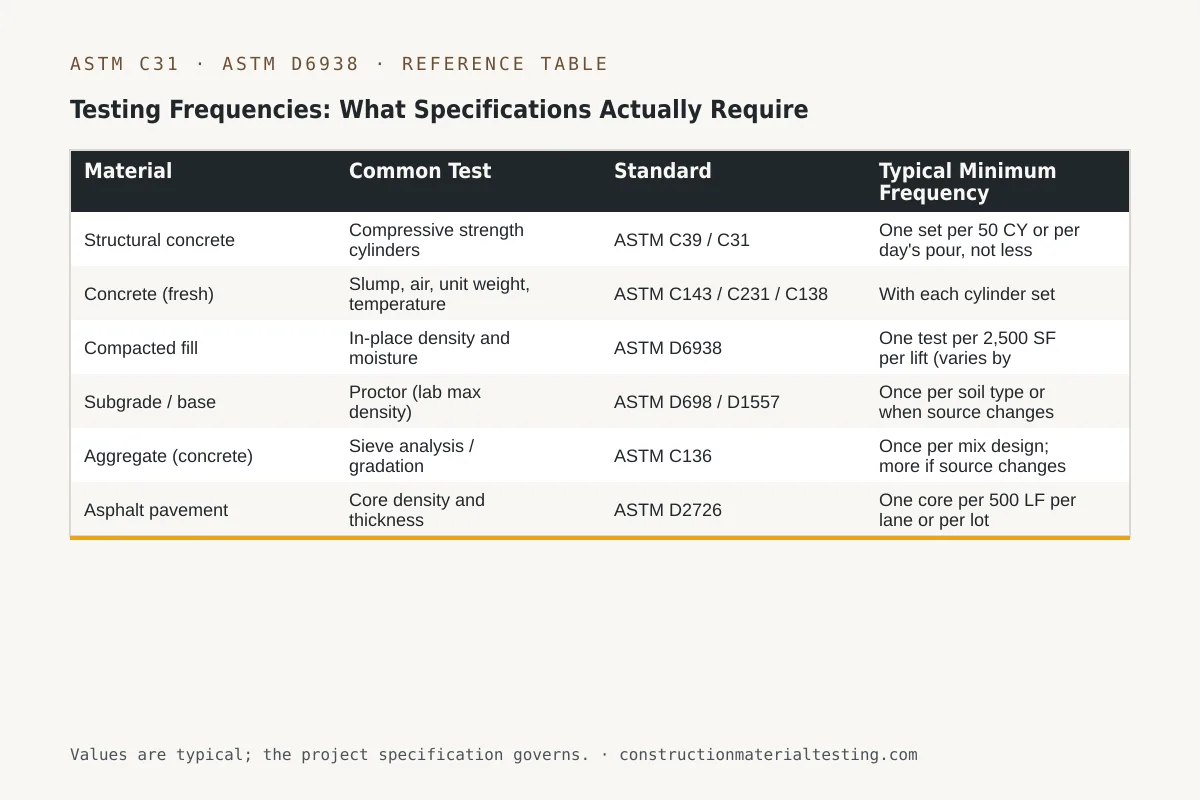
Testing frequency is the most common area where owners discover they scoped CMT incorrectly — usually because they provided too few tests for the volume of material placed. IBC Chapter 1705 establishes minimum inspection and testing frequencies for structural concrete, soils, and other materials on projects subject to its provisions. Project specifications written by the engineer of record typically match or exceed those minimums, and DOT work adds another layer of state-specific requirements. The starting point for any CMT scope is reading what the contract documents actually require before estimating coverage.
For structural concrete under ACI 318, the acceptance criteria for compressive strength are specific: the average of any three consecutive strength test results must equal or exceed the specified compressive strength f'c, and no individual test (the average of at least two cylinders broken at the same age) may fall more than 500 psi below f'c when f'c is 5,000 psi or less, or more than 0.10 × f'c below f'c when f'c exceeds 5,000 psi. Those thresholds are not suggestions; they define when the engineer of record must be notified and when additional investigation is required.
For earthwork, frequency is typically expressed as a minimum number of tests per lift per a defined area — for example, one test per 2,500 square feet of compacted fill, or one test per 500 linear feet of roadway subbase per lane. The geotechnical report and project specifications set those intervals, and our geotechnical services team can help owners understand what frequencies are appropriate during pre-bid scope development.
Owners sometimes ask whether they can reduce testing frequency to cut costs. The honest answer is that frequency reductions below specification minimums shift risk back to the owner. A failed element that was under-tested leaves no data trail to support or contest a contractor's claim. Testing more than the minimum is not always necessary, but testing less than the minimum on structural elements is a decision that should involve the engineer of record, not just the CMT budget.
| Material | Common Test | Standard | Typical Minimum Frequency |
|---|---|---|---|
| Structural concrete | Compressive strength cylinders | ASTM C39 / C31 | One set per 50 CY or per day's pour, not less than once per 5,000 SF of slab |
| Concrete (fresh) | Slump, air, unit weight, temperature | ASTM C143 / C231 / C138 | With each cylinder set |
| Compacted fill | In-place density and moisture | ASTM D6938 | One test per 2,500 SF per lift (varies by spec) |
| Subgrade / base | Proctor (lab max density) | ASTM D698 / D1557 | Once per soil type or when source changes |
| Aggregate (concrete) | Sieve analysis / gradation | ASTM C136 | Once per mix design; more if source changes |
| Asphalt pavement | Core density and thickness | ASTM D2726 | One core per 500 LF per lane or per lot |
Who Reads the Reports — and Why It Matters
A CMT report is a multi-audience document. The field technician's daily report documents what was observed, when it was observed, and what the fresh test results showed. The laboratory report records break strengths, Proctor values, and gradation data. Both flow to the engineer of record, who is responsible for evaluating results against the design basis. They also flow to the owner's representative, the construction manager if one is engaged, and — on special inspection projects — to the building official as part of the Statement of Special Inspections compliance record.
Contractors receive copies of reports that pertain to their work, but it's worth noting that the CMT firm's primary obligation runs to the owner and the engineer, not to the contractor. That independence is the entire value of third-party testing. When a compaction test fails or a cylinder set breaks low, the CMT firm notifies the engineer of record and the owner's representative — not just the contractor. The contractor then receives the information and the obligation to respond, but the reporting chain does not start with the contractor.
On large projects with multiple active construction fronts, the volume of CMT data can be substantial. Our reports are delivered through client portals that allow the owner, CM, and design team to track results by location, date, and material type. Exportable formats allow integration with project management platforms the owner's team is already using. But the technology is in service of the data, not the other way around — a clear, traceable report that documents what was tested, how, and what the result was is the foundation of everything.
How Construction Materials Testing Services Protect the Schedule
The conventional view of CMT is that it protects structural integrity, and it does. But experienced project teams know that CMT also protects the schedule in ways that are less obvious. When compaction tests are run promptly after each lift and results are communicated before the next lift begins, failing areas can be reworked while equipment is already on site. When seven-day cylinder breaks show a strength trend that suggests the 28-day result will be low, the engineer of record has three weeks to evaluate the mix design, review curing practices, and decide whether to adjust the approach — rather than discovering a problem at 28 days with structural load already applied.
Conversely, delays caused by CMT are almost always the result of late scheduling, not the testing itself. If a contractor fails to notify the CMT firm of a concrete pour until the day before, the firm may not have a certified technician available for the specific time window required by ASTM C31. If soil compaction tests are not requested until the contractor wants to place the next lift immediately, the technician may arrive after the window for valid testing has passed. CMT delays are a scheduling symptom, not a CMT failure.
Pre-construction meetings that include the CMT firm alongside the contractor and design team prevent most of these friction points. Those meetings establish notification lead times, define the chain of communication for failing results, agree on how non-conformance reports will be handled, and confirm that all parties understand what the specification requires before anyone places material.
What Happens When Results Fail
Failed test results are a normal part of construction — not common on well-run projects, but not exceptional either. How the project team responds defines whether a failed result becomes a managed event or a dispute. The first step is immediate notification to the engineer of record. Not next-day notification, not a note in a weekly report — immediate. The engineer needs to know so they can evaluate whether the structural element in question is at risk and what investigation is warranted.
For concrete, a low cylinder break at 28 days triggers a defined sequence under ACI 318. If the strength is below the acceptance criteria, the engineer may order core drilling per ASTM C42 to test the in-place concrete directly. Core strengths are evaluated against a different acceptance criterion — typically 85% of f'c for an average of three cores and no single core below 75% of f'c — because cores from in-place concrete behave differently than standard-cured cylinders. If cores pass, the structural element is typically accepted. If cores fail, the engineer evaluates load capacity directly, which may involve a load test or structural modification.
For soil compaction failures, the path is more straightforward: the contractor reworks the failing area by scarifying, adjusting moisture, and recompacting, then requests retesting. The CMT firm documents both the failing result and the passing result after rework, and both appear in the project record. Non-conformance reports issued by the CMT firm are project record documents, not internal communications — they should be treated accordingly.
The most important thing an owner can do when results fail is resist pressure to suppress or minimize the information. A non-conforming result that is properly documented and resolved creates a defensible project record. A non-conforming result that is ignored or underreported creates liability that does not expire when the project closes.
How to Scope Construction Materials Testing Services for a Project
Scoping CMT begins with the project documents: geotechnical report, structural drawings, specifications divisions 01 45 00 (quality control) and the relevant material sections, and the statement of special inspections if the project is subject to IBC Chapter 17. Those documents define what must be tested, at what frequency, and who is responsible for ordering the tests. A complete scope addresses field testing labor, laboratory testing fees, equipment (including nuclear gauge use and calibration), report preparation, and engineering review where required.
The full range of testing methods we perform covers concrete, soils, aggregates, asphalt, masonry, and structural steel. Not every project needs every category. A tilt-up warehouse on a slab with conventional spread footings will need concrete testing and earthwork testing; it may not need asphalt mix design verification unless there is a significant paving scope. A highway reconstruction project will need extensive asphalt and aggregate testing with relatively limited structural concrete coverage. Matching the scope to the actual project reduces both gaps and unnecessary cost.
Common scoping errors include failing to account for Saturday or early-morning concrete pours (which carry premium field labor rates), underestimating the number of lifts in a deep fill area, and omitting laboratory fees for Proctor tests when the fill source has not been confirmed. A pre-bid site walkthrough with the CMT firm, combined with a review of the project schedule's earthwork and concrete sequences, catches most of these before the contract is signed.
On projects with an accelerated schedule, it is also worth discussing whether 4×8 cylinders can be substituted for 6×12 cylinders under ASTM C31, and whether early-break testing at 3 or 7 days will be used to trend toward the 28-day acceptance result. Neither substitution changes the 28-day acceptance criteria, but both give the project team earlier visibility into concrete performance.
| Project Type | Primary CMT Scope Items | Common Additions |
|---|---|---|
| Commercial building (IBC Chapter 17) | Structural concrete testing, special inspections, soil compaction | Masonry prism testing, post-installed anchor inspection |
| Highway / roadway | Asphalt mix design and field density, aggregate gradation, subgrade compaction | Base and subbase Proctor tests, pavement core density |
| Industrial slab / tilt-up | Concrete cylinders, slab thickness verification, earthwork compaction | Concrete mix design review, pre-pour subgrade testing |
| Residential subdivision (earthwork) | Fill compaction, subgrade testing, utility trench backfill | Proctor tests per soil type encountered |
| Parking structure | Structural concrete, post-tensioning inspection, rebar placement | Concrete mix design verification, chloride content testing |
Laboratory Quality and the Chain of Custody
The value of test data depends entirely on the integrity of the process that produced it. Our laboratory operates under a documented quality system that governs sample receiving, identification, storage, testing, and reporting. Every concrete cylinder that enters the lab is logged with a unique identifier tied to the field technician's sample record, the pour location, the mix design, and the specified break age. When that cylinder is broken, the result posts to the same record. That traceability is not administrative overhead — it is what allows a test result to are prepared for review.
Technician qualification is maintained through participation in proficiency programs and ongoing calibration of field and laboratory equipment. ASTM C31 standard practice for making and curing concrete cylinders specifies the equipment requirements and tolerances for the curing environment — our curing room temperature is logged continuously, and those logs are part of the project record. If a technician's curing records show a temperature excursion during the cure period for a given set of cylinders, that information is disclosed in the report. Selective disclosure of data is not part of how we operate.
Aggregate gradation testing illustrates how laboratory precision connects to field outcomes. A sieve analysis run per ASTM C136 on a coarse aggregate sample from a concrete batch plant verifies that the supplier's material matches the approved gradation band. If the gradation has shifted — which happens when a quarry changes its crushing settings or draws from a different face — the concrete mix proportions may need to be adjusted. Catching that shift through routine aggregate testing before it affects the in-place concrete is a better outcome for every party on the project. Learn more about our aggregate and concrete testing services.
Reading a CMT Report: What the Numbers Mean
A concrete compressive strength report lists the cylinder identification, break age, break date, measured compressive strength in psi, and the specified f'c. It also identifies whether the result represents a standard-cured or field-cured cylinder, because the two serve different purposes — standard-cured cylinders evaluate the mix design's potential; field-cured cylinders evaluate the adequacy of the actual curing conditions at the site. Both matter, but they answer different questions. Treating a field-cured result as an acceptance test is a common misreading that leads to incorrect conclusions.
A soil compaction report lists the test location by station or grid coordinate, the lift number, the test depth, the measured wet density, the measured moisture content, the calculated dry density, the maximum dry density from the reference Proctor test, the optimum moisture content, and the percent compaction. A result of 95% compaction means the field-measured dry density is 95% of the laboratory-determined maximum dry density. Whether 95% is a passing result depends entirely on what the specification requires — some specs require 90%, others 98%, and the requirements often differ by layer (subgrade versus base versus subbase).
For the International Code Council's perspective on inspection and testing requirements under the IBC, Chapter 17 provides the framework that building officials use to determine whether special inspections are required and what those inspections must cover. Understanding that framework helps owners recognize why certain inspections appear on their CMT scope and what the documentation obligations are at project closeout.
Where Construction Materials Testing Services Fit on Your Project
CMT is not a service you add after the contract is signed and the schedule is set. The most effective engagements start during design or at the latest during bid preparation, when the specification is still being written and the schedule of values still has room for adequate testing coverage. By the time a project is under construction, the testing frequency requirements are fixed by the contract documents, and the only variable is whether the CMT firm and the project team are communicating well enough to execute them.
If you are preparing a bid, starting design on a new project, or trying to understand what a specification is requiring of you, the right first step is a scope conversation — not a proposal based on a line item count. We scope CMT by reading the project documents, identifying what the specification and the IBC require, and translating that into a coverage plan that accounts for the actual construction sequence. That conversation costs nothing and typically catches scope gaps before they become change orders.
Use our proposal request form to send us the project documents and a brief description of the work. We will follow up with a scope and fee that reflects what the project actually needs.
Get our guides in your Google results
Add Construction Materials Testing as a preferred source and Google shows our guides more often when you search for testing topics.