
What a Phase I Environmental Site Assessment Actually Is
A Phase I environmental site assessment is a structured, non-invasive investigation that follows ASTM E1527, the recognized standard practice for environmental site assessments. Its purpose is to identify recognized environmental conditions — situations where hazardous substances or petroleum products are present, or likely present, in concentrations that could pose a risk to health or the environment. The assessment produces no soil borings, no groundwater samples, and no laboratory data. It is a paper-and-eyes exercise, but when executed correctly it carries real legal weight under federal law.
The legal backbone is the Comprehensive Environmental Response, Compensation, and Liability Act — CERCLA, commonly called Superfund. CERCLA holds current property owners liable for cleanup costs even if they did not cause the contamination, but it carves out a defense for bona fide prospective purchasers and innocent landowners who can demonstrate they conducted All Appropriate Inquiries before closing. Completing a Phase I that meets ASTM E1527 and the EPA's AAI rule is the accepted way to satisfy that requirement. Skipping it, or using a cut-rate report that does not comply with the standard, can expose a buyer to liability for contamination they inherited unknowingly.
Owners, lenders, developers, and occasionally insurers commission Phase I assessments. The triggering event is almost always a commercial real estate transaction, a refinancing, or the start of a development project on a property with unknown history. Environmental agencies may also require one as part of a permit or brownfield redevelopment application. Whatever the trigger, the scope is the same: ASTM E1527 sets the floor, and nothing in that scope can be omitted without documenting why.
The ASTM E1527 Standard and All Appropriate Inquiries
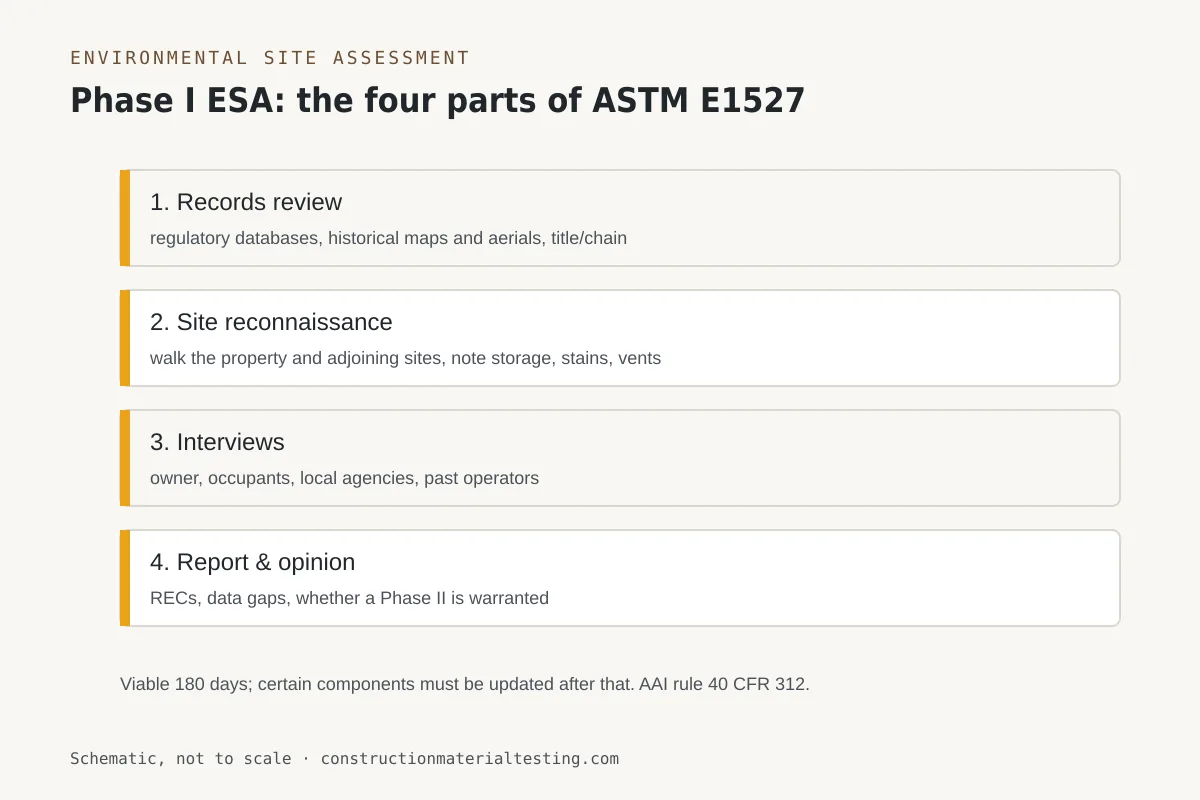
ASTM E1527 is the governing standard practice for Phase I assessments. The ASTM E1527 standard was developed by the ASTM E50 committee and has been revised over the years to stay aligned with EPA regulatory requirements. The current version defines the scope of work, the qualifications required of the environmental professional conducting the assessment, what constitutes a REC, and how findings must be reported. Deviation from the standard — whether by omitting a records search tier or by using an unqualified reviewer — undermines the legal protection the report is meant to provide.
The EPA's All Appropriate Inquiries rule, codified at 40 CFR Part 312, establishes the federal regulatory standard for pre-purchase environmental due diligence. The EPA's AAI rule explicitly references ASTM E1527 as an acceptable means of compliance. This alignment between a private consensus standard and a federal regulation is intentional — it gives the industry a single, auditable framework rather than a patchwork of agency-by-agency interpretations. When lenders, counsel, and regulators review a Phase I report, they measure it against both the ASTM standard and the AAI checklist.
The environmental professional — the EP, in ASTM terminology — must meet specific education and experience criteria. An EP is typically a licensed professional engineer or geologist, or someone with equivalent credentials and documented environmental experience. Our geotechnical and environmental services team works closely with qualified EPs on projects where subsurface conditions and environmental history intersect, which is common on infill and brownfield sites. The EP is personally responsible for the professional judgment calls in the report, including the final determination of whether RECs exist.
Records Review: What Gets Searched and Why
The records review is the most time-intensive component of a Phase I environmental site assessment. It involves querying a defined set of federal and state databases to identify properties with known or suspected contamination, enforcement actions, underground storage tank registrations, hazardous waste generator status, and similar flags. ASTM E1527 specifies minimum search radii for each database type — the radius required for a Superfund National Priorities List site differs from the radius required for a leaking underground storage tank database, because the migration potential of each hazard type is different.
Beyond regulatory databases, the records review covers historical sources: Sanborn fire insurance maps, historical aerial photographs, city directories, building permit records, and topographic maps at intervals that capture major changes in land use. These sources matter because regulatory databases only reflect reported incidents. A dry cleaner that operated on a site in the 1940s and never had a regulatory violation can still have left a chlorinated solvent plume in the soil. Historical research is how the EP finds those gaps. The search must extend far enough back in time to capture the first developed use of the property, which on older urban sites in Texas can mean going back to the late 1800s.
Physical setting sources — USGS topographic maps, FEMA flood data, soil surveys, and geologic maps — are also part of the records review. These tell the EP which direction groundwater flows, whether the site sits in a flood zone, and what the stratigraphy looks like. A site upgradient from an industrial facility is a different risk profile than the same facility downgradient. Understanding the physical setting is not optional background — it shapes how the EP weights every other finding in the report.
Site Reconnaissance: The Walk-Through That Cannot Be Delegated
The site reconnaissance is a firsthand, in-person inspection of the subject property and its adjoining properties. ASTM E1527 requires that the environmental professional either conduct the reconnaissance personally or directly supervise a trained site visit technician and review all observations. The purpose is to document current conditions that either corroborate or contradict what the records review found. A database may show no registered underground storage tanks, but a reconnaissance might reveal vent pipes, fill ports, or a depressed area with petroleum-stained soil that tells a different story.
During the walk-through, the EP or technician observes and documents the condition of structures, paved surfaces, drainage patterns, surface water, vegetation stress, odors, visible waste storage or disposal areas, above-ground storage tanks, staining on concrete or soil, the condition of neighboring properties visible from the boundary, and any evidence of fill material. Photographs are taken systematically, not selectively — the report must be defensible to a reviewer who was not present. Any observation that cannot be fully explained by the records review becomes a potential REC flag.
Access limitations matter and must be documented. If a building interior cannot be inspected because access was denied, the EP must note it and assess how that limitation affects the conclusions. A report that glosses over access limitations is not compliant with the standard. When our teams support environmental work through our environmental services division, we document access conditions carefully, because an unexplained gap in coverage is the first thing a lender's environmental reviewer will question.
Interviews: Who Gets Asked and What the EP Is Looking For
ASTM E1527 requires interviews with a defined set of parties: the current property owner (or an authorized representative), the current occupant if different from the owner, the key site manager, and where reasonably obtainable, one or more former owners or occupants. The EP must also contact the local fire department or relevant regulatory agency if there is a reason to believe they would have relevant information — a site with a history of reportable spills, for example.
The goal of interviews is to surface information that does not appear in any written record. Former employees may know about waste disposal practices that were never documented. A current tenant may have noticed odors or observed discolored water. A property manager may know that a previous tenant brought in chemicals and left them behind. Anecdotal as it sounds, this information is required under the standard and can be the source that prevents a REC from being missed. The EP must use professional judgment to weigh credibility, but cannot simply skip interviews because the records review looked clean.
Government agency interviews may also be conducted when records searches identify regulatory file information that is not fully reflected in the database — a closed case where the file might contain monitoring data, for instance. These interviews are often conducted by mail or phone and documented in the report. The AAI rule is explicit that the inquiry must be thorough and that reliance solely on database printouts is not sufficient.
Recognized Environmental Conditions: Definitions and Categories
The term recognized environmental condition — REC — has a specific definition under ASTM E1527 that is frequently misunderstood. A REC is the presence or likely presence of any hazardous substance or petroleum product in, on, or at a property due to a release, threatened release, or material threat of a release, regardless of whether it poses a risk to human health. The definition is intentionally broad. A closed regulatory case where contamination was documented but cleanup was never verified to current standards is still a REC — the historical confirmation of contamination is enough.
ASTM E1527 also defines two sub-categories worth knowing. A controlled REC (CREC) is a recognized environmental condition that has been addressed to regulatory standards that allow some contamination to remain, subject to controls such as land use restrictions or institutional controls. A historical recognized environmental condition (HREC) is a past release that has been remediated to the satisfaction of the applicable regulatory authority with no controls remaining. The distinction matters to buyers and lenders because a CREC may carry deed restrictions or monitoring obligations that affect how the property can be used.
The EP may also note conditions that do not rise to the level of a REC but warrant attention — these are called de minimis conditions or, in the current standard, non-scope issues. A small spill of a non-hazardous substance that poses no realistic risk of migration is an example. The report must be clear about what is a REC, what is a CREC or HREC, and what is a non-scope observation, because each category carries different implications for the transaction.
The 180-Day Shelf Life and What Triggers a Phase I Environmental Site Assessment Update
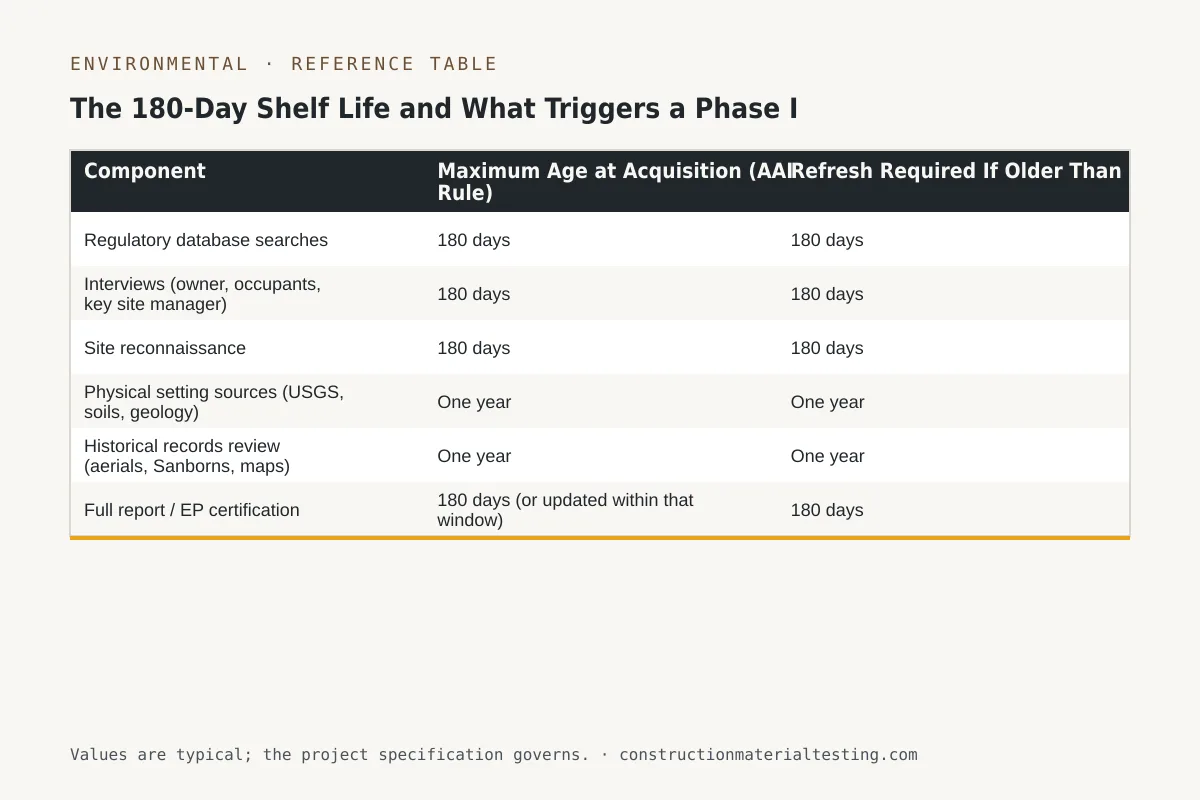
A completed Phase I environmental site assessment has a defined useful life. Under the AAI rule, the assessment must have been completed within 180 days prior to the date of property acquisition for all components — or within one year for most components, provided the regulatory database searches and interviews are refreshed within the 180-day window. In practice, lenders treat the entire report as stale after 180 days and will not accept it for underwriting without an update.
An update is not simply a letter saying the report still applies. It requires the EP to conduct fresh interviews, perform new regulatory database searches, and revisit the site to confirm that conditions have not changed. If the original report identified RECs, the update must address whether those conditions have changed — if a remediation was completed and a no-further-action letter was issued in the interim, the REC status may change. The update must also confirm that no new conditions have developed on adjoining properties.
Timing the Phase I correctly is therefore a project management task, not just a procurement task. On a complex commercial acquisition with a long due-diligence period, commissioning the Phase I at the wrong point in the timeline can result in it expiring before closing, forcing a repeat of significant work. We recommend coordinating with counsel and the lender early to establish the target closing date and work backward to set the start date for the Phase I.
| Component | Maximum Age at Acquisition (AAI Rule) | Refresh Required If Older Than |
|---|---|---|
| Regulatory database searches | 180 days | 180 days |
| Interviews (owner, occupants, key site manager) | 180 days | 180 days |
| Site reconnaissance | 180 days | 180 days |
| Physical setting sources (USGS, soils, geology) | One year | One year |
| Historical records review (aerials, Sanborns, maps) | One year | One year |
| Full report / EP certification | 180 days (or updated within that window) | 180 days |
How Lenders Use the Phase I and What They Expect in the Report
Commercial lenders — particularly those making loans through programs backed by federal agencies — require a Phase I as a condition of underwriting. The lender is not just protecting the borrower; it is protecting itself. If a borrower defaults and the lender takes the property back through foreclosure, the lender can become the property owner of record and, potentially, a liable party under CERCLA. A clean Phase I — one that finds no RECs — gives the lender documentation that it conducted due diligence before acquiring an interest in the property.
Lenders review Phase I reports against a checklist derived from ASTM E1527 and the AAI rule. They look at EP qualifications, the completeness of the database searches (checking that required radii were met and that the search was current), the adequacy of the site reconnaissance description, whether interviews were documented, and whether the REC determination is clearly stated and supported. A report that omits a required database, uses an unqualified reviewer, or presents conclusions without supporting logic will be rejected or sent back for revision — which can delay closing.
When RECs are identified, most lenders will require either a Phase II investigation before closing or, at minimum, a formal risk assessment that quantifies the liability exposure. Some lenders accept environmental insurance in lieu of a Phase II for low-severity RECs. The EP's report cannot make that business decision — it can only characterize the REC clearly enough for counsel and the lender to evaluate the options. A well-written Phase I report gives all parties the information they need to negotiate an appropriate path forward.
When a Phase II Investigation Follows
A Phase II environmental site investigation is the sampling and analytical phase that follows a Phase I when RECs are present and need to be characterized. Where the Phase I is entirely non-invasive, the Phase II involves intrusive work: soil borings, monitoring well installation, groundwater sampling, soil gas surveys, or building material sampling for asbestos or lead-based paint, depending on the nature of the REC. The scope of a Phase II is driven entirely by the Phase I findings — a competent Phase I report should describe the RECs with enough specificity that the Phase II scope can be logically derived from it.
Not every REC leads to a Phase II. An HREC — a historical condition that was remediated with regulatory closure and no remaining controls — may not require further investigation. A CREC with an active institutional control already in place may only require verification that the control is being maintained. The decision to proceed with a Phase II is a business and legal judgment made by the buyer, lender, and their counsel with input from the EP. Our role as the technical team is to make sure the Phase I characterization is precise enough to support that decision without ambiguity.
The Phase II scope typically begins with a work plan that identifies the target analytes, the boring or well locations, the sampling depths, and the laboratory methods. Turnaround time and chain-of-custody documentation are critical — results used in regulatory submittals or litigation must be traceable to collection. If subsurface conditions are relevant to the site's structural feasibility as well as its environmental status, there is value in coordinating Phase II boring locations with geotechnical exploration, which can reduce total intrusive work on the site.
| Phase I Finding | Typical Next Step | Sampling Required? |
|---|---|---|
| No RECs identified | Transaction proceeds; retain report for files | No |
| HREC — regulatory closure, no controls | EP review of closure documentation; usually no further action | Rarely |
| CREC — controls in place | Verify institutional control is active; disclose to buyer | Sometimes (to verify compliance) |
| REC — active or uncharacterized release | Phase II investigation to define extent and concentration | Yes |
| REC — petroleum underground storage tank | Phase II soil and groundwater sampling; state UST program notification may apply | Yes |
| Non-scope / de minimis condition | Document in report; no Phase II required | No |
Common Situations That Complicate a Phase I
Certain property types and histories reliably produce complications. Former dry cleaners are among the highest-risk commercial properties in urban areas because perchloroethylene — the primary solvent used for decades — is a dense non-aqueous phase liquid that migrates downward through soil and can persist in groundwater for generations. A Phase I on a property that was ever a dry cleaner, or that is adjacent to one, should be approached with heightened scrutiny of the historical records and reconnaissance observations. The EP should note vapor intrusion as a potential exposure pathway even if no documented release exists.
Properties with a history of agricultural use present a different set of challenges. Organochlorine pesticides, herbicides, and fertilizer-associated nitrates are common concerns on former farmland. Fuel storage for farm equipment may have been informal and unregistered. In Texas, the presence of historic oil field equipment — even on land that has not been commercially operated in decades — can indicate buried pipelines, produced water disposal pits, or legacy contamination that will not appear in any regulatory database because it predates modern reporting requirements.
Multi-tenant commercial properties where one tenant's operations are unknown or where access to certain areas is restricted require careful documentation of limitations. An EP who cannot access a portion of a site must state that clearly and assess whether the limitation is significant enough to preclude a REC determination. In some cases, the limitation itself is the finding — a locked outbuilding with chemical odors emanating from it is information, even if the EP cannot enter it.
Where a Phase I Environmental Site Assessment Fits on Your Project
A Phase I environmental site assessment belongs at the front of any commercial property transaction or development project, not as an afterthought after the purchase agreement is signed. It is pre-closing work, and the findings should inform negotiations — a buyer who discovers a REC after closing has far less leverage than one who identifies it during due diligence. For projects moving toward ground disturbance, the Phase I also sets the baseline that determines whether a Phase II is needed before permitting or financing can proceed.
Our environmental services team supports the full sequence of pre-construction environmental work, from Phase I coordination through Phase II scoping and field sampling. When subsurface investigation is needed — whether for environmental or geotechnical purposes — we bring both disciplines to the same site, which avoids duplicate mobilizations and gives the design team a more complete picture of what they are building on. If you are at the stage where you need to scope this work and understand what the timeline and deliverables look like, submit a proposal request and we will respond with the information you need to move forward.
Get our guides in your Google results
Add Construction Materials Testing as a preferred source and Google shows our guides more often when you search for testing topics.